
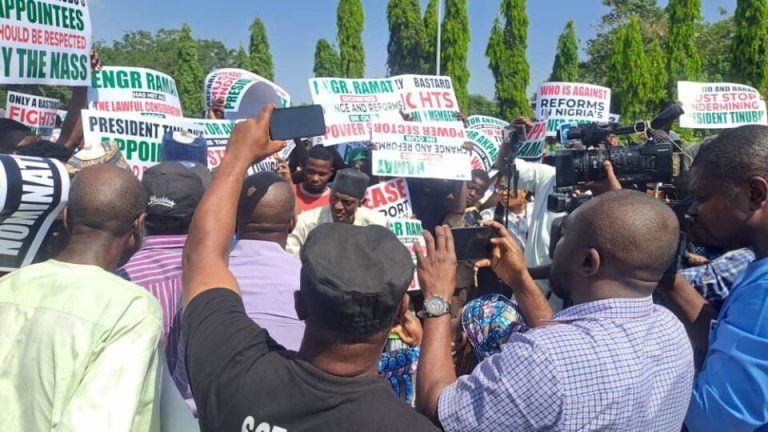
There was tension at the National Assembly in Abuja on Tuesday as hundreds of protesters gathered to demand the immediate confirmation of President Bola Tinubu’s nominee for Chairman of the Nigerian Electricity Regulatory Commission (NERC), Engr. Abdullahi Ramat.
The protesters, made up of civil society groups, human rights activists, and supporters of Ramat, marched around the National Assembly complex chanting solidarity songs and displaying placards. Some of the inscriptions on their signs read, “President Tinubu Did Not Send Nominees to be Harassed” and “Ramat Represents Reform in the Power Sector.”
The group’s protest follows the Senate’s recent decision to suspend the confirmation of Ramat, even after he was successfully screened by the Senate Committee on Power led by Senator Enyinnaya Abaribe. The development has sparked public debate and raised concerns about political interference in the appointment process of key regulatory bodies.
Addressing journalists at the protest, the spokesperson of the Grassroots Initiative Concept, Ahmed Suleiman, said the group was deeply disappointed by the Senate’s decision to halt Ramat’s confirmation. Suleiman, who led the protesters, alleged that some “vested political interests” were working behind the scenes to block the nominee for personal and political reasons.
“We have petitioned both President Bola Tinubu and the Senate President, Senator Godswill Akpabio, to intervene in this matter,” Suleiman said. “We write as proud indigenes of Kano State, just like the Deputy Senate President, Senator Barau Jibrin, to reaffirm our commitment to peace and good governance.”
He continued, “It is surprising and deeply unsettling that Engr. Ramat’s confirmation was stepped down despite his qualifications and the positive recommendation of the Senate Committee on Power. We have since learned that some vested interests are pushing false narratives to discredit him.”
The protesters warned that if political influence continued to override merit, it would set a “dangerous precedent” for the country. According to Suleiman, such a move would discourage capable Nigerians from accepting public service roles and could undermine the Tinubu administration’s reform agenda.
“We urge the Senate leadership not to yield to blackmail or manipulation,” Suleiman added. “Confirming Engr. Ramat will serve the national interest and strengthen the ongoing reforms in the power sector under President Tinubu’s administration.”
The protest came just a few days after the Senate issued a stern warning to former presidential aide, Alwan Hassan, over allegations that lawmakers collected a $10 million bribe to stall Ramat’s confirmation.
In a statement, Senate spokesperson Yemi Adaramodu dismissed the bribery claim as “baseless and reckless,” explaining that the decision to delay Ramat’s confirmation was not politically motivated. He said the Senate only stepped down the nomination after receiving “public and private complaints” about the nominee’s suitability for the role.
“Many nominees have been stepped down due to public outcry or unresolved issues. Mr. Ramat’s case is not an exception,” Adaramodu stated.
He added that the Senate would not bow to pressure to confirm any nominee “under a cloud of public concern.” Adaramodu further explained that the Senate had invited Alwan Hassan to provide evidence to support his bribery claims, warning that legal action would be taken if he failed to do so.
“The integrity of the Senate is not for sale,” the spokesperson said firmly. “We will not allow false allegations to tarnish the reputation of this institution.”
The Nigerian Electricity Regulatory Commission (NERC) plays a crucial role in the nation’s power sector. It is responsible for regulating electricity tariffs, ensuring fair competition among operators, and protecting consumer interests. The chairman of NERC is one of the most influential figures in the sector, as the commission’s decisions affect both investors and millions of households.
Nigeria’s electricity sector has long struggled with inefficiency, poor infrastructure, and frequent power outages. Despite several reforms and privatization efforts, electricity supply remains unreliable, and tariffs continue to rise. Many Nigerians have expressed frustration over the high cost of electricity and the lack of consistent power, which affects businesses and everyday life.
Given these challenges, the appointment of a new NERC chairman is seen as critical to advancing much-needed reforms and restoring confidence in the sector.
Engr. Abdullahi Ramat, President Tinubu’s nominee for NERC Chairman, is an engineer with extensive experience in the energy sector. Before his nomination, he was involved in various projects aimed at improving power distribution and rural electrification in northern Nigeria.
Supporters describe him as a technocrat and reform advocate who understands the technical and regulatory aspects of the power industry. They believe his appointment could help accelerate Tinubu’s power sector agenda, which aims to expand access to electricity, improve service delivery, and attract more investment.
However, some critics have reportedly raised concerns about his administrative style and possible political connections. These issues are believed to be part of the “public and private complaints” mentioned by the Senate.
Ramat’s confirmation remains pending, and the Senate has not announced a new date for reconsideration. This uncertainty has sparked debate among Nigerians, especially as the country continues to grapple with electricity shortages and rising energy costs.
Public opinion appears divided. Some believe the Senate is right to take its time to review the complaints before confirming the nominee. Others see the delay as unnecessary political drama that could slow down progress in the energy sector.