
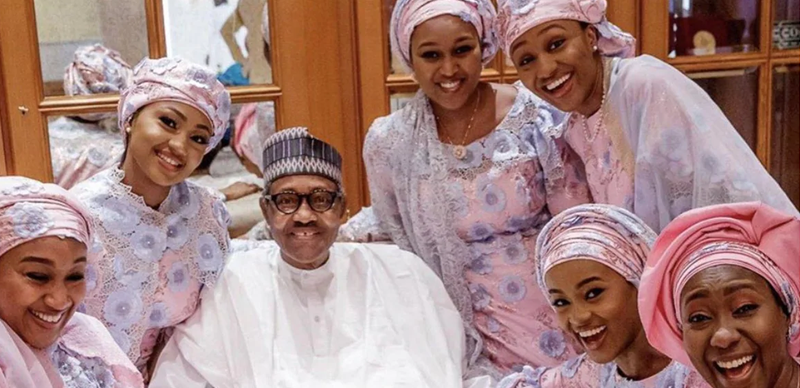
Fatima Buhari, daughter of late former President Muhammadu Buhari, has shared a startling account of life inside Nigeria’s seat of power, revealing that her father once believed his office in the Presidential Villa, Aso Rock, was secretly monitored.
According to her, this fear was so strong that there were moments when she and her father avoided speaking altogether and instead communicated by writing notes to each other, much like characters in a spy movie.
Fatima made the disclosure in a newly released book titled From Soldier to Statesman: The Legacy of Muhammadu Buhari. The book was written by Dr Charles Omole, Director-General of the Institute for Police and Security Policy Research (IPSPR), and was recently presented in Abuja.
In her account, Fatima described an atmosphere of deep suspicion and uncertainty around her father during his time as president, even within the highly secured Presidential Villa.
“We wrote notes like spies”
Recalling one particular encounter, Fatima said her father suddenly refused to speak during their meeting. Instead, he made a gesture to signal that they should not talk.
“He touched his cheek, like he had a toothache, and signalled that we shouldn’t talk,” she said. “We wrote notes to each other, like spies in a film.”
She explained that Buhari believed there were listening devices planted in his office and warned her to be careful about what she said. According to her, he acted with extreme caution, even in private conversations with close family members.
The book presents this behaviour not as drama or paranoia, but as a coping method adopted by Buhari in an environment where trust had broken down and privacy could not be guaranteed.
Fear inside the Villa
What appeared most troubling in Fatima’s account was the fact that her father felt this way despite being the Commander-in-Chief of the Armed Forces and the most powerful individual in the country at the time.
She questioned how such surveillance could have taken place inside Aso Rock, one of the most secured locations in Nigeria, and what level of influence those allegedly responsible might have had.
She referred to these unseen forces as “the cabal”, a term often used in Nigerian political discussions to describe powerful individuals operating behind the scenes.
According to the book, some security officials who worked closely with Buhari later confirmed that unusual objects were sometimes discovered during routine security sweeps of the president’s office and bedroom. However, it remained unclear how such items entered areas meant to be under strict control.
This, Fatima said, created an unsettling atmosphere within the Villa.
“At times, it felt diabolical,” she said.
She hinted at incidents she chose not to describe in detail, saying some matters were better left to God.
“We’re Africans. We know supernatural powers,” she said, adding that certain experiences went beyond normal explanation.
Buhari’s personality and leadership style
The book also offers insight into Buhari’s personal character and how it shaped his response to such challenges. According to Fatima, age and deep religious faith had softened her father, making him less confrontational than many expected.
She explained that Buhari was often reluctant to openly confront or disgrace people close to him, even when he suspected wrongdoing. Instead, he preferred quiet warnings and subtle corrections.
“He understands people’s histories — their parents, their families — and he doesn’t want to destroy hope,” she said.
Fatima noted that once her father trusted someone, it was extremely difficult for him to withdraw that trust without clear and overwhelming evidence. Rather than sack aides publicly or accuse them openly, he often chose patience and restraint.
This leadership style, the book suggests, may have contributed to the perception that Buhari tolerated too much from those around him.
Fears for his life
Beyond concerns about surveillance, Fatima also revealed that she lived in constant fear for her father’s safety throughout his presidency.
According to her, there were moments when she believed attempts were made to harm him.
“There were attempts,” she said. “Harm was done, but his time was not yet.”
She did not provide details of these incidents, but her statement suggests that Buhari faced threats beyond what was publicly known.
The fear, she said, affected how Buhari related with members of his family in public.
Public distance, private reassurance
Fatima disclosed that as part of measures to manage perceived threats, her father sometimes deliberately scolded or distanced himself from her in public.
According to her, this was done to create the impression that she was not close to him, possibly to reduce any risk associated with being seen as part of his inner circle.
“I cried in front of them,” she recalled.
However, she said that privately, Buhari would later reach out to reassure her and her children.
“Deep inside, he would call me and the kids,” she said.
This dual approach, public sternness and private affection, was described as part of Buhari’s attempt to protect his family while navigating the dangers he believed surrounded him.
A different picture of power
The revelations have sparked fresh discussions about the realities of power in Nigeria and the pressures faced by those at the very top of government.
For many Nigerians, the idea that a sitting president felt unsafe even within his own office raises serious questions about internal security, loyalty within government circles, and the true extent of power held by elected leaders.
The book paints a picture of a president who, despite his military background and reputation for discipline, felt constrained by invisible forces and chose caution over confrontation.
It also adds to long-standing debates about the influence of unelected power brokers during Buhari’s administration and whether these forces limited his ability to act decisively in some situations.
Public reaction and wider context
Since the excerpts from the book became public, reactions have been mixed. Some Nigerians expressed sympathy for Buhari, saying the account shows the heavy burden of leadership and the loneliness that comes with power.
Others questioned how such a situation could exist under a former military general known for his tough stance on security and discipline.
Political analysts say the revelations may not come as a complete surprise, given persistent rumours over the years about internal power struggles within the Buhari administration.
They note that similar claims of internal sabotage and hidden influence have been made by past leaders, though rarely with such personal detail from a close family member.
A personal window into history
From Soldier to Statesman: The Legacy of Muhammadu Buhari aims to provide a deeper look into the private life, beliefs, and struggles of the former president, beyond official speeches and public appearances.
Fatima’s account offers a rare, personal window into the emotional and psychological toll of leadership at the highest level in Nigeria.
While some of her claims may raise further questions and demand closer scrutiny, they add another layer to the ongoing assessment of Buhari’s years in power and the complex environment in which he governed.
As discussions continue, the book is likely to fuel renewed debate about trust, power, and security within Nigeria’s political system, and whether future leaders can learn from the experiences shared by those closest to the presidency.