
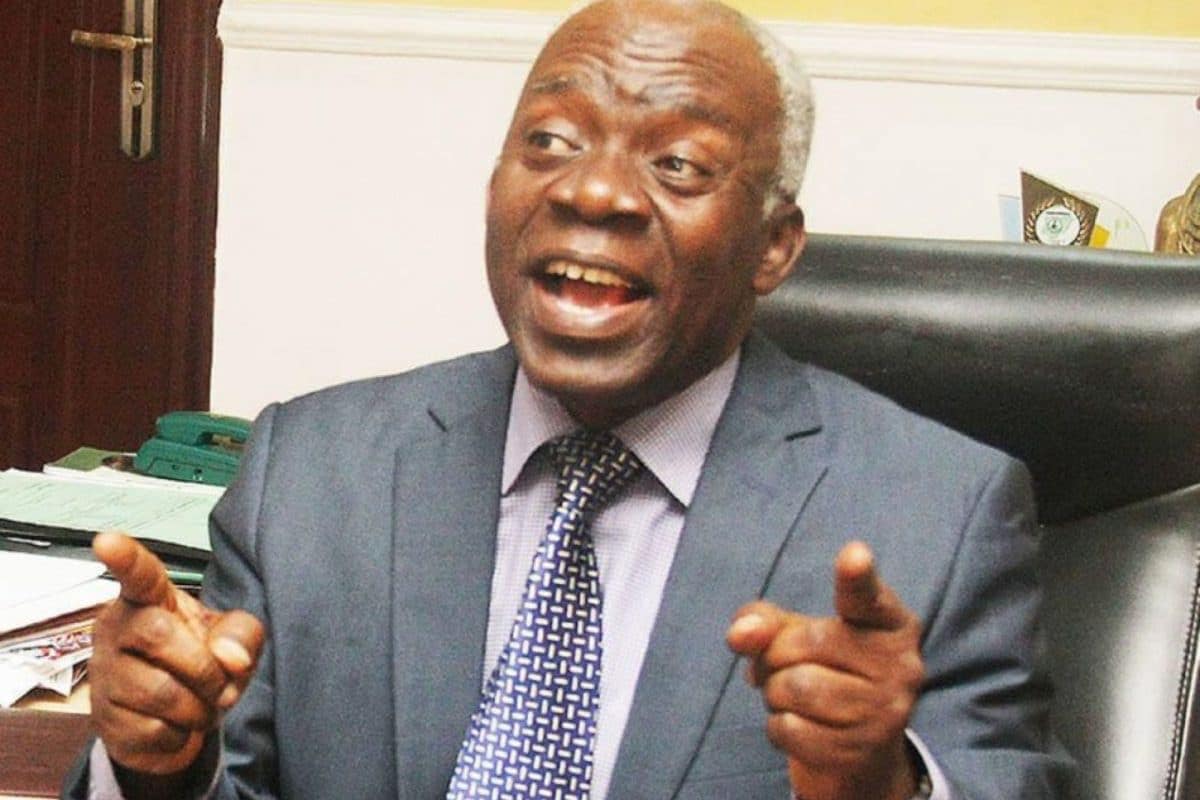
Prominent human rights lawyer and Senior Advocate of Nigeria, Femi Falana, has said that the Nigerian Constitution does not give the President the power to remove or suspend a state governor, even when a state of emergency is declared.
Falana made this clarification on Tuesday during an interview on Arise Television, where he reacted to a recent Supreme Court judgment on the powers of the President during a state of emergency.
His comments come amid renewed public debate over the meaning of Section 305 of the 1999 Constitution, which deals with the declaration of a state of emergency in any part of the country. The issue has attracted attention following concerns about insecurity, political instability, and governance challenges in some states.
According to Falana, although the Constitution allows the President to declare a state of emergency, it does not go further to empower him to take over the functions of elected state officials.
“Unlike the constitutions of India and Pakistan, the Nigerian Constitution does not expressly confer power on the President to assume or temporarily displace executive or legislative institutions of a state,” Falana said.
He explained that while some countries clearly allow their central governments to remove or suspend state governments during emergencies, Nigeria’s Constitution does not contain such clear provisions.
Falana stressed that Nigeria operates a federal system of government, where powers are shared between the federal and state governments. He said this system was designed to protect the independence of states and prevent excessive control by the centre.
The senior lawyer said much of the current controversy arose from misunderstandings of the Supreme Court judgment. According to him, many commentators have not taken time to read and understand the ruling.
“Well, I think in fairness to the Supreme Court, the justice that delivered the leading judgment did send out what is regarded as a summary judgment,” Falana said.
“Unfortunately, most commentators have not bothered to read the judgment.”
He explained that the Supreme Court only reaffirmed what has always been in the Constitution: that the President has the power to declare a state of emergency when there is a serious threat to public safety or governance in any state.
“There is no doubt that the court did confirm the power of the President to adopt extraordinary measures to restore law and order in any state where a state of emergency has been declared,” he said.
Falana noted that the real issue has always been the extent of the President’s powers once a state of emergency is declared. He said the Supreme Court acknowledged that the Constitution does not clearly spell out how far the President can go.
“What has always been controversy is the extent of the powers, and the Supreme Court made the point that the provision of the Constitution, Section 305, has not set out the extent of the powers that the President can exercise,” Falana said.
He explained that there was never any doubt that the President could deploy security forces, such as the police or the armed forces, to restore peace and order during an emergency.
“There was no doubt before now that the President could deploy forces or take other steps to restore law and order,” he added.
However, Falana insisted that deploying security forces is different from removing or suspending elected officials, which he said would amount to a violation of the Constitution.
The issue of state of emergency has a long history in Nigeria. Since the return to democracy in 1999, past presidents have declared states of emergency in some states due to political crises, insecurity, or breakdown of law and order.
One of the most notable cases was in 2004, when former President Olusegun Obasanjo declared a state of emergency in Plateau State and suspended the governor and state assembly. A similar action was taken in Ekiti State in 2006.
These actions generated serious legal and political debates, with many lawyers and civil society groups arguing that such suspensions were unconstitutional. Others defended the moves, saying they were necessary to restore peace.
The Supreme Court later ruled on some of these cases, setting legal precedents on the limits of emergency powers. Falana said the latest judgment should be seen as part of that ongoing effort to clarify the law.
Falana warned that allowing the President to remove governors under the guise of emergency powers could weaken democracy and federalism in Nigeria.
He said governors and state lawmakers are elected by the people and can only be removed through constitutional processes such as impeachment or court judgments.
“Any attempt to remove an elected governor without following due process would amount to an abuse of power,” he said.
He added that democracy thrives when the rule of law is respected and when each arm and level of government operates within its constitutional limits.
The human rights lawyer also called for clearer constitutional provisions to avoid future confusion and abuse.
He suggested that if Nigerians want the President to have broader powers during emergencies, such changes should be clearly written into the Constitution through proper amendment.
According to him, leaving such important issues open to interpretation creates uncertainty and tension in the political system.
Falana also urged public officials, commentators, and the media to study court judgments carefully before drawing conclusions or making public statements.
The debate over emergency powers is important because Nigeria continues to face serious challenges, including insecurity, communal violence, terrorism, and political instability in some parts of the country.
How the federal government responds to these challenges has implications for democracy, human rights, and national unity.
Falana said strong leadership must always be balanced with respect for the Constitution and the rights of citizens.
In his view, the Supreme Court judgment should not be used to justify unconstitutional actions, but rather to remind all authorities of the limits of their powers.