
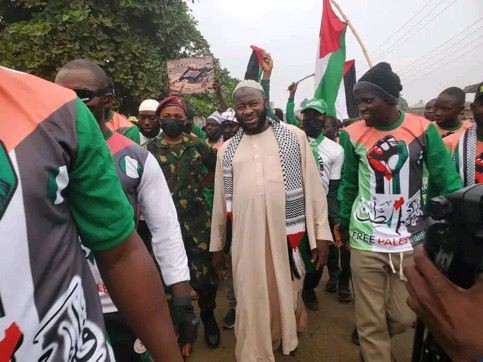
The Department of State Services (DSS) has reportedly arrested an Islamic cleric based in Osun State, Sheikh Daood Imran Molaasan, following a pro-Palestine protest held in Iwo, a town in the state.
According to Western Post, Sheikh Molaasan was taken into custody after a video of the protest surfaced online and sparked widespread reactions across social media platforms. The cleric is the leader of Ta’awunu Muslimeen, an Islamic group known for its advocacy on issues affecting Muslims globally.
The demonstration, which took place in Iwo, was organised to show support for Palestine, which is currently under occupation by Israel. In the video that circulated online, Sheikh Molaasan and his followers were seen carrying Palestinian flags and chanting slogans calling for the liberation of Palestine.
The footage quickly generated intense debate among Nigerians, with some expressing support for the right to peaceful protest, while others raised serious concerns about national security and public safety.
Sources said the DSS acted after the protest drew the attention of security agencies, especially given Nigeria’s long-standing security challenges linked to religious extremism and violent groups.
Although the DSS has not released an official statement on the arrest, reports suggest that Sheikh Molaasan was picked up for questioning over the nature of the protest and its possible security implications.
As of the time of filing this report, it remains unclear whether the cleric has been formally charged or is being detained temporarily as part of an ongoing investigation.
Sheikh Daood Imran Molaasan is a well-known Islamic cleric in parts of Osun State and the leader of Ta’awunu Muslimeen. The group describes itself as an organisation dedicated to Islamic teachings and advocacy for Muslim causes around the world.
Ta’awunu Muslimeen has a history of organising public demonstrations, particularly in support of Palestine. Records show that the group held a similar pro-Palestine protest in 2018, which also attracted public attention but did not result in arrests at the time.
Supporters of the group say its activities are peaceful and aimed at raising awareness about the suffering of Palestinians. However, critics argue that some of its actions and methods raise red flags for security agencies.
During the recent march, participants were seen chanting religious slogans and declaring allegiance to the Qur’an and Sunnah. While such chants are common in religious gatherings, certain aspects of the demonstration drew criticism.
One of the major points of concern was the synchronised arm movements made by some protesters. Social media users and commentators noted that these gestures appeared unusual and, in some cases, drew controversial comparisons to Nazi-style salutes.
Although supporters dismissed these claims as exaggerated and misleading, the imagery added to public anxiety, especially in a country already sensitive to signs of radical behaviour.
Another issue that generated strong reactions was the presence of children at the protest. In the video, minors were seen among the demonstrators, chanting religious slogans alongside adults.
Security analysts and members of the public warned that involving children in such demonstrations could increase fears of indoctrination or radicalisation.
Nigeria has for years battled insurgency and violent extremism, particularly in the North-East, where groups like Boko Haram have recruited young people into their ranks. This history has made security agencies highly cautious about any activity that could suggest early exposure of minors to extremist ideas.
Pro-Palestine protests are not new in Nigeria. Many Nigerians, especially within the Muslim community, have expressed solidarity with Palestinians over the years through rallies, prayers, and public statements.
The ongoing conflict in the Middle East, especially the war between Israel and Hamas, has renewed global attention on the Palestinian issue. Across Africa, Europe, and Asia, large protests have been held calling for a ceasefire and an end to the occupation.
However, in Nigeria, such protests often attract close monitoring by security agencies due to the country’s fragile security situation and history of religious tensions.
The arrest of Sheikh Molaasan has once again raised questions about the balance between freedom of expression and national security in Nigeria.
The Nigerian Constitution guarantees citizens the right to peaceful assembly and expression. At the same time, the law allows security agencies to intervene when public actions are seen as threats to peace and order.
Without an official statement from the DSS, many Nigerians are calling for transparency on the reasons behind the arrest and the legal basis for any charges.
As investigations continue, attention remains on the DSS to provide details on the case. Observers expect the agency to either release Sheikh Molaasan after questioning or formally charge him if evidence of wrongdoing is found.
For now, the arrest highlights the sensitive nature of religious activism in Nigeria and the fine line between lawful protest and security concerns.