
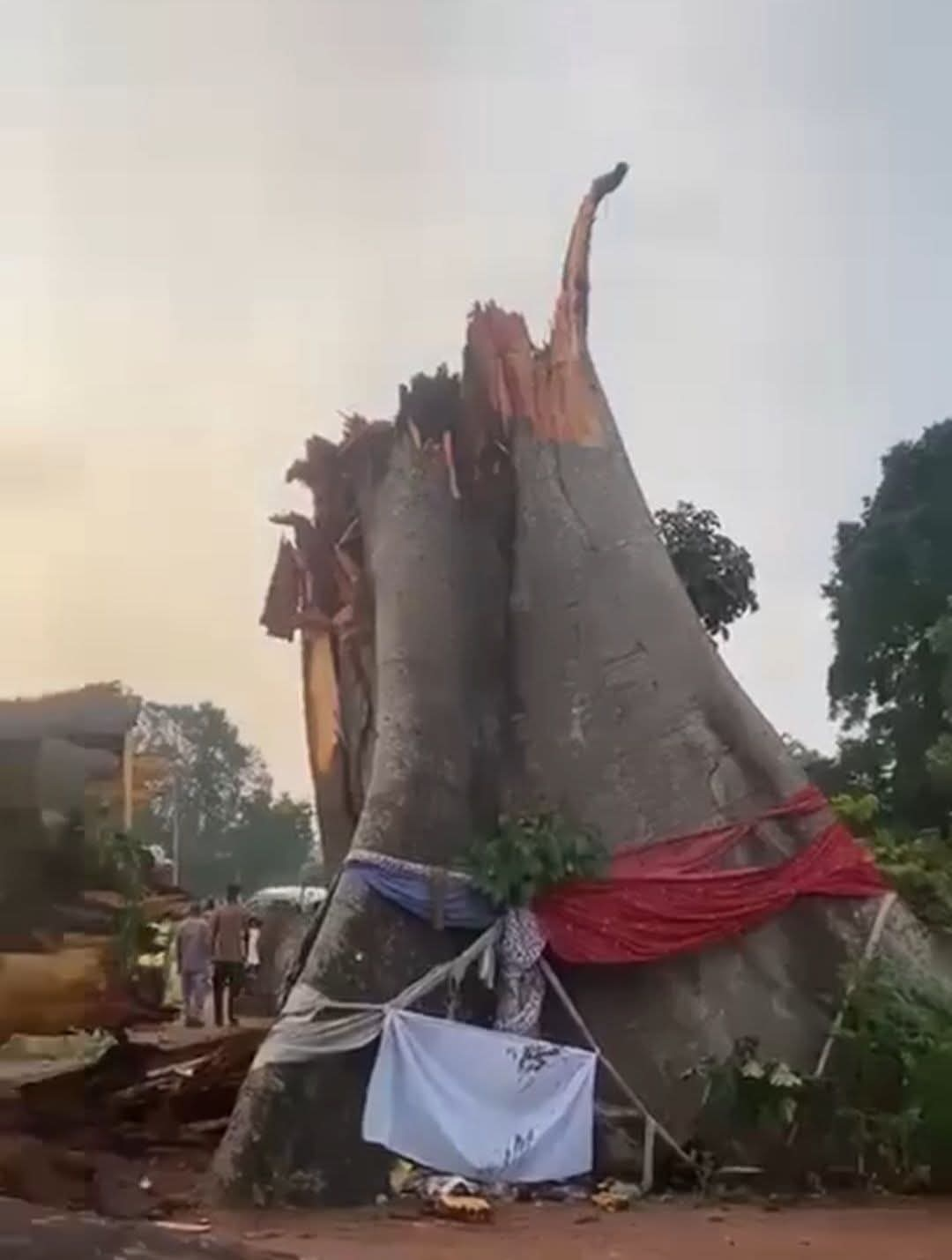
Tragedy struck on Tuesday in Awhum community, Udi Local Government Area of Enugu State, when a massive ancestral tree fell on a commercial bus, killing at least 18 passengers.
The tree, known locally as “Ukwu Akpu Awhum,” collapsed during a heavy thunderstorm and rainfall. The 18-seater minibus was said to be fully loaded when the incident happened.
Sources in the area said the vehicle was travelling from Ukehe in Igbo-Etiti Local Government Area to Enugu metropolis when the giant tree suddenly toppled and crushed the bus.
Residents who rushed to the scene said the impact was severe and that all the passengers died on the spot.
The accident has thrown the quiet community into deep mourning. Families of the victims and other residents gathered at the scene in tears as they struggled to understand what had happened.
As of the time of filing this report, officials of the Enugu State Government had not issued an official statement on the incident.
The tree involved in the accident is known in Awhum as an ancestral tree. For years, it has stood as a symbol of tradition and history in the community.
According to some residents, branches had fallen from the tree in the past, especially during storms. However, they said nothing of this scale had ever happened before.
A community member, Charly Okeke, described the incident as shocking and painful.
“This has never happened before. We have seen branches fall, but not the whole tree,” he said.
Okeke suggested that certain activities around the tree may have contributed to its fall. He claimed that some people had tied red and white cloths around the trunk in recent times, possibly for spiritual reasons.
“Some people started tying red and white cloths around the trunk, seeking spiritual powers. I suspect this may have caused the tragedy,” he said.
However, other residents believe the heavy rainfall and strong winds were the main cause. Enugu State and other parts of the South-East have experienced torrential rains in recent days, with strong winds that have damaged buildings and uprooted trees.
Awhum is also known for its famous cave and waterfall, which attract visitors from within and outside the state. The community holds strong cultural and spiritual values, and certain trees and sites are regarded as sacred.
The tragic event has now raised questions about safety around old and sacred trees, especially those located close to roads and residential areas.
The accident has renewed calls for authorities to inspect old trees and other potential hazards, especially during the rainy season.
Residents say the road linking Ukehe to Enugu metropolis is busy, with many commercial vehicles using it daily. They are now asking local authorities to carry out safety checks to prevent a similar tragedy in the future.
Officials from emergency agencies and local government authorities are expected to visit the scene to assess the situation and support the affected families.
Road accidents caused by fallen trees are not common in Enugu State, but heavy rains have in the past led to flooding, collapsed buildings and damaged roads.
Each year, the Nigerian Meteorological Agency (NiMet) warns states about the dangers of heavy rainfall and strong winds during the rainy season. Such weather conditions can lead to fallen trees, blocked roads and other hazards.
Community leaders in Awhum are said to be discussing possible measures, including clearing weak branches and reviewing the safety of large trees located near roads.
Meanwhile, families of the victims have been left devastated. Some residents described the scene as heartbreaking, with the crushed bus trapped under the huge trunk.
“This is a painful loss for our community,” one resident said. “Eighteen people gone in one moment.”
As news of the tragedy spread, many people took to social media to express sympathy and call for urgent action to prevent similar incidents.
The incident also highlights the wider challenge of infrastructure and environmental safety in many rural communities. In several parts of the country, old trees stand close to major roads without regular inspection.
While cultural and spiritual sites remain important to local identity, safety experts say there is a need to balance tradition with public safety, especially when such sites are located near busy roads.
As Awhum mourns, attention is now focused on what steps will be taken to prevent another disaster. Residents hope that government officials will act quickly to assess other potential risks in the area.
For now, the community remains in grief, with prayers and condolences pouring in for the families who lost loved ones in the tragic accident.
The collapse of “Ukwu Akpu Awhum” has not only claimed 18 lives but also left a lasting mark on the community’s history.