
The Petroleum and Natural Gas Senior Staff Association of Nigeria (PENGASSAN) has called on President Bola Tinubu to immediately withdraw a new executive order on oil revenue remittance, saying it goes against existing law and could harm the oil and gas industry.
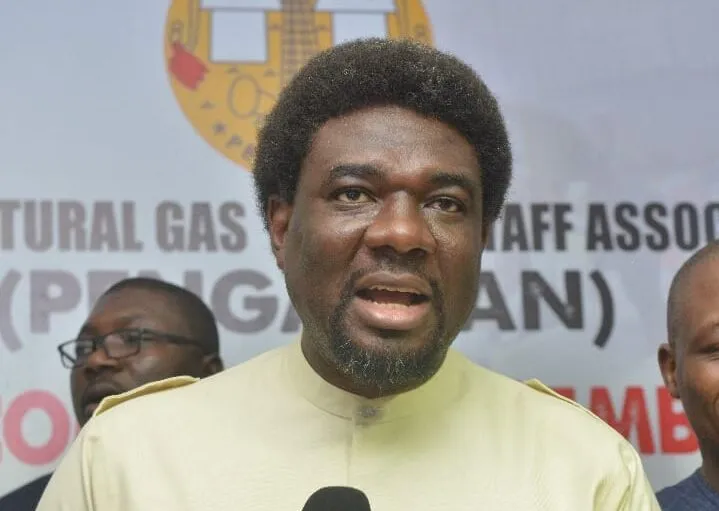
The union made the call during a press briefing held on Thursday. Its National President, Festus Osifo, described the executive order as a “direct attack” on the Petroleum Industry Act (PIA), which governs Nigeria’s oil and gas sector.
On February 18, President Tinubu signed an executive order directing that revenues from oil and gas be paid directly into the Federation Account Allocation Committee (FAAC). This order removes the previous arrangement that allowed the Nigerian National Petroleum Company Limited (NNPC Limited) to deduct certain costs before remitting funds to the federation account.
The Federation Account Allocation Committee is the body responsible for sharing revenue collected by the federal government among the federal, state, and local governments. Oil revenue remains Nigeria’s main source of foreign exchange and government income.
Before this executive order, the NNPC Limited had the power, under the PIA, to deduct operational costs and other approved expenses before sending the remaining revenue to the federation account. This arrangement was part of reforms introduced by the Petroleum Industry Act in 2021.
The PIA was signed into law after many years of debate and was designed to reform Nigeria’s oil sector, attract investors, and make the industry more transparent. One of its major changes was the transformation of NNPC into a limited liability company, operating in a more commercial way.
PENGASSAN now argues that the new executive order weakens the structure created by the PIA.
Speaking at the briefing, Osifo said sections 8, 9, and 64 of the Petroleum Industry Act clearly define the powers and responsibilities of NNPC Limited. He argued that an executive order cannot override an Act passed by the National Assembly.
“An executive order cannot supersede the law of the land,” Osifo said. “Executive order cannot override the provision of a law.”
He said by signing the order, the president has used executive power to “set aside a law of the Federal Republic of Nigeria.”
Osifo stressed that while the president has the constitutional right to issue executive orders, such powers must not conflict with existing laws. He described the move as troubling and said it sends the wrong message to both Nigerians and foreign investors.
To explain his point, he compared the action to a situation where a president signs an executive order to change the structure of the Independent National Electoral Commission (INEC) or reduce government contributions to pensions without going through the proper legal process.
According to him, such actions would create uncertainty and weaken confidence in government policies.
Nigeria has been working to attract both local and foreign investment into its oil and gas sector. In recent years, the industry has faced many challenges, including oil theft, pipeline vandalism, declining production, and uncertainty in policy.
The Petroleum Industry Act was widely seen as a major step towards addressing these problems. It introduced new fiscal terms, host community development funds, and clearer rules for investors.
Osifo said President Tinubu has made efforts to improve Nigeria’s economy and attract investment into the energy sector. He noted that the president has experience in the oil industry, including previous work with ExxonMobil.
Because of this background, Osifo said he believes the president may not have been fully informed about the possible effects of the executive order before signing it.
“We strongly believe that, in this particular case, the president has been misled,” he said. “The people advising the president did not actually tell him the entire truth.”
He added that if the president had been properly briefed on the implications of the order, he might have taken a different decision.
The union warned that investors could see the executive order as a sign that laws can be changed suddenly through executive action. This, Osifo said, may create fear that other parts of the PIA, such as royalty rates and fiscal terms, could also be altered in the future without legislative approval.
Such uncertainty, he said, could discourage international oil companies and other investors from committing new funds to Nigeria.
Beyond legal and investment concerns, PENGASSAN also raised alarm about the possible impact on workers in the oil and gas sector.
Osifo said if the executive order is not recalled, NNPC Limited may face financial challenges in meeting its obligations. According to him, this could put jobs at risk.
“Our members are in danger of being declared redundant because NNPC may not be able to meet their obligations,” he said.
PENGASSAN is one of the major unions in Nigeria’s oil and gas industry, representing senior staff. Its members work in NNPC Limited and other oil companies across the country. Any major change affecting the finances of NNPC could have a direct impact on thousands of workers.
Labour unions in Nigeria have often played strong roles in national debates, especially on issues related to oil revenue, fuel pricing, and economic reforms.
Oil revenue remains critical to Nigeria’s budget. Many state governments depend heavily on allocations from the federation account to pay salaries and fund projects. Any change in the way oil revenue is collected and shared can affect government finances at all levels.
Supporters of direct remittance to FAAC argue that it could increase transparency and ensure that more funds reach the federation account without deductions.
However, critics like PENGASSAN say the process must follow the law. They insist that any major change to the structure set up by the Petroleum Industry Act should go through the National Assembly.
For now, PENGASSAN is urging dialogue and a review of the decision. The union says it is ready to engage with the government to find a solution that protects both the law and the stability of the oil and gas sector.