
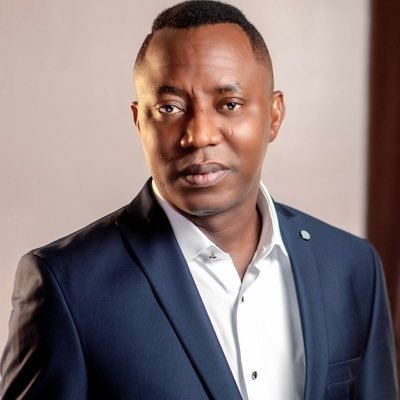
A Federal High Court in Abuja has warned that it may revoke the bail granted to politician and online publisher Omoyele Sowore if he fails to appear at the next hearing in his ongoing cybercrime trial.
Justice Mohammed Umar issued the warning on Thursday after Sowore and his team of lawyers failed to appear in court for the scheduled proceedings.
The judge said that if the defendant does not attend the next sitting, the court may withdraw his bail and issue a bench warrant for his arrest so that he can be brought to court to continue the trial.
The case is being heard at the Federal High Court in Abuja.
Sowore is being prosecuted by the Department of State Services on charges related to alleged cybercrime.
According to the prosecution, the charges are linked to social media posts made by the activist in which he allegedly described Nigeria’s president, Bola Ahmed Tinubu, as a criminal.
The prosecution claims the statements were false and were published on Sowore’s accounts on social media platforms X and Facebook.
The case forms part of ongoing legal disputes involving the activist, who is widely known for his political activism and criticism of government policies.
Sowore has previously denied wrongdoing and has maintained that his comments fall under freedom of expression.
At Thursday’s hearing, Sowore did not appear in court.
None of his lawyers were present either, even though the defence team reportedly consists of about 30 lawyers.
The absence prompted the prosecuting lawyer, Akinlolu Kehinde, to raise the issue before the court.
Kehinde told the judge that the day’s proceedings were meant for the defence to complete the cross-examination of the first prosecution witness.
He said the prosecution had confirmed that the defence had been properly informed about the hearing date.
According to him, the court registry had served a hearing notice on the defendant through his lawyers.
Kehinde said the prosecution had also received its own notice from the court.
Because of this, the prosecutor said there was no explanation for why Sowore and his legal team failed to attend the session.
The prosecuting lawyer asked the court to take action over the absence of the defendant.
He referred to provisions of Section 352(1) and (2) of the Administration of Criminal Justice Act.
Under the law, a court has the authority to revoke the bail of a defendant who fails to appear for trial without a valid reason.
Kehinde therefore asked the judge to cancel the bail previously granted to Sowore.
He also requested that the court issue a bench warrant for the defendant to be arrested and brought before the court.
Such a warrant would authorise law enforcement agencies to take the accused person into custody and present him before the court to continue the trial.
In his ruling, Justice Umar confirmed that the defendant had indeed been served with a hearing notice through his lawyers.
However, the judge noted that Sowore had consistently attended previous court sittings since the case began late last year.
Because of this record, the court decided to give the defendant the benefit of the doubt for the current absence.
The judge also observed that previous adjournments in the case had sometimes occurred because of requests made by both the prosecution and the defence.
This, he said, showed that delays in the case had not been caused by one side alone.
Although the judge did not immediately revoke Sowore’s bail, he issued a strong warning regarding future court appearances.
Justice Umar said the defendant must appear in court at the next hearing.
He stated clearly that failure to attend the next sitting would have serious consequences.
According to the judge, if Sowore fails to appear again, the court will grant the prosecution’s request to revoke his bail.
The judge also said he would issue a warrant for Sowore’s arrest so that he can be brought before the court to continue his trial.
This warning, the judge explained, was necessary to ensure that court proceedings are taken seriously and that justice is not delayed.
After addressing the issue, the judge adjourned the case to March 16 for the continuation of the trial.
He also ordered that another hearing notice be sent to the defence to ensure that Sowore and his legal team are aware of the next court date.
The adjournment means that the defence will have another opportunity to continue the cross-examination of the first prosecution witness when the trial resumes.
Omoyele Sowore is a well-known activist, journalist and politician in Nigeria.
He is the founder of the online news platform Sahara Reporters, which has published several investigative stories on politics, corruption and governance.
Sowore has also been active in Nigerian politics.
He contested the presidential election in 2019 under the platform of the African Action Congress.
Over the years, he has been involved in several political campaigns and protests, including movements calling for government reforms.
Because of his outspoken criticism of political leaders, he has faced several legal battles with government authorities.
The current case has attracted attention from legal observers and civil society groups.
Some groups have raised concerns about the use of cybercrime laws in cases involving political speech.
Others argue that public officials also have the right to seek legal action when they believe false statements have been made about them.
The outcome of the trial may therefore have implications for how online speech and criticism of public officials are treated under Nigerian law.
One of the most important conditions is attending court whenever the case is scheduled for hearing.
Failure to appear without a valid reason can lead to serious consequences, including the cancellation of bail.
If bail is revoked, the accused person may be taken into custody until the trial is completed.
Courts often issue warnings before taking such steps, especially when the absence occurs for the first time.
With the case now adjourned until March 16, attention will be on whether Sowore and his lawyers will attend the next hearing.
If they appear in court, the trial will continue with the defence completing its cross-examination of the prosecution’s witness.
However, if the defendant fails to appear again, the court may take stricter action as earlier warned by the judge.