
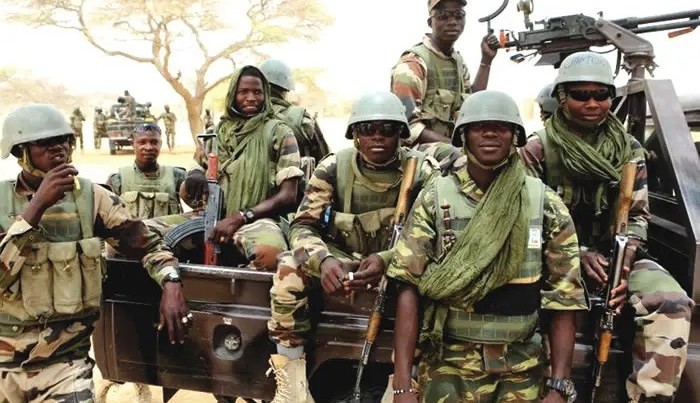
Troops of the Joint Task Force in the North-East, operating under Operation Hadin Kai, have killed more than 20 insurgents during a coordinated attack by suspected fighters of the Islamic State West Africa Province (ISWAP) in Yobe State.
The military said the attack targeted troops stationed in Goniri, a community under Sector 2 of the operation. The incident began late on Monday night, March 9, and continued into the early hours of Tuesday, March 10, 2026.
According to the military, the troops successfully repelled the assault after a fierce battle with the insurgents.
The development was disclosed in a statement issued on Wednesday by the Media Information Officer of the Joint Task Force, Lt. Col. Sani Uba.
In the statement, the military said the insurgents attempted to attack the troops from different directions in what appeared to be a planned attempt to surround and overpower the soldiers’ position.
Uba said the troops detected the movement of the terrorists early through surveillance systems before they reached the military location.
“Troops of the Joint Task Force (North-East), deployed in Goniri under Sector 2 of Operation Hadin Kai, have successfully foiled coordinated attacks launched by ISWAP terrorists on their location in Goniri, Yobe State, killing over 20 terrorists,” the statement said.
The military spokesman explained that the insurgents were first spotted advancing toward the troops from two directions.
He said they moved from Goniri village and the Ngamdu Junction axis at the same time, which suggested that they planned to surround the military base before launching their attack.
“The terrorists were initially detected through surveillance assets advancing simultaneously from Goniri village and the Ngamdu Junction axis in an apparent attempt to encircle the military location,” Uba added.
However, the troops responded quickly once the insurgents were identified.
According to the military, the soldiers used strong defensive tactics and superior firepower to stop the attackers from gaining ground.
Reinforcements were also sent to support the troops already on the ground.
The air component of Operation Hadin Kai was also deployed during the operation. Fighter aircraft provided close air support to the troops, helping to weaken the insurgents and reduce their fighting strength.
The military said the battle was intense but the troops eventually overwhelmed the insurgents.
“As the firefight intensified, the terrorists were overwhelmed and forced to retreat in disarray, suffering heavy casualties,” the statement said.
More than 20 insurgents were killed during the clash, including a senior commander identified as Abu Yusu.
The military described Abu Yusu as the Munzir of Dursula, a position believed to be a leadership role within the insurgent group.
Security officials said the death of the commander is a major setback for the insurgents operating in the area.
During the operation, troops also recovered several weapons and equipment left behind by the fleeing fighters.
Items recovered from the scene included multiple machine guns, AK-47 rifles, improvised explosive devices, locally made bombs, and large quantities of ammunition.
The military said the discovery of these weapons shows the level of planning involved in the attack.
After the initial battle, troops continued search operations in nearby areas to ensure that no insurgents remained close to the military location.
Follow-up clearance operations were carried out in Gwaigomari within the Timbuktu Triangle, an area known for insurgent activity.
During patrols conducted up to the early hours of Wednesday, March 11, troops discovered additional bodies of insurgents believed to have been killed during the fighting.
The military also confirmed that some soldiers were injured during the encounter.
However, the injured personnel have been evacuated to medical facilities and are receiving treatment.
According to the statement, the soldiers are currently in stable condition.
The military further assured that the troops remain in full control of the location where the attack occurred.
“The location remains firmly under the control of Operation Hadin Kai troops,” Uba said.
Security forces are now conducting aggressive follow-up operations in surrounding communities and forests.
These operations include search and clearance missions aimed at tracking down insurgents who escaped with injuries during the battle.
The military believes some of the fleeing fighters may be hiding in nearby settlements or forest areas.
Residents in communities around Goniri have also been advised to remain vigilant and report suspicious movements to security agencies.
The latest clash highlights the continued security challenges in Nigeria’s North-East region.
For more than a decade, the area has faced violent insurgency carried out mainly by Boko Haram and its splinter faction, the Islamic State West Africa Province.
ISWAP emerged after a split within Boko Haram around 2016. The group later aligned itself with the global Islamic State network and has since carried out several attacks on military bases and civilian communities in the region.
The group is known for targeting military formations, attacking villages, and planting improvised explosive devices on roads frequently used by security forces and civilians.
Yobe State, along with Borno and Adamawa states, forms part of the core conflict zone in the North-East.
Many communities in these states have experienced repeated attacks over the years, leading to the displacement of thousands of residents.
To address the crisis, the Nigerian military launched Operation Hadin Kai in 2021 as part of efforts to strengthen counter-insurgency operations in the region.
The operation replaced the earlier Operation Lafiya Dole and involves ground forces, air support, and intelligence units working together to combat insurgent groups.
Military authorities say operations under Hadin Kai have led to several successes, including the killing of insurgent leaders, the rescue of kidnapped victims, and the recovery of weapons.
However, insurgent groups continue to carry out attacks, especially on isolated military bases and rural communities.
Despite this, the military insists that troops remain determined to defeat insurgency in the region.
Lt. Col. Uba said Operation Hadin Kai will continue its efforts to restore peace and stability in the North-East.
He added that troops, supported by air power and intelligence resources, will maintain pressure on insurgent groups until the region is fully secured.
The military also called on residents of the North-East to continue supporting security forces with information that could help prevent future attacks.