
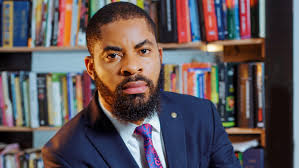
Human rights activist and lawyer, Deji Adeyanju, has alleged that the Governor of Oyo State, Seyi Makinde, is positioning himself to replace Nyesom Wike as Minister of the Federal Capital Territory (FCT) in 2027.
Adeyanju made the claim in a video shared on his social media page, where he also criticised the Peoples Democratic Party (PDP), describing it as weak and divided ahead of the next general election.
In the video, Adeyanju said many members of the PDP are no longer acting as a strong opposition. Instead, he alleged that several party members are quietly supporting President Bola Ahmed Tinubu.
According to him, internal struggles within the party are not about rebuilding or strengthening the opposition, but about personal interests and political advantage.
“PDP is a distraction; what is dead may never die again,” he said, suggesting that the party has lost its relevance in national politics.
He added that politicians within the party are mainly focused on gaining influence and negotiating positions rather than offering a clear alternative to the ruling government.
Adeyanju specifically alleged that Governor Makinde is interested in becoming the next FCT minister after Wike.
He claimed that Makinde’s political moves are aimed at building influence that could secure him the position in 2027.
“Seyi Makinde wants to replace Wike and maybe he will become the next FCT minister in 2027,” Adeyanju said.
He further suggested that such ambitions could influence how some politicians align themselves ahead of the next election cycle.
However, Makinde has not publicly responded to the claim, and there has been no official confirmation of any such ambition.
Nyesom Wike, a former governor of Rivers State and a member of the PDP, currently serves as the Minister of the Federal Capital Territory under the administration of President Tinubu.
His appointment in 2023 drew significant attention because he remained a member of the PDP while working in a government led by the All Progressives Congress (APC).
Wike has been a strong political figure in Nigeria, known for his influence within the PDP and his role in internal party disputes, especially during the 2023 general elections.
His relationship with the current administration has continued to shape political discussions, particularly regarding loyalty and party discipline.
Governor Seyi Makinde is one of the prominent leaders within the PDP and has been seen as a key figure in the party’s future.
Since becoming governor in 2019, he has built a reputation for focusing on infrastructure, education, and economic development in Oyo State.
Makinde also played a notable role during the internal crisis in the PDP before the 2023 elections, where he was part of a group of governors who opposed the party’s presidential candidate at the time.
The PDP, once Nigeria’s dominant political party, has faced several challenges in recent years. These include internal divisions, leadership disputes, and electoral losses.
Since losing power at the federal level in 2015, the party has struggled to maintain unity and present a strong opposition to the ruling party.
The 2023 general elections further exposed these divisions, with disagreements among party leaders affecting its overall performance.
Adeyanju’s comments reflect a wider concern among some political observers that the PDP needs to rebuild and redefine its role if it hopes to remain relevant in future elections.
Although the 2027 general election is still some time away, political discussions and alignments are already taking shape.
Politicians across party lines are beginning to position themselves, form alliances, and consider future opportunities.
Adeyanju suggested that many of these moves are driven by personal ambition rather than ideology or public interest.
He also indicated that some politicians may be working behind the scenes to support President Tinubu’s potential re-election, even if they belong to opposition parties.
The activist’s comments have sparked discussions among Nigerians, especially on social media, where political debates are common.
Some people agree with his view that the PDP is divided and struggling, while others believe the party still has a role to play in Nigeria’s democracy.
There are also differing opinions about whether politicians should be criticised for seeking new roles or aligning with different political interests.
For many Nigerians, the focus remains on governance, economic conditions, and security, rather than political manoeuvring.
If opposition parties are seen as weak or divided, it can affect the balance of power and reduce political competition.