
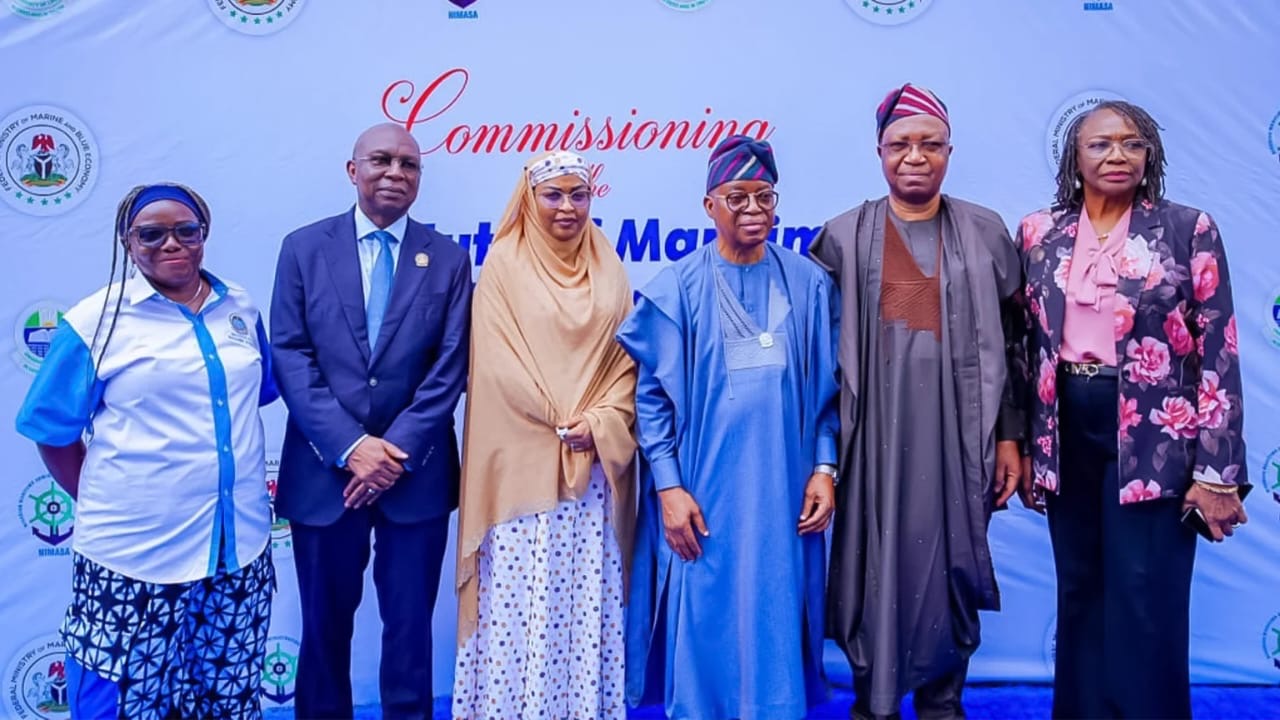
The Federal Government has said that the Institute of Maritime Studies at the University of Lagos (UNILAG) will play a major role in advancing Nigeria’s blue economy, as part of efforts to strengthen the country’s economic growth and global competitiveness.
The Minister of Marine and Blue Economy, Adegboyega Oyetola, made this known on Thursday during the commissioning of a new multi-purpose building at the institute. The project was developed through a partnership between the Nigerian Maritime Administration and Safety Agency (NIMASA) and the university.
Speaking at the event, Oyetola described the facility as a major step forward in building the skills and knowledge needed to grow Nigeria’s maritime sector. He said the project shows the government’s strong commitment to developing human capacity and strengthening institutions that support the blue economy.
“I am deeply honoured to be part of this important occasion,” the minister said. “This facility represents a key milestone in our efforts to grow Nigeria’s blue economy and build a strong foundation for the future.”
He explained that the blue economy, which includes activities linked to oceans, seas, rivers, and coastal areas, is very important to Nigeria’s development. According to him, the country depends heavily on maritime activities for trade and economic survival.
“In a country like Nigeria, where over 90 per cent of trade is carried out through maritime channels, the blue economy is not just another sector. It is a major lifeline for our economy,” he said.
Oyetola added that the new building would help produce skilled professionals who can support the growth of the sector. He stressed that the future of the blue economy depends not only on natural resources but also on the quality of education and training provided to young Nigerians.
“This modern facility shows that the Federal Government believes in knowledge-driven development. We understand that it is the quality of minds we train in places like this that will shape the future of our maritime industry,” he added.
The minister also spoke about ongoing efforts by the government to strengthen policies in the sector. He said NIMASA is working to improve the implementation of the Coastal and Inland Shipping Act, also known as the Cabotage Act, which is aimed at promoting local participation in maritime business.
Also speaking at the event, the Director-General of NIMASA, Dayo Mobereola, said the project reflects the agency’s commitment to building a strong and competitive maritime sector.
According to him, the success of any sector depends largely on the quality of its workforce. He noted that the new facility would help train students, support research, and provide useful data for policy decisions.
“This project is a clear sign of our shared vision for a better maritime sector,” Mobereola said. “The strength of any industry lies in the knowledge and readiness of its people. With this facility, we can improve training and prepare the next generation of maritime professionals.”
He also said the partnership between NIMASA and UNILAG would help Nigeria become a centre for maritime education and research in West Africa and beyond. He noted that better research and data would support policy development and help address challenges facing the sector.
The Vice-Chancellor of the University of Lagos, Folasade Ogunshola, described the project as a major investment in human capital development. She said the institute has already played an important role in training experts in maritime studies, not just in Nigeria but across Africa.
According to her, the new building is the first phase of a larger plan to expand the Institute of Maritime Studies. She explained that the facility would improve teaching, research, and innovation in the university.
“This building represents a major step in our journey,” she said. “It will help us provide better training, carry out important research, and support innovation in the maritime sector.”
Ogunshola added that the university is ready to play a leading role in driving Nigeria’s blue economy. She said UNILAG aims to become a key centre for research and development in maritime studies.
“Our vision is clear. We want this institute to have a lasting impact on Nigeria’s economy and to contribute to global maritime development,” she said.
She also highlighted the importance of partnerships in achieving these goals. According to her, the agreement between UNILAG and NIMASA is focused on building academic and research capacity for the maritime industry.
Ogunshola said the university is also working with international organisations, including the International Maritime Organization, to ensure that Nigeria remains competitive in the global maritime space.
She assured stakeholders that the university has put in place plans to maintain the facility and ensure it continues to serve its purpose effectively.
“We are committed to making sure this facility is well used and properly maintained. Our goal is to train, research, and serve the community in a way that supports Africa’s growth and global relevance,” she added.
The newly commissioned building is equipped with modern lecture rooms, laboratories, and office spaces designed to support advanced learning and research. It is expected to provide students and researchers with the tools they need to succeed in the maritime field.
The development comes at a time when Nigeria is placing more focus on the blue economy as a new source of growth. With global attention shifting towards sustainable use of ocean resources, experts believe that countries with strong maritime sectors will have an advantage.
Nigeria, with its long coastline and busy ports, is seen as having strong potential in this area. However, challenges such as limited infrastructure, weak enforcement of laws, and shortage of skilled manpower have slowed progress.
The Federal Government has in recent years taken steps to address these issues by investing in infrastructure, improving policies, and supporting education and training in the sector.
For students, the facility offers new opportunities to gain practical knowledge and skills that can lead to employment in shipping, logistics, port management, and other related fields.
For the country, it represents another step towards building a stronger and more sustainable economy.