
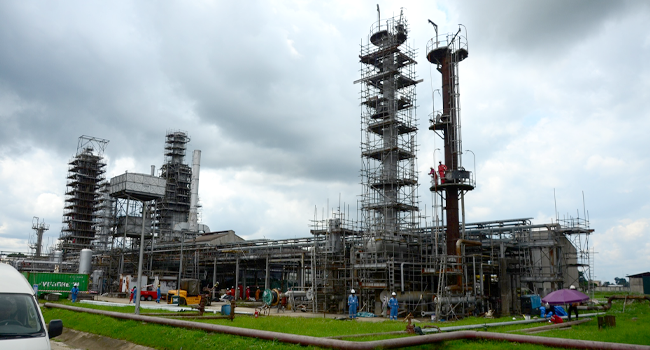
Former President Olusegun Obasanjo has again raised serious doubts about the future of Nigeria’s government-owned refineries, declaring that the facilities in Port Harcourt, Warri and Kaduna will never function properly.
Obasanjo made the remarks during a television interview aired on Sony Irabor Live on Saturday night, where he spoke on Nigeria’s energy sector, governance and lessons from his time in office.
His comments come at a time when the Nigerian National Petroleum Company Limited (NNPC) is searching for technical partners to operate the country’s refineries after years of poor performance, repeated shutdowns and costly rehabilitation efforts.
Speaking during the interview, Obasanjo said his experience in government convinced him that public-private partnerships (PPP) are more effective than full government control of major projects.
“One of the lessons I learnt is that PPP works,” he said. “Look at the Nigeria Liquefied Natural Gas, where the private sector has 51 per cent and the government has 49 per cent. That project has not been destroyed.”
He compared the success of NLNG with what he described as the failure of other government-owned enterprises, including the railways, the national shipping company and the refineries.
According to him, he had warned while in office that the refineries under NNPC would not work, but his concerns were not taken seriously.
“The NNPC has refineries, and I said to people that it will never work,” he stated.
Obasanjo also spoke about his efforts to attract foreign investment into Nigeria’s refining sector while he was president. He revealed that he had approached Shell, one of the world’s leading oil firms, to take over or manage the refineries.
“I called Shell and asked them to take 10 per cent equity and run the refinery for us. They said no,” he said. “I then told them, even if you don’t want equity, just come and run it. They still said no.”
Curious about their refusal, Obasanjo said he invited a top official of the company for a private discussion to understand their reasons.
According to him, the Shell executive gave several explanations.
First, the official said oil companies make most of their profits from upstream operations such as exploration and production, not from downstream activities like refining.
Second, he said Nigeria’s refineries were too small to be profitable. At the time, Obasanjo noted, the country’s refineries had capacities of about 60,000 to 100,000 barrels per day, while modern refineries elsewhere were producing between 250,000 and 300,000 barrels daily.
Third, the official pointed out that the refineries were poorly maintained, often handled by unqualified personnel.
“He said we call quacks and amateurs to maintain our refineries,” Obasanjo recalled.
Finally, the Shell representative cited corruption as a major concern, saying the company did not want to be involved in a system plagued by irregularities.
“There’s too much corruption around our refineries, and they don’t want to be part of that,” Obasanjo added.
The former president also recounted how Nigerian businessman Aliko Dangote once showed interest in acquiring part of the refineries.
According to him, Dangote offered $750 million to take a 51 per cent stake in two of the facilities, a move Obasanjo described as a major opportunity for the country.
“I said, ‘Wow, God, you are really a God of miracles,’” he recalled. “I told Aliko to bring the money quickly, and they paid.”
However, the deal did not last. Obasanjo said his successor, the late Umar Yar’Adua, later reversed the transaction after facing pressure from officials within the NNPC.
He said he personally met Yar’Adua to explain the reasons behind the sale but was told that the decision had already been influenced by internal pressures.
“I told him NNPC cannot run this thing, and he said he knew, but there was pressure,” Obasanjo said.
He added that he warned at the time that reversing the deal would lead to further decline in the value of the refineries.
“When you sell these refineries, you will not get $200 million for them because you will sell them as scrap,” he said.
Obasanjo expressed concern over the huge amount of money spent on the refineries over the years with little to show for it.
He said he had been informed that about $16 billion had been spent on rehabilitation efforts, an amount close to what Dangote used to build his private refinery.
This comparison has raised questions among analysts about the efficiency of government spending in the sector.
The Dangote Group has since built what is widely regarded as Africa’s largest refinery, located in Lagos. The facility is expected to significantly reduce Nigeria’s dependence on imported petroleum products.
Dangote himself has said he decided to build the refinery after the earlier deal to acquire government refineries was cancelled.
In recent years, the NNPC has made several attempts to revive the Port Harcourt, Warri and Kaduna refineries. The facilities were briefly reopened in 2024 after rehabilitation work but were later shut down again due to operational challenges.
The current Group Chief Executive Officer of NNPC, Bayo Ojulari, has acknowledged the difficulties facing the refineries.
He stated that despite efforts to restore operations, the facilities are still performing below international standards and are not competitive in the market.
In November 2025, the NNPC announced plans to bring in technical partners to manage the refineries more efficiently. The company said it aims to complete the selection process by June 2026.
The move is seen as part of broader efforts to reform the oil sector and reduce the burden of maintaining aging infrastructure.
Nigeria, Africa’s largest oil producer, has long struggled with refining its crude oil locally. Despite having multiple refineries, the country depends heavily on imported fuel, which puts pressure on foreign exchange and contributes to high fuel prices.
Obasanjo’s latest comments have added to the ongoing debate about whether the government should continue to own and manage refineries or fully hand them over to the private sector.
Supporters of privatisation argue that private companies are more efficient and less prone to political interference. Critics, however, worry about job losses and the impact on national control of key resources.
As Nigeria looks to improve its energy sector, the success of private initiatives like the Dangote refinery is likely to play a major role in shaping policy decisions.
For now, the future of the NNPC refineries remains uncertain, with the government seeking new partners while critics like Obasanjo continue to question whether the facilities can ever deliver the expected results.