
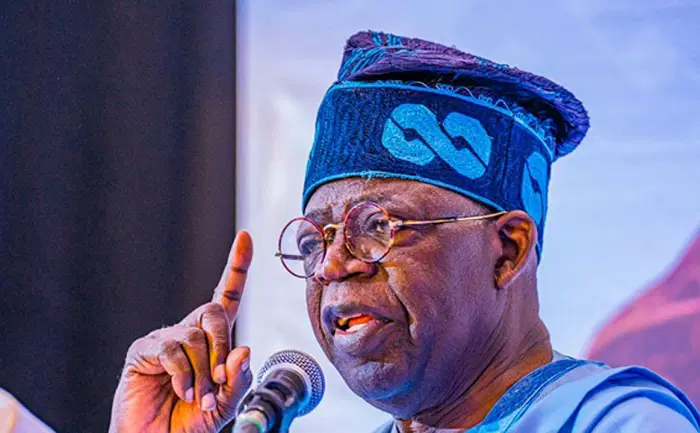
President Bola Tinubu has defended his administration’s strong backing of the Dangote Petroleum Refinery, saying Nigeria would have faced serious economic and energy problems without local refining capacity, especially at a time of growing global tension and instability in the oil market.
Tinubu spoke on Thursday on the sidelines of the 13th Africa CEO Forum held in Kigali, Rwanda, where African leaders and business executives gathered to discuss economic growth, investment and development across the continent.
According to the President, supporting the Dangote refinery was a deliberate and strategic decision aimed at protecting Nigeria’s economy and ensuring energy security for over 200 million Nigerians.
He said the country could not continue to depend heavily on imported petroleum products in the face of increasing global conflicts and uncertainty in major oil-producing regions.
“Today, with the crisis around the whole world, particularly around conflict, Nigeria wouldn’t be able to survive, over 200 million people, without a refinery,” Tinubu said.
The President explained that the Federal Government decided to encourage private investment in refining because of the risks involved and the long-term benefits to the country.
“A risk-taker like the Dangote Refinery must be encouraged by the government in power. What I did was support him, give him free trade for his own licence, and support him in his efforts to source the crude that is necessary. Today, he is the exporter of both the PMS and aviation fuel,” he added.
Tinubu’s comments come at a time when tensions in the Middle East continue to affect global oil supply and fuel prices. Conflicts and security concerns around major oil-producing areas and shipping routes have raised fears of possible disruptions in crude oil supply across the world.
The instability has pushed many countries to review their energy policies and seek ways to reduce dependence on imported refined petroleum products. Analysts say nations with strong local refining capacity are in a better position to manage global supply shocks and price increases.
Nigeria, despite being one of Africa’s largest crude oil producers, has for decades relied heavily on imported petrol and other refined products due to the poor state of government-owned refineries. The situation has contributed to foreign exchange pressure, fuel shortages and rising subsidy costs over the years.
The Dangote refinery, owned by Africa’s richest man, Aliko Dangote, was built to help address these long-standing problems. Located in the Lekki Free Zone in Lagos State, the multi-billion-dollar facility is regarded as the largest single-train refinery in the world.
The refinery began fuel production as part of broader efforts by the Federal Government to end Nigeria’s dependence on imported petroleum products. It is expected to refine up to 650,000 barrels of crude oil per day when fully operational.
Since production began, the refinery has supplied diesel, aviation fuel and Premium Motor Spirit (PMS), commonly known as petrol, to the local market. The facility has also started exporting refined products to other countries, a development government officials say could boost Nigeria’s foreign exchange earnings.
The Tinubu administration has repeatedly described local refining as a key part of its economic reform agenda. Government officials argue that encouraging domestic refining will help stabilise fuel supply, create jobs and strengthen the economy in the long term.
The President’s latest remarks also come amid ongoing debates over fuel prices and crude oil supply arrangements involving local refineries. In recent months, discussions have continued between the Nigerian National Petroleum Company Limited (NNPCL), oil producers and local refiners over the supply of crude oil in naira.
Supporters of the Dangote refinery say the project represents a major turning point for Nigeria’s oil and gas sector after years of failed attempts to revive state-owned refineries.
However, some industry stakeholders have also raised concerns about competition and market dominance, given the scale of the refinery and its growing influence in the downstream sector.
Despite the concerns, many economists maintain that increased local refining capacity remains critical for Nigeria’s economic stability, particularly at a time when global energy markets remain uncertain.
The Africa CEO Forum where Tinubu spoke is one of the continent’s leading business and economic gatherings. The event attracts heads of state, investors and top business leaders who discuss policies aimed at improving Africa’s economic future.
Tinubu used the platform to highlight Nigeria’s ongoing reforms and investment opportunities, while also defending his administration’s policies in the energy sector.