
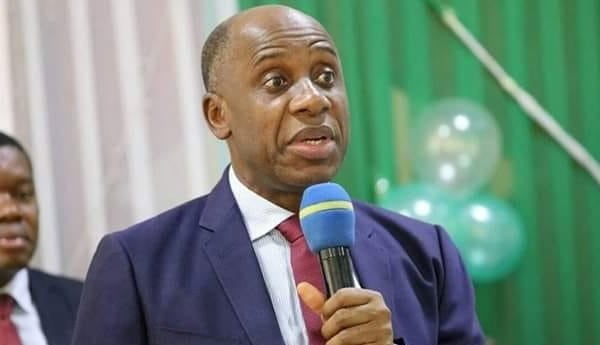
Former Minister of Transportation and former Rivers State Governor, Rotimi Amaechi, has promised to transform Nigeria within four years if elected president in the 2027 general election.
Amaechi made the declaration on Thursday shortly after submitting his nomination forms at the national headquarters of the African Democratic Congress (ADC) in Abuja.
The former minister used the occasion to criticise the administration of President Bola Tinubu, blaming the Federal Government for the rising economic hardship across the country.
He said Nigerians should focus on competence, experience and performance when choosing their next president instead of ethnic, religious or regional considerations.
According to him, the country’s current challenges require leadership with proven experience and capacity.
“What Nigerians should do is assess all of us who are running for office based on our records,” Amaechi said.
“Nearly everybody who is running for the office of the president has served Nigeria in one way or another. Let this be a referendum. If you have performed, whoever has outperformed the other, vote for the person.”
Amaechi argued that his years in public service had prepared him for the responsibility of leading the country.
He pointed to his record as governor of Rivers State and later as Minister of Transportation under former President Muhammadu Buhari as evidence of his ability to manage large responsibilities and deliver results.
“The next thing is, who is capable of delivering the votes? Who is capable of beating the incumbent? Who has the experience? I believe I am the most experienced.
“I am young, I am the most experienced, and I believe I have the capacity. Go back to Rivers State and see what I have done. Go back to the Ministry of Transportation and see what I have done, and assess it and see whether I can turn the country around. And I will, in four years, turn the country around,” he declared.
Amaechi’s comments come as political activities ahead of the 2027 general election continue to gather momentum across the country.
Although the election is still more than a year away, politicians and political parties have already begun consultations, alliances and strategic planning.
The African Democratic Congress, which was previously considered a smaller opposition party, has recently attracted several prominent politicians seeking alternative political platforms ahead of the next election cycle.
Since assuming office in May 2023, President Tinubu has introduced major economic reforms, including the removal of fuel subsidy and the floating of the naira.
While the government argues that the reforms are necessary to stabilise the economy and attract investment, many Nigerians have complained about the sharp rise in fuel prices, transport costs, food prices and general hardship.
Amaechi blamed the current administration for worsening living conditions in the country.
“Nigerians should vote for merit, not vote for those who say, ‘I’m from this place’ or ‘it is our turn.’
“It is the ‘Emilokan’ mentality that brought us here. It is our turn that brought us here. Now Nigerians are suffering,” he said.
The phrase “Emilokan,” a Yoruba expression meaning “it is my turn,” became popular during the political campaigns leading to the 2023 presidential election after Tinubu publicly used it while defending his presidential ambition.
Amaechi’s remarks are likely to increase political debate ahead of the 2027 polls, especially within opposition circles seeking to challenge the APC.
The former minister also said the hardship facing Nigerians affects everyone regardless of religion or ethnic background.
“There is no market for Christians, nor is there a market for Muslims, nor a market for northerners or southerners. The market has only one purpose — the naira. Nigerians are suffering,” he stated.
He further criticised the Tinubu administration, saying the APC government had failed Nigerians.
“The current president has put us in this suffering. I don’t know why he wants to run again. I don’t even know why the APC wants to participate. They should be ashamed and allow other Nigerians to participate and change the country,” Amaechi added.
Amaechi is one of Nigeria’s most experienced politicians and has played major roles in the country’s political development over the past two decades.
He served as Speaker of the Rivers State House of Assembly before becoming governor of Rivers State from 2007 to 2015.
During his time as governor, he was known for large infrastructure projects, including roads, schools and urban renewal programs.
He later became one of the key figures behind the formation of the APC in 2013 when opposition parties merged to challenge the then ruling Peoples Democratic Party (PDP).
Amaechi also served as Director-General of Muhammadu Buhari’s 2015 presidential campaign, which led to the APC’s historic victory over the PDP.
After Buhari became president, Amaechi was appointed Minister of Transportation, a position he held from 2015 to 2023.
As minister, he supervised major railway projects such as the Abuja-Kaduna rail line and the Lagos-Ibadan railway project.
The Buhari administration described the rail projects as part of efforts to modernise Nigeria’s transport system and improve economic activities.
However, critics raised concerns about the rising debts associated with some of the projects, particularly loans obtained from China for railway development.
Some opposition politicians also accused the administration of failing to complete several promised projects across the country.
Despite the criticisms, Amaechi maintains that his record in office speaks for itself.
On the issue of the ADC presidential ticket, Amaechi said he was prepared to contest through a transparent primary election.
However, he added that he would also accept a consensus arrangement if party members agreed to support him.
“I’m going for primary. If the consensus is me, fine. But if it’s not me, I’m going for primary,” he said.
Political observers say the race for the 2027 presidency may witness major political realignments, especially among opposition parties seeking to build stronger coalitions against the APC.
There are already reports of consultations among opposition leaders, former governors and influential politicians across different parties.
The ADC is believed to be positioning itself as one of the possible alternative platforms for politicians dissatisfied with the APC and the PDP.