
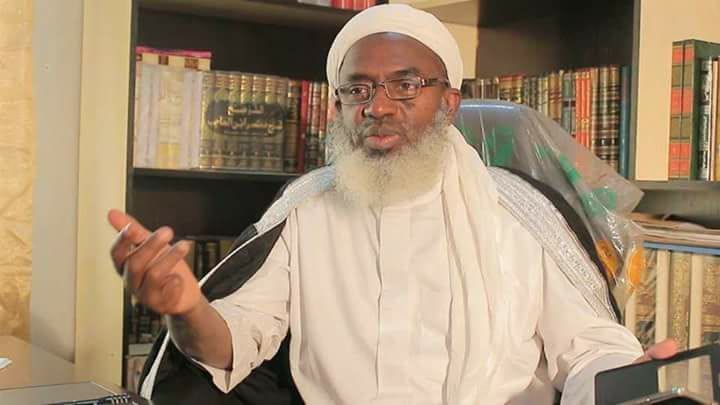
Islamic cleric, Sheikh Ahmad Gumi, has warned against involving the United States in Nigeria’s fight against terrorism and banditry, saying such a move could attract more dangerous international terror groups into the country.
Gumi made the remarks in a Facebook post on Monday amid renewed discussions about foreign support for Nigeria’s security operations following recent military offensives against terrorists and bandits in parts of the country.
The cleric said Nigeria must protect its sovereignty and avoid opening the door to foreign military involvement that could worsen the security situation.
According to him, Nigeria’s Armed Forces are capable of dealing with insecurity if operations are conducted professionally and fairly without what he described as prejudice and deception.
“Nigeria’s sovereignty is a red line,” Gumi stated.
“The military can handle the situation if the rules of engagement are free from prejudices and deception, both in the application of force and finances.”
He warned that bringing the United States into Nigeria’s security operations could turn the country into a new battlefield for international terrorist organisations.
“The involvement of the USA will only attract international terror groups to the ‘new arena,’ exposing Nigeria to an unnecessary increase in violence,” he wrote.
The cleric also rejected claims that efforts to negotiate with bandits and insurgents through amnesty programs had stopped the military from taking strong action against criminal groups.
He described such allegations as false and misleading, insisting that dialogue and non-violent approaches should not be blamed for the continued insecurity in the country.
According to him, Boko Haram has continued to operate nearly 17 years after the killing of its founder, Mohammed Yusuf, in 2009.
Yusuf, who founded the extremist group in Maiduguri, Borno State, was captured and killed by security operatives after clashes between Boko Haram members and government forces.
His death was widely condemned by human rights groups because it was seen as an extra-judicial killing.
After Yusuf’s death, Boko Haram became more violent under new leadership and expanded its attacks across several states in northern Nigeria.
Over the years, the insurgency has claimed thousands of lives, destroyed communities and displaced millions of people, especially in Borno, Yobe and Adamawa states.
The crisis later spread into neighbouring countries including Niger, Chad and Cameroon, making it one of Africa’s deadliest security challenges.
Gumi argued that the continued violence showed that military force alone had not solved the problem.
According to him, the failure of the kinetic approach, meaning the use of military force as the main strategy, was partly due to alleged abuses by security personnel and the killing of innocent civilians during operations.
The cleric has for years advocated dialogue and negotiations with armed groups, especially bandits operating in parts of the North-West.
His position has remained controversial, with many Nigerians accusing him of being too sympathetic to criminal groups.
However, Gumi has repeatedly defended his approach, saying peaceful engagement is necessary to end bloodshed and secure the release of kidnapped victims.
In recent years, he has held meetings with some bandit leaders in forests across states such as Zamfara and Niger in attempts to encourage them to surrender their weapons and embrace peace.
Some government officials and security experts have supported limited dialogue efforts, while others insist that armed groups should be confronted mainly through military action.
Nigeria has continued to face serious security challenges, including terrorism, banditry, kidnapping for ransom and attacks on rural communities.
In the North-East, troops have continued operations against Boko Haram and the Islamic State West Africa Province, ISWAP, while military offensives are also ongoing against bandits in the North-West and North-Central regions.
Despite repeated military campaigns, attacks and abductions still occur in several communities, raising concerns among citizens over the pace of improvement in security.
The debate over foreign involvement in Nigeria’s anti-terror operations has also remained sensitive.
Nigeria already works with several international partners, including the United States, the United Kingdom and France, mainly in areas such as intelligence sharing, training and equipment support.
Security cooperation between Nigeria and the United States has increased in recent years, especially in intelligence gathering and surveillance operations against terrorist groups.
However, Nigerian authorities have often maintained that foreign troops are not directly involved in combat operations on Nigerian soil.
Recently, the Defence Headquarters clarified that no foreign soldier participated in the operation that eliminated terrorist commander Abu Bilal Al-Minuki, stating that only intelligence and surveillance support came from the United States.
The military has also insisted that Nigerian troops remain capable of handling security threats across the country.
Gumi’s latest comments are expected to further fuel public debate over the best strategy to tackle insecurity in Nigeria.
While some Nigerians support stronger international cooperation against terrorism, others fear that deeper foreign military involvement could undermine national sovereignty or worsen the conflict.
The Federal Government has repeatedly promised to improve security through better funding of the military, acquisition of modern equipment and stronger collaboration with local communities.
President Bola Tinubu’s administration has also pledged to strengthen intelligence gathering and address the economic and social conditions that contribute to insecurity.
However, many communities in affected areas continue to demand faster action as attacks, kidnappings and killings persist in parts of the country.
Gumi maintained that Nigeria must remain careful in handling the security crisis and avoid actions that could internationalize the conflict further.
According to him, the country should focus on improving its internal security operations and ensuring justice and fairness in the fight against terrorism and banditry.