
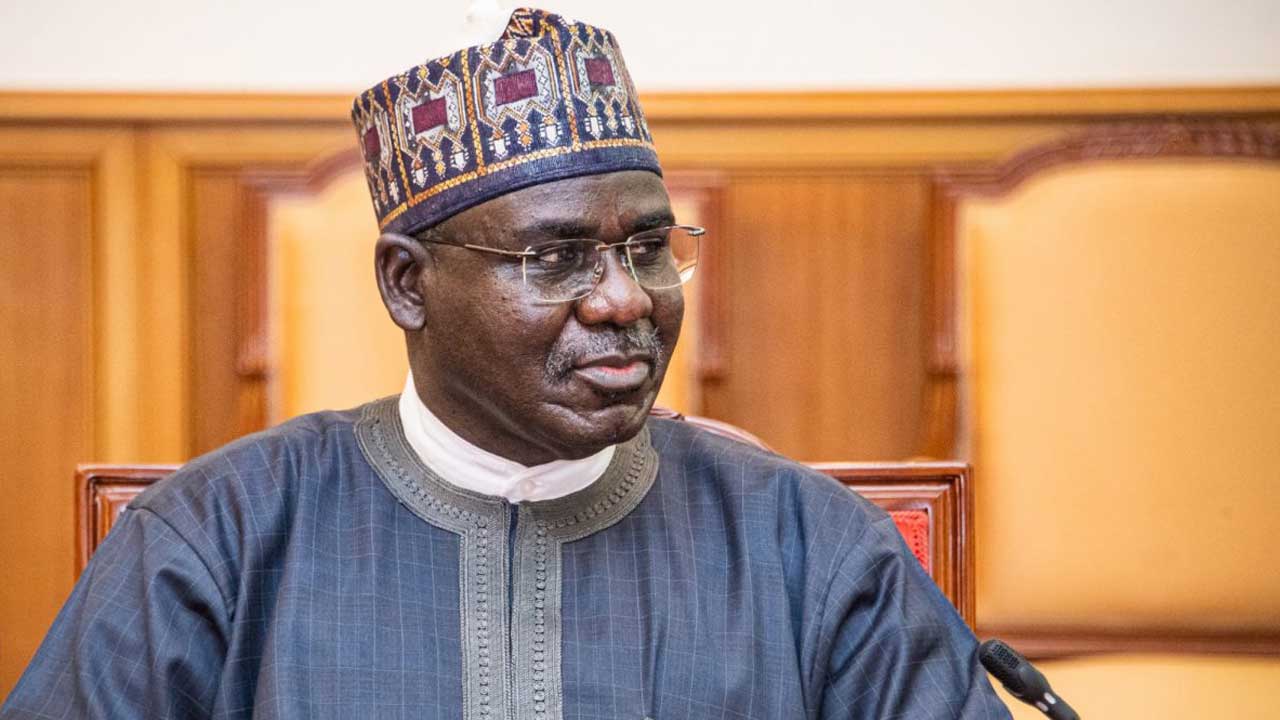
Former Chief of Army Staff, Lt.-Gen. Tukur Buratai (retd.), has expressed confidence in the ability of Nigerian security agencies to track and locate bandits, insisting that the military possesses the capacity to find criminal groups if it can locate ordinary citizens and social media users across the country.
Buratai made the remarks on Monday during an interview on TVC while responding to questions on the growing insecurity in parts of Nigeria and the recent abduction of schoolchildren and teachers in Oyo State.
His comments came amid renewed public concern over the rising cases of kidnapping, banditry and attacks on schools and communities across different parts of the country.
The retired army chief was specifically asked whether Nigerian troops have the capability to rescue the pupils and teachers abducted by gunmen in Oyo State.
The incident attracted national attention after armed men reportedly attacked a school, abducted several pupils and teachers and later killed one of the teachers.
The attack sparked widespread outrage and renewed calls for stronger action against criminal groups operating across the country.
Responding to the concerns, Buratai said he did not believe that security agencies lacked the ability to locate bandits and kidnappers.
“I don’t believe security agencies cannot locate bandits if they can locate ordinary citizens and social media influencers,” he said.
His statement suggests that the technology, intelligence-gathering systems and surveillance capabilities available to security agencies should make it possible to trace criminal elements and their hideouts.
However, Buratai stopped short of accusing security agencies of negligence, noting that there could be factors unknown to the public affecting security operations.
“I would not like to say it is a capacity challenge, but I think they may have their reasons,” he added.
The former army chief nevertheless stressed the need for continuous improvement in the country’s security architecture through recruitment, training and retraining of personnel.
According to him, strengthening the manpower of the military and other security agencies remains critical to addressing Nigeria’s security challenges.
“What I know is that there must be capacity building of all the security agencies. We need more troops to be recruited, more operatives, more policemen need to be recruited, trained and retrained,” he said.
Buratai’s comments come at a time when insecurity remains one of the major concerns facing the country.
Several states across the North-West, North-East and North-Central regions have experienced attacks by bandits, terrorists and kidnappers in recent years. Communities have suffered killings, abductions and destruction of property, while many residents have been displaced from their homes.
School abductions have also become a major security concern. Since the mass abduction of schoolgirls from Chibok, Borno State, in 2014, several other schools across the country have come under attack.
Criminal groups have increasingly targeted educational institutions, often kidnapping pupils and teachers for ransom or other demands.
The recent incident in Oyo State has revived fears about the safety of schools and students, particularly in rural areas where security presence is limited.
Many believe that better coordination among the military, police, intelligence agencies and local communities would improve efforts to track criminals and prevent attacks before they occur.
Buratai’s call for increased recruitment also reflects concerns about the pressure on existing security personnel.
Nigeria’s military and police have for years been engaged on multiple fronts, including counter-terrorism operations in the North-East, anti-banditry operations in the North-West, anti-kidnapping campaigns in several states and efforts to protect critical national infrastructure.
The Federal Government has in recent years approved the recruitment of military personnel and police officers as part of efforts to strengthen security nationwide.
Authorities have also invested in new equipment, surveillance technology and intelligence operations to improve the effectiveness of security agencies.
Despite these efforts, attacks by armed groups continue to occur in some parts of the country, leading to calls for further reforms and investment in the security sector.
Buratai served as Chief of Army Staff from 2015 to 2021, a period marked by major military operations against insurgents and bandits. Since leaving office, he has remained active in national discussions on security and defence issues.
His latest remarks have added to ongoing debates about the best strategies for tackling insecurity and protecting communities from criminal attacks.
Many Nigerians continue to demand stronger measures from government and security agencies to end kidnappings, rescue victims and restore confidence in public safety.
As concerns over insecurity persist, stakeholders have emphasized the need for a combination of intelligence gathering, modern technology, adequate manpower and community support to effectively confront criminal groups.
For many citizens, the ultimate goal remains the same: a safer country where schools, roads and communities are protected from attacks and where criminals can be swiftly identified, tracked and brought to justice.
.