
Lagos State Governor, Babajide Sanwo-Olu, has ordered the demolition of all shanties and illegal structures built on the median of the Lagos-Badagry Expressway, giving occupants a 72-hour ultimatum to vacate the area before a full enforcement exercise begins next week.
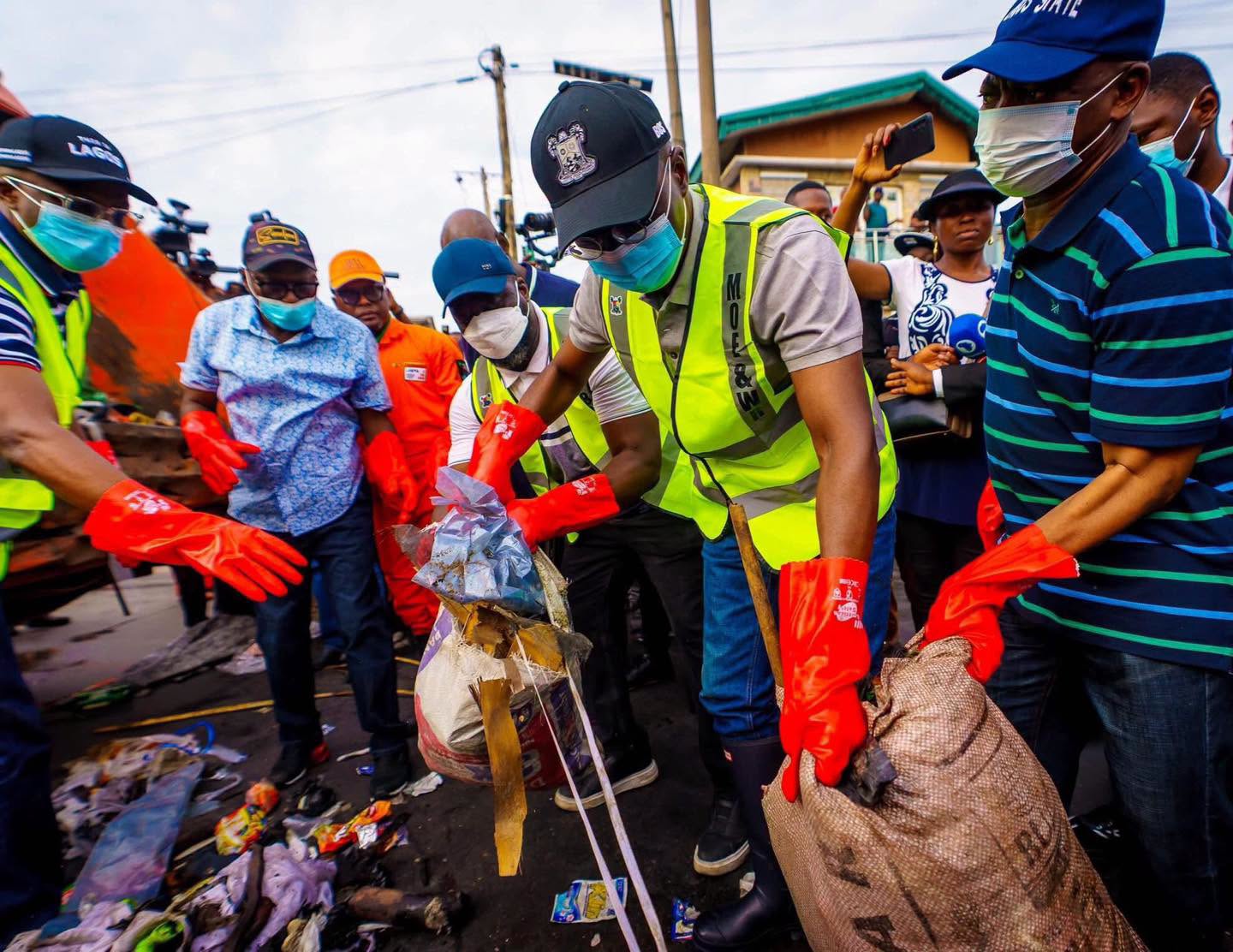
The governor announced the directive on Saturday after participating in the monthly environmental sanitation exercise held across communities in Surulere Local Government Area.
Sanwo-Olu, accompanied by his wife, Dr. Ibijoke Sanwo-Olu, inspected parts of the area during the exercise before addressing journalists on the state’s renewed campaign against environmental degradation and illegal occupation of public infrastructure.
He said the state government could no longer tolerate the growing number of makeshift structures erected along the median of the Lagos-Badagry Expressway, describing the development as a threat to public safety, environmental sanitation and the huge investment made by the government in the road project.
According to him, enforcement officials will begin clearing the entire corridor from Orile-Iganmu to Okokomaiko immediately after the expiration of the 72-hour notice.
“This is the final notice to everyone occupying the median of the Lagos-Badagry Expressway. From next week, we are coming to clear the entire median. Everything there will go. Every illegal structure will be removed,” the governor declared.
He stressed that the median was never designed for commercial activities or residential use and warned that all illegal structures standing on the corridor would be demolished without exception.
“It is not meant to be a market. It is not meant to be a place where people erect structures. It is a highway median, and we must preserve it, especially considering the huge public investment on that corridor.
“It’s a 10-lane highway that was built with the resources of our taxpayers. I will not fold my arms and allow them to turn that international gateway into a slum. This is a notice that I am giving officially to everybody on that corridor. We are starting next week, and we are going to deploy thousands of men there,” Sanwo-Olu said.
The Lagos-Badagry Expressway is one of the state’s busiest transport corridors and serves as a major gateway linking Lagos with neighbouring West African countries. It is also a key route for commercial activities and forms part of the Lagos rail and Bus Rapid Transit (BRT) infrastructure being developed by the state government.
Over the years, however, sections of the road have become occupied by illegal traders, makeshift shops and temporary shelters, raising concerns over environmental pollution, traffic congestion, security and public safety.
The governor said clearing the illegal structures would help protect the road infrastructure, improve traffic flow and restore the corridor to its original purpose.
Beyond the demolition exercise, Sanwo-Olu said the state government was strengthening its waste management strategy through increased investment in modern equipment and recycling infrastructure.
He disclosed that the government would soon add 150 new compactors to its fleet of waste collection vehicles to improve refuse evacuation across the state.
According to him, waste collection tricycles will also be introduced in densely populated inner communities where larger waste trucks cannot easily operate.
The governor said these measures are part of broader efforts to ensure cleaner neighbourhoods and improve environmental health across Lagos.
He explained that the state was also investing in long-term waste processing facilities that would reduce dependence on traditional dumpsites.
According to him, a modern material recovery and recycling facility capable of processing about 4,250 metric tonnes of waste daily is being developed as part of the state’s transition to a more sustainable waste management system.
Sanwo-Olu appealed to residents to support the government’s efforts by disposing of waste properly and paying their waste collection bills promptly.
“Waste management is not the responsibility of government alone. It is a collective responsibility.
“Residents must also play their part by paying for waste collection services. That is what enables the PSP operators to continue providing efficient services,” he said.
The governor also encouraged parents to involve their children in environmental sanitation activities to help instil a culture of cleanliness and environmental responsibility from an early age.
According to him, maintaining a clean environment is essential for building a healthier and more sustainable Lagos.
Meanwhile, the Commissioner for the Environment and Water Resources, Tokunbo Wahab, visited the Olusosun Landfill after the sanitation exercise to inspect ongoing work on the state’s waste management reforms.
Speaking during the inspection, Wahab said Lagos could no longer rely on the traditional “collect and dump” approach that has dominated waste disposal for more than four decades.
He explained that the state was moving towards a circular waste management system where refuse would be treated as a valuable resource rather than discarded as useless material.
According to him, the Olusosun site will serve as one of the transfer loading stations that will transport about 2,500 metric tonnes of waste daily to the new material recovery facility under construction in Ikorodu.
He expressed optimism that the facility would begin operations before the end of the year.
“This place will be one of the transfer loading stations that will transfer about 2,500 metric tonnes of waste a day to the material recovery facility that will be located in Ikorodu. The target is for it to commence operations before the end of the year, so we just have to come and see what they are doing,” Wahab said.
The commissioner noted that Lagos was running out of available land for new dumpsites because of its growing population and rapid urban development.
“We can’t sustain the linear waste management system that we have practised for over four decades, which simply means we have been used to collect and dump. Collect and dump cannot be sustainable. Even if we leave climate issues aside, we simply do not have the land for it.
“So let us make waste a resource—for wealth, for energy, and for many other purposes. That is the transition we are going through now,” he added.
Wahab appealed to Lagos residents to cooperate with the government as it continues implementing reforms aimed at creating a cleaner and more environmentally friendly city.
The latest directive by Governor Sanwo-Olu signals the state’s determination to protect public infrastructure, restore order along major highways and modernise waste management as Lagos continues to expand as Nigeria’s commercial hub.