
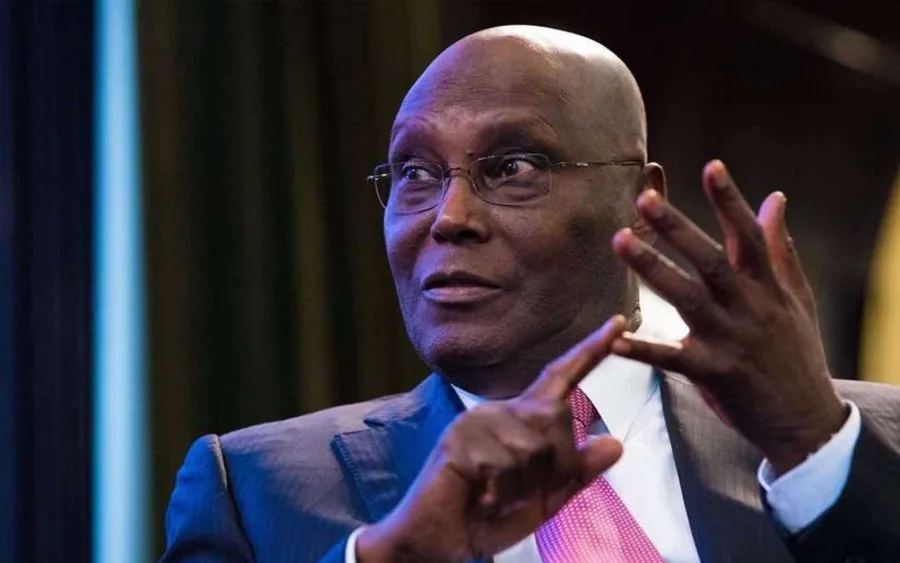
Former Vice President and presidential candidate of the African Democratic Congress (ADC), Atiku Abubakar, has launched a fresh attack on the administration of President Bola Ahmed Tinubu, saying the controversies surrounding the Presidential Foreign Intervention Promotion Council (PFIPC) have reinforced what he described as a pattern of scandals under the current government.
Atiku said the latest controversy was not an isolated incident but part of a growing list of issues that, according to him, have continued to define the Tinubu administration since it assumed office.
The former vice president made the remarks in a statement issued on Sunday by his media aide, Phrank Shaibu.
According to Atiku, Nigerians are becoming increasingly concerned by what he described as repeated controversies involving the Federal Government, arguing that the frequency of such incidents suggests a deeper problem in governance.
He said scandals have become so common that they can no longer be dismissed as isolated cases.
“Nigeria has sadly arrived at that point. The issue is no longer one scandal or another. The issue is the pattern. And when scandals become a pattern of governance, the inevitable conclusion is this: you are no longer managing scandals; you have become the scandal itself,” Atiku said.
The former presidential candidate argued that the controversy surrounding the Presidential Foreign Intervention Promotion Council represents another setback for the administration’s image.
According to him, the PFIPC issue is only the latest chapter in what he described as an expanding list of controversies that have repeatedly placed the government under public scrutiny.
He alleged that major controversies have often been followed by promises of investigations, but that the outcomes of such investigations are rarely made public.
“The PFIPC affair is not merely another embarrassment for the government but the latest chapter in an ever-expanding book of scandals that have come to define the Tinubu administration, a government in which controversy erupts with unsettling regularity, investigations are announced with fanfare, and the truth too often disappears into official silence,” he stated.
Atiku further argued that the PFIPC controversy did not emerge in isolation but should be viewed alongside several other issues that have generated public debate during the current administration.
He listed unresolved questions surrounding the Ministry of Humanitarian Affairs, allegations relating to crude oil theft and the release of seized tankers, concerns over the implementation of the 2024 budget, spending on the rehabilitation of Nigeria’s state-owned refineries, procurement processes for major infrastructure projects and the appointment of individuals linked to unresolved allegations.
According to him, many of these issues generated widespread public attention but were never followed by comprehensive reports explaining the outcome of government investigations.
“From unresolved questions surrounding the Humanitarian Affairs scandal to allegations of crude oil theft and illegal tanker releases that faded without publicly released investigative reports; from concerns raised over alleged discrepancies in the 2024 budget and the absence of a comprehensive forensic explanation; to the billions reportedly expended on refinery rehabilitation while public refineries remain largely dysfunctional; from procurement controversies involving major infrastructure projects to recurring concerns over opaque contract awards, missing procurement records and appointments of persons linked to unresolved allegations, Nigerians have watched a familiar and deeply troubling pattern unfold,” he said.
Atiku maintained that what should worry Nigerians is not only the individual controversies but the repeated nature of such allegations.
“The pattern itself has become the scandal.
“The scandal is no longer around the government. The government itself becomes the scandal,” he added.
He also directed criticism personally at President Tinubu, saying many Nigerians are beginning to question why controversies continue to surround the administration.
“And to President Tinubu, Nigerians are increasingly asking a simple but profound question: if every road of controversy leads back to your doorstep, then who, indeed, is the scandal?” Atiku said.
The latest criticism comes amid ongoing public discussions surrounding the Presidential Foreign Intervention Promotion Council, an initiative that has recently attracted attention following questions raised about its status, operations and relationship with the Federal Government.
The controversy has generated debate among political stakeholders, with opposition figures demanding greater clarity over the council and its activities.
The Federal Government has in recent months also faced criticism from opposition parties over issues relating to economic reforms, public spending, security, procurement processes and governance.
Since assuming office in May 2023, the Tinubu administration has defended its policies, insisting that major economic reforms, including the removal of fuel subsidy, foreign exchange reforms and tax proposals, are necessary to stabilise the economy and attract investment.
Government officials have repeatedly maintained that ongoing reforms require time to produce meaningful results and have rejected allegations of wrongdoing made by opposition politicians.
The administration has also insisted that it remains committed to transparency, accountability and the rule of law, while promising to investigate allegations of misconduct whenever they arise.
Political exchanges between the Presidency and opposition leaders have become more frequent as parties begin positioning ahead of the 2027 general elections.
Atiku, who was the presidential candidate of the Peoples Democratic Party in the 2023 election before aligning with the ADC-led opposition coalition, has remained one of the most outspoken critics of the Tinubu administration.
He has consistently questioned the government’s handling of economic reforms, public finance, security and governance, while urging Nigerians to demand greater accountability from public officials.
Supporters of the administration, however, argue that many of the allegations raised by opposition figures are politically motivated and should not be treated as established facts unless supported by credible investigations and evidence.