
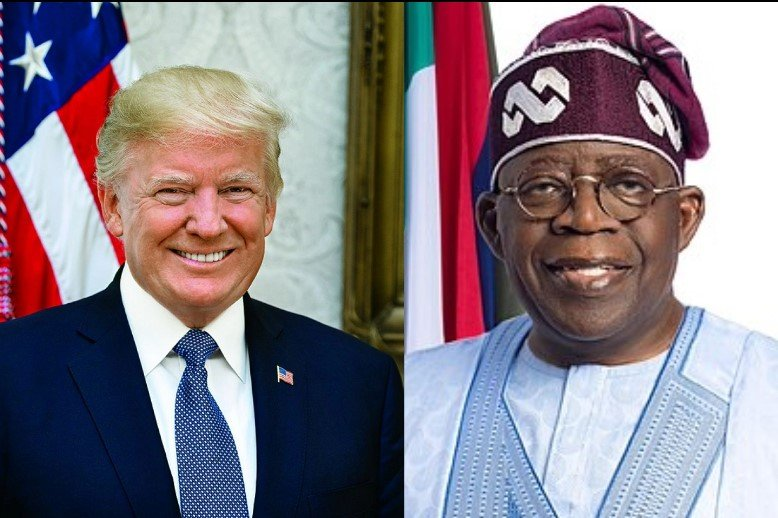
United States President Donald Trump has praised President Bola Tinubu for what he described as strong and decisive leadership in Nigeria’s fight against terrorism, especially efforts to protect Christian communities affected by violent attacks.
Trump made the remarks in a letter dated July 6, 2026, addressed to President Tinubu. Details of the letter were made public on Wednesday by the Presidency through a statement issued by the Special Adviser to the President on Information and Strategy, Bayo Onanuga.
The letter, titled *”President Trump Lauds President Tinubu’s Decisive Leadership Against Terrorists,”* also reaffirmed the United States’ commitment to working closely with Nigeria in tackling terrorism and strengthening security cooperation between the two countries.
According to the Presidency, Trump’s message came at a time when Nigeria and the United States have expanded their security partnership to confront terrorism, insurgency and violent extremism, which continue to threaten peace in Nigeria and across the West African region.
In the letter, Trump thanked Tinubu for an earlier message sent to him and commended the Nigerian leader for his commitment to addressing the country’s security challenges.
“Thank you for your thoughtful letter. Your kind words mean a great deal to me, and I appreciate your decisive leadership on behalf of the Nigerian people,” Trump wrote.
He added that he admired Tinubu’s determination to confront the problems affecting Nigeria, particularly attacks on Christian communities by terrorist groups.
“I applaud your resolve to tackle the issues plaguing your nation, especially the violence affecting Christian communities, and it is a true honour to stand with you in the fight against terrorists and to make the Federal Republic of Nigeria stronger and more prosperous,” Trump stated.
The American President stressed that the relationship between Nigeria and the United States has become even more important as security threats continue to spread across West Africa and other parts of the world.
According to him, both countries share a common objective of defeating terrorism in all its forms.
“The United States-Nigeria relationship is crucial at a time when conflict has spread across West Africa and around the world. We both share a mutual goal of confronting terrorism in all its forms, and our historic US-Nigeria 2026 Defence Cooperation Roadmap has established a robust framework to accomplish this feat,” Trump said.
He also highlighted the growing defence cooperation between both nations, revealing that the United States had deployed its Special Operations Forces to assist Nigeria’s military.
Trump said the elite American military personnel were helping to train Nigerian troops, improve intelligence gathering and strengthen operational capabilities in the fight against terrorists.
“I am proud to have deployed the United States Special Operations Forces—among the most elite military units anywhere in the world—to equip the brave men and women in the Armed Forces of Nigeria with the skills, tools and intelligence they need to protect your homeland and ensure the safety and security of citizens, particularly those of faith who have been under attack,” he wrote.
He expressed confidence that both countries would continue to deepen their engagement during his administration.
“I look forward to our continued discussions over the course of my Presidency,” Trump added.
The Presidency said the exchange of letters reflects the growing partnership between Abuja and Washington on security matters.
It explained that Nigeria and the United States have intensified cooperation in recent months through a Joint Working Group jointly led by the National Security Advisers of both countries.
According to the statement, the partnership has focused on military training, intelligence sharing, capacity building and coordinated operations against terrorist organisations operating in Nigeria and the wider Lake Chad region.
One of the major achievements cited by the Presidency was the coordinated military operation carried out on May 16 against ISIS hideouts around the Lake Chad Basin.
The operation reportedly led to the death of Abubakar Al-Minoki, identified as one of the top leaders of the terrorist group, along with several of his senior commanders.
Although security agencies have not publicly released full operational details, the Presidency described the mission as a significant breakthrough in the ongoing campaign against terrorist networks operating in the region.
The Lake Chad Basin, which borders Nigeria, Niger, Chad and Cameroon, has remained one of the major strongholds of Boko Haram and the Islamic State West Africa Province (ISWAP). The region has witnessed years of insurgency that have claimed thousands of lives and displaced millions of people.
Nigeria has continued to rely on both domestic military operations and international partnerships to weaken the insurgents and restore stability to affected communities.
Successive administrations have sought closer security cooperation with allies, including the United States, Britain, France and neighbouring African countries, particularly in intelligence gathering, surveillance, logistics and military training.
The Tinubu administration has repeatedly stated that defeating terrorism remains one of its top priorities.
Government officials say the Armed Forces have recorded gains against terrorist groups through sustained offensives, although attacks still occur in parts of the North-East, North-West and North-Central regions.
The Federal Government has also continued to seek greater international support to improve Nigeria’s military capabilities and strengthen efforts to combat terrorism, kidnapping and other violent crimes.
As part of these efforts, senior officials from both countries have maintained regular diplomatic engagements.
The Presidency disclosed that the United States Assistant Secretary of State for Africa, Frank Garcia, visited Abuja last week, where he met with senior Nigerian government officials.
During the visit, Garcia reportedly pledged to deepen cooperation between the two countries, not only in security but also in other strategic sectors.