
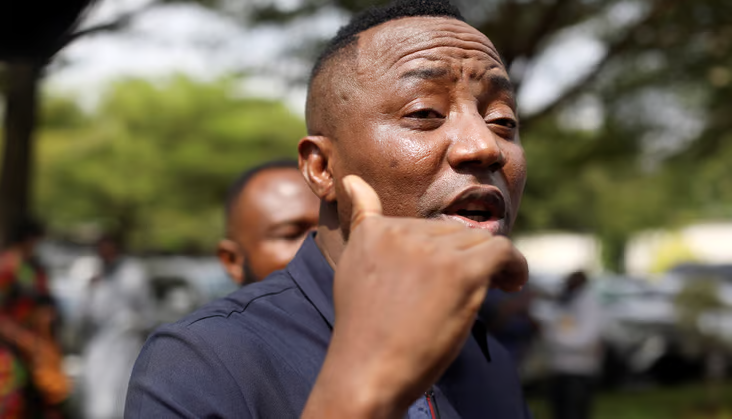
Activist and African Action Congress (AAC) presidential candidate, Omoyele Sowore, has declared that he will not apologise to President Bola Tinubu for previously referring to him as a criminal, insisting that the President should instead apologise to Nigerians.
Sowore made the remarks on Monday while addressing journalists in Abuja, where he also challenged the authorities to first take action against the presidential candidate of the African Democratic Congress (ADC), Atiku Abubakar, over comments he recently made about Tinubu.
According to Sowore, if the authorities believe he should be prosecuted or compelled to apologise for his remarks about the President, they should first arrest Atiku, whom he accused of making even more serious allegations against Tinubu.
The former presidential candidate said he had no intention of withdrawing his comments or offering an apology.
“We are here to defeat them in this election. Someone told me that the reason they’re charging me is because I refused to apologise to President Tinubu. For what? Did I apologise to Buhari?” Sowore asked.
He argued that rather than demanding an apology from him, President Tinubu should be apologising to Nigerians for seeking the country’s highest office.
“It is Tinubu that should be apologising to Nigerians for presenting himself for an office that he’s not qualified for,” he said.
“He’s the one that should be apologising on a daily basis for presenting himself as a person who is worthy when he knows that he’s not worthy.”
Sowore further alleged that he was being targeted because he had referred to the President as a criminal.
“They say my crime is that I called him a criminal. Atiku called him a forger and a drug baron yesterday. Let them go and carry Atiku,” he added.
His comments come amid growing political tension ahead of the 2027 general elections, with opposition politicians intensifying criticism of the Tinubu administration over its economic policies, governance and security situation.
The Federal Government has repeatedly defended President Tinubu against allegations made by political opponents, maintaining that such claims are false and politically motivated.
Tinubu has also consistently maintained that he was duly elected and remains focused on implementing reforms aimed at stabilising Nigeria’s economy and improving national development.
Sowore has long been one of Tinubu’s fiercest critics. During the 2023 presidential election and in the years that followed, he frequently questioned the President’s qualifications, governance style and policy decisions.
The activist, who is also the publisher of Sahara Reporters, has built his political career around campaigns against corruption, poor governance and abuse of power. He has contested the presidency under the platform of the African Action Congress in previous elections and has remained active in opposition politics.
His latest remarks also follow recent comments by former Vice President Atiku Abubakar, who has been critical of President Tinubu and his administration.
Political exchanges between leading opposition figures and the ruling All Progressives Congress (APC) have intensified as parties begin positioning themselves ahead of the next general elections.
The Tinubu administration has faced sustained criticism over the removal of fuel subsidy, the floating of the naira and the rising cost of living. While the government insists the reforms are necessary to rebuild the economy and attract investment, opposition politicians argue that the policies have imposed severe hardship on Nigerians.
In recent months, opposition leaders have repeatedly called on the Federal Government to introduce stronger measures to cushion the effects of the reforms, including increased social welfare programmes and interventions to reduce the cost of food and transportation.
Despite the criticisms, the Presidency has maintained that the economic reforms are beginning to yield positive results, citing improved government revenue, increased investor confidence and signs of greater macroeconomic stability.
With political parties expected to begin broader consultations and mobilisation in the coming months, analysts believe public debates over the economy, governance, security and accountability will dominate the campaign season.