
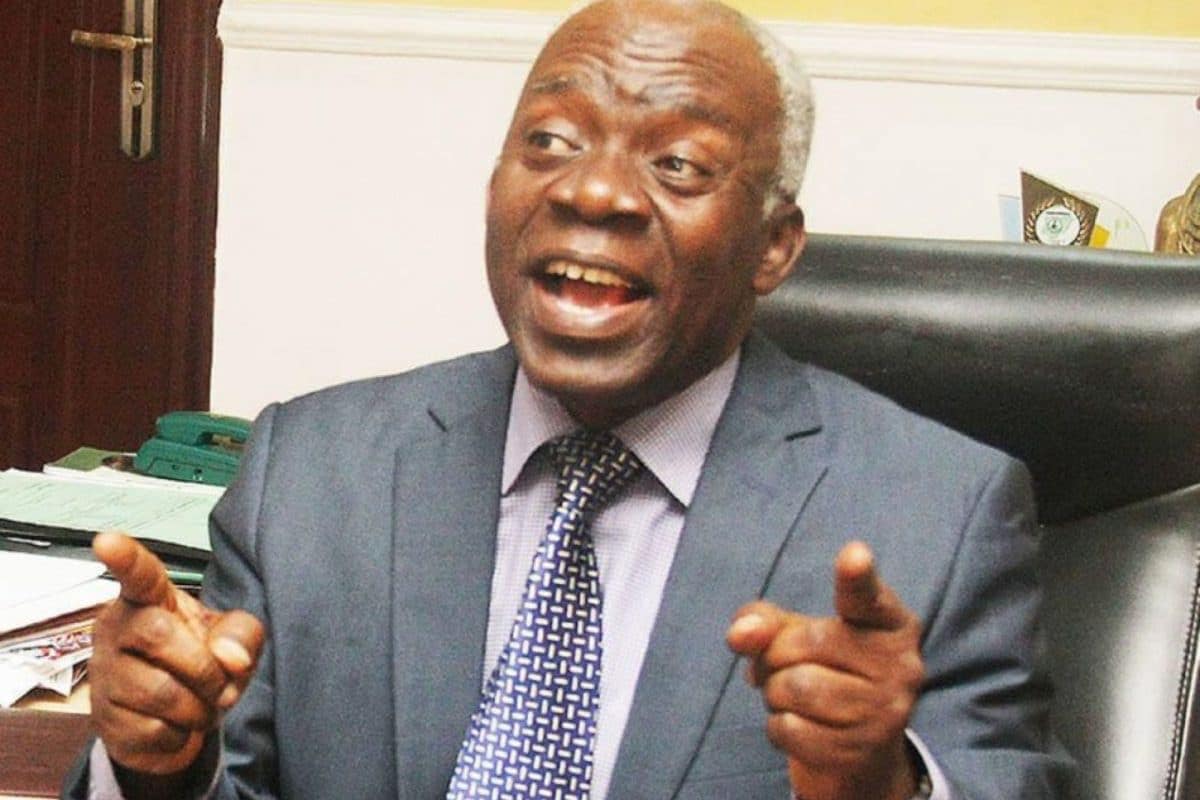
Human rights lawyer and Senior Advocate of Nigeria (SAN), Femi Falana, has called on the Federal Government to ensure that the death of Mary Habila, a domestic worker in the household of the Minister of Works, David Umahi, is thoroughly investigated, warning that the case must not be swept under the carpet.
Falana also urged the authorities to ensure that the death of Babatunde Tanimola and other suspicious deaths linked to political violence are investigated transparently, stressing that every Nigerian has a constitutional right to life and justice.
The senior lawyer made the call in a statement issued on Monday titled, “These Deaths Must Not Be Swept Under the Carpet.”
He specifically urged the Inspector-General of Police to take over the investigation into Habila’s death and called for the immediate conduct of an autopsy to establish the cause of death.
According to Falana, the circumstances surrounding the deaths have raised serious public concerns that can only be addressed through independent and transparent investigations.
“The right to life is the most basic human right. Without it, other rights cannot be enjoyed by any person. On account of the sanctity of human life, the following cases of suspicious deaths must be thoroughly investigated,” he said.
Mary Habila, who reportedly worked as a domestic staff member in the household of Works Minister David Umahi, was found dead on June 27, 2026, in a room at the minister’s country home in Uburu, Ohaozara Local Government Area of Ebonyi State.
Reports indicated that she was found unclothed, a development that triggered widespread public attention and calls for an impartial investigation into the circumstances surrounding her death.
The incident generated intense reactions on social media and among civil society groups, with many demanding that the authorities ensure a thorough investigation free from political influence.
Responding to the controversy, Umahi has consistently denied allegations of foul play or any attempt to cover up the incident.
The minister has maintained that Habila had an existing medical condition and that the matter was promptly reported to the police for investigation.
However, Falana questioned aspects of the handling of the case, saying some actions taken after the incident could affect the integrity of the investigation.
According to him, the minister admitted handling the deceased’s mobile phone after her death in order to speak with her boyfriend.
Falana argued that such an action amounted to contamination of the scene and could complicate ongoing investigations.
“Even though the Minister has denied any foul play or cover-up, stating she had an existing medical condition and that the matter was reported to the police, the minister contaminated the scene of the incident by handling her phone to speak with her boyfriend,” he said.
The senior lawyer also expressed concern over the delay in conducting an autopsy despite the body remaining in the custody of the authorities.
He noted that Habila’s father had earlier filed a sworn affidavit rejecting an autopsy and requesting that his daughter’s body be released for burial.
According to Falana, while the Nigeria Police Force declined the father’s request, it has yet to explain why an autopsy has not been carried out.
“In a sworn affidavit, the father of the deceased rejected an autopsy and requested the release of the body for burial. While the authorities of the Nigeria Police Force have turned down the request of the father of the deceased, they have failed to explain the delay in carrying out the autopsy,” he said.
Falana maintained that an autopsy remains a critical part of any suspicious death investigation and should be conducted without unnecessary delay to establish the actual cause of death.
He therefore called on the Inspector-General of Police to personally take over the investigation to ensure public confidence in the outcome.
The human rights lawyer also extended his concerns to the death of Babatunde Tanimola and other politically related killings in Osun State, urging security agencies to ensure that those responsible are identified and prosecuted.
He stressed that no suspicious death should be ignored because of the status or influence of those connected to the case.
According to him, the credibility of Nigeria’s justice system depends on the willingness of law enforcement agencies to investigate every case professionally and without interference.
Falana said Nigerians deserve assurance that all citizens are equal before the law and that no individual is above investigation where questions arise over a suspicious death.
The death of Mary Habila has remained one of the most widely discussed incidents in recent weeks, attracting attention from rights groups, lawyers and members of the public.
Many have called for transparency in the investigation, while others have urged the authorities to avoid actions that could undermine public confidence in the criminal justice process.
The case has also renewed conversations about the importance of preserving crime scenes, conducting timely forensic examinations and ensuring that investigations involving prominent public officials are handled independently.
With Falana’s latest intervention, pressure is expected to mount on the Nigeria Police Force and other relevant authorities to conclude investigations promptly and make their findings public.
The senior lawyer insisted that the protection of the right to life requires not only preventing unlawful deaths but also ensuring that every suspicious death is investigated thoroughly, fairly and without fear or favour.