
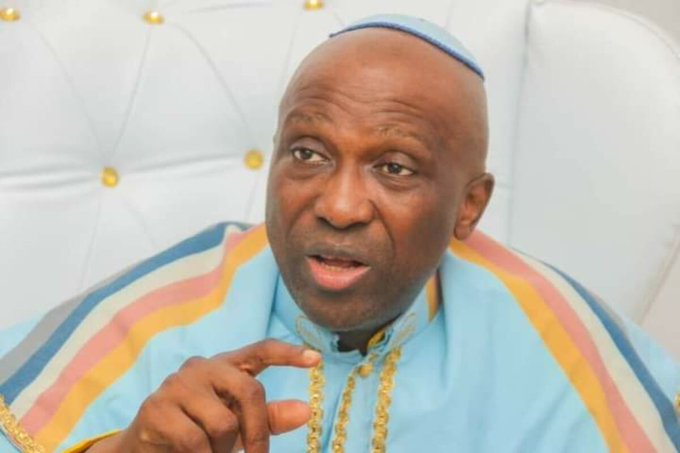
Primate Elijah Ayodele, the leader of INRI Evangelical Spiritual Church, has claimed that President Bola Tinubu may relocate Nigeria’s capital from Abuja to Lagos if he wins the 2027 presidential election.
Ayodele made the claim in a video posted on X while speaking about the 2027 general elections and Tinubu’s bid to secure another term in office.
According to the cleric, major changes would take place in Lagos if Tinubu wins the election, including the possible relocation of the nation’s capital.
“Lagos architecture will change. You may not see this one very seriously, but if Tinubu wins the second time, the capital of Nigeria will be relocated to Lagos,” Ayodele said.
He added that the capital could be located in any part of Lagos State, mentioning Epe and Lekki as possible locations.
“When this happens, the capital can be in Epe or Lekki or anywhere at all in Lagos,” he said.
The claim comes as political activities ahead of the 2027 general elections continue to gather momentum across the country.
Tinubu, who was elected president in 2023 on the platform of the All Progressives Congress, is expected to seek re-election in 2027. The APC has also been making preparations for the next presidential contest, although the party’s formal nomination process for the election is yet to take place.
If Tinubu contests and wins, he would serve a second four-year term, subject to the constitutional limit of two terms for a president.
The issue of Nigeria’s capital has historically been tied to the country’s political and administrative development.
Abuja became Nigeria’s capital in December 1991, replacing Lagos. The decision to move the capital was formally announced in 1976 under the military government of General Murtala Mohammed.
The move was driven by several factors, including the desire to establish a capital that was more centrally located and less identified with any particular ethnic or regional group.
Lagos, Nigeria’s former capital, remains the country’s largest commercial centre and one of its most important economic hubs. It is home to major financial institutions, businesses, industries, ports and a large population.
Abuja, on the other hand, serves as the political and administrative centre of the country. It houses the Presidential Villa, National Assembly, Supreme Court, ministries, departments and agencies, as well as many diplomatic missions.
The relocation of the capital from Abuja back to Lagos would therefore be a major political and administrative decision requiring extensive planning and significant resources.
Such a move would also have implications for government institutions, diplomatic missions, businesses, infrastructure and millions of Nigerians who live and work in Abuja.
However, Ayodele did not provide details on how such a relocation would be carried out or whether any government plan exists to move the capital.
There has also been no official statement from the Presidency or the Federal Government confirming any plan to relocate the capital from Abuja to Lagos.
The cleric’s statement should therefore be regarded as a prediction rather than an announcement of government policy.
Ayodele has regularly made predictions on political, economic and social issues in Nigeria. His statements have often attracted public attention, particularly when they concern elections and major political figures.
The 2027 election is already shaping up as a major political contest, with political parties and politicians positioning themselves ahead of the poll.
The election will also be the first presidential election since the 2023 poll and is expected to attract strong competition from the ruling APC and opposition parties.
Tinubu’s administration has been pursuing several economic and infrastructure reforms since assuming office in May 2023. Some of the policies have generated both support and criticism, particularly over their effects on the cost of living and the economy.
The President has also maintained strong political links with Lagos, where he served as governor from 1999 to 2007 and built a strong political base.
His long association with Lagos has made the state an important part of discussions about his political career.
Lagos has continued to expand rapidly, with major projects in transport, housing, technology and urban development. The state is also home to the country’s busiest commercial activities and remains a major gateway for international trade.
Despite this importance, Abuja remains the legally established seat of the Federal Government.
Any decision to change the capital would therefore require more than a political declaration and would involve major constitutional, legal, administrative and financial considerations.
For now, there is no indication from the Federal Government that Abuja’s status as Nigeria’s capital is under review.