
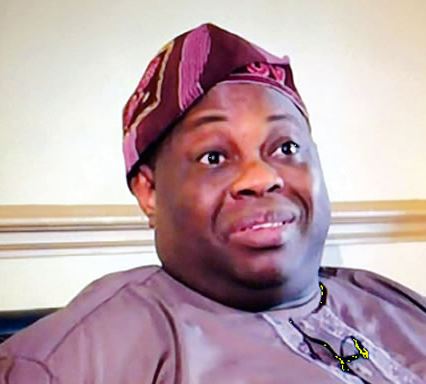
Publisher and former presidential candidate, Dele Momodu, has said he would give strong support to President Bola Tinubu if his administration practised the democratic principles they fought for during the military era.
Momodu, however, warned that he would not support any attempt to replace military dictatorship with what he described as civilian dictatorship.
The publisher made the statement during an interview on Arise TV on Thursday while discussing his relationship with Tinubu, his criticisms of the President’s administration and the political direction of the country ahead of the 2027 general elections.
Momodu said his criticism of Tinubu was based mainly on his concern about the need to protect democracy and ensure that Nigerians do not return to a system in which citizens are denied their rights.
He said he would go to great lengths to support Tinubu if the President remained committed to the democratic values for which they fought during the military years.
“I will ordinarily swim to the depth of the Atlantic Ocean for Tinubu if he was practising what we fought against when we were fighting the military,” Momodu said.
“There is no earthly reason why I would not, but I would be a bloody hypocrite if after we claimed to have changed the way of military dictatorship, we now replace it with civilian dictatorship. That’s my only problem with him.”
Momodu said he had great respect for Tinubu despite his disagreements with the President’s policies and political decisions.
He stressed that his criticism was not based on personal hatred and said he would not join people who insulted the President.
“Everything else, you see, when they are abusing him, you won’t see me abusing him. I have tremendous regards for him,” he said.
According to Momodu, Tinubu played an important role in shaping his political outlook and taught him to challenge those in authority when necessary.
He said the President was among the people who helped develop his courage to confront powerful institutions.
“He was one of those who trained me and instilled in me this kind of discipline that, look, you can take on the establishment and win. And he did win,” Momodu said.
The publisher also acknowledged Tinubu’s political achievements, particularly his rise from Lagos politics to the national stage.
“And that is why that was the record he carried from Lagos as a local champion to a national champion,” he said.
Momodu and Tinubu have known each other for more than three decades, with their relationship linked to Nigeria’s struggle against military rule in the 1990s.
Both men were involved in the pro-democracy movement that followed the annulment of the June 12, 1993 presidential election won by the late Chief Moshood Abiola.
The election, widely regarded as one of Nigeria’s freest and fairest polls at the time, was annulled by the military government headed by General Ibrahim Babangida.
The annulment triggered widespread protests and a prolonged campaign for the restoration of the democratic mandate.
Tinubu, who was then a serving senator, became one of the founding members of the National Democratic Coalition, commonly known as NADECO, which opposed military rule and demanded the restoration of democracy.
Momodu was also active in the struggle. He had worked for Abiola’s presidential campaign before the election was annulled and later faced detention over his support for the June 12 cause.
The political crisis deepened after the late General Sani Abacha seized power in 1993 and intensified the crackdown on pro-democracy activists, journalists and other opponents of military rule.
Tinubu left Nigeria in 1994 and spent several years in exile in the United Kingdom and the United States.
Momodu also left the country during the period, travelling through the Benin Republic, Togo and Ghana before eventually settling in the United Kingdom.
The exile experience became an important part of the history of Nigeria’s pro-democracy struggle, as several activists and political figures were forced to leave the country because of pressure from the military government.
Abacha died in 1998, paving the way for a political transition and the eventual return of democratic rule in 1999.
Tinubu returned to Nigeria and later became governor of Lagos State from 1999 to 2007. He went on to become a major figure in the formation and development of the APC before emerging as the party’s presidential candidate and winning the 2023 election.
Momodu, meanwhile, continued his career as a publisher, journalist and political activist. He contested the 2011 presidential election under the platform of the National Conscience Party.
Since Tinubu became President in 2023, Momodu has increasingly criticised the administration, particularly its economic policies and political decisions.
Despite the disagreements, he has repeatedly acknowledged his long relationship with Tinubu and the role the President played in shaping his political consciousness.
Momodu’s latest comments come as political activities ahead of the 2027 elections intensify.
The former presidential candidate has become active in opposition politics and has aligned himself with the African Democratic Congress, which is positioning itself as one of the platforms seeking to challenge the ruling APC in 2027.
The 2027 election is expected to attract a strong contest as political parties and opposition groups continue consultations and efforts to build alliances.
For Momodu, however, the central issue remains the protection of democratic values.
His comments also reflect a wider debate in Nigeria over the quality of democracy since the return to civilian rule in 1999.
While Nigeria has held regular elections and experienced several changes of government through the ballot box, political actors and civil society groups have continued to raise concerns about issues such as abuse of power, electoral irregularities, restrictions on political opposition and the weakening of democratic institutions.
Momodu’s position is that the struggle against military rule should not end simply with the departure of soldiers from government. He argued that civilian leaders must also respect democratic principles and the rights of citizens.
His comments therefore combine criticism of Tinubu with an acknowledgement of their shared history and the President’s influence on his political development.
The statement is also likely to fuel discussions within opposition circles, where Momodu has remained an active voice ahead of the 2027 election.
For now, Tinubu remains the incumbent President and is expected to seek another term on the platform of the APC.