
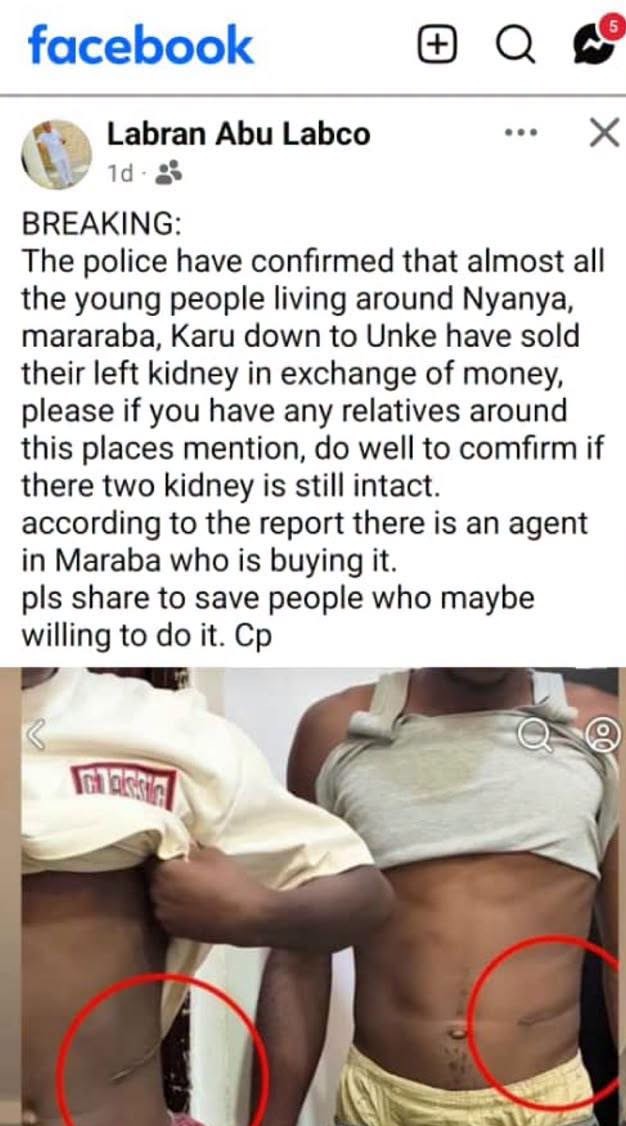
The Federal Capital Territory Police Command has dismissed reports circulating on social media claiming that almost all young residents of Mararaba, Nyanya, Karu and other communities in and around the nation’s capital have sold their kidneys to organ traffickers.
The command said it neither received nor confirmed any report supporting the claim and warned residents against spreading unverified information capable of causing fear and panic.
The police reaction followed a viral Facebook post by a user identified as Labran Abu Labco, who claimed that the police had confirmed that almost all young people living in Mararaba, Nyanya, Karu and other parts of the FCT had sold their kidneys “in exchange for money”.
The post also alleged that an agent living in Mararaba had been buying human kidneys.
The claims quickly attracted attention on social media, with some users expressing concern over the alleged scale of organ trafficking and the safety of young people living in the affected communities.
However, the FCT Police Command said there was no official confirmation of the allegations.
In a statement issued on Wednesday, the command’s Public Relations Officer, SP Josephine Adeh, said the police had not received any report of the alleged kidney sales.
The command also denied issuing any statement or communication confirming the claims.
“The FCT Police Command has neither received nor confirmed any report of such nature,” Adeh said.
She added that “no statement or communication to that effect has emanated from the Command”.
The police spokesperson urged members of the public to disregard the publication and stop circulating information that had not been verified by the relevant authorities.
According to the command, the spread of such claims could create unnecessary fear and anxiety among residents and make it difficult for members of the public to distinguish genuine security alerts from false information.
The police also called on residents to exercise caution when sharing information on social media, particularly reports involving serious crimes and public safety.
The command said people who come across information about alleged criminal activities should report directly to the police instead of relying on social media posts or forwarding unverified claims.
It also encouraged anyone with genuine information about alleged human organ trafficking, or any other security concern within the FCT, to contact the nearest police station.
“Anyone with information regarding the alleged human organ trafficking, or any other security concern within the FCT, should promptly report the same to the nearest Police Station,” the command said.
Organ trafficking is a serious crime involving the illegal removal, sale or purchase of human organs. It is closely linked to other forms of organised crime and can involve the exploitation of vulnerable people.
Because of the seriousness of such crimes, allegations of organ trafficking often generate strong public concern. However, the police stressed that claims of this nature must be properly investigated and verified before being presented as facts.
The latest incident also highlights the growing challenge posed by misinformation and unverified reports on social media.
Platforms such as Facebook, WhatsApp, X and other social networks have become major sources of information for many Nigerians. While they allow people to receive and share information quickly, false claims can also spread rapidly before authorities have the opportunity to investigate them.
Security agencies have repeatedly advised members of the public to verify information before sharing it, especially when such information concerns kidnapping, terrorism, organ trafficking, communal violence or other serious crimes.
In the case of the kidney trafficking allegation, the FCT Police Command said there was no basis for attributing the claim to the police.
Mararaba, Nyanya and Karu are densely populated communities located around the FCT and neighbouring areas. They are home to large numbers of workers, students, traders and other residents who travel daily between their communities and Abuja.
Because of their large populations and close links to the Federal Capital Territory, reports of a major criminal operation in the areas are capable of generating widespread concern.
The police therefore urged residents not to allow unverified social media reports to create unnecessary panic.
The command’s clarification does not prevent members of the public from reporting genuine concerns about possible organ trafficking. Rather, it encourages anyone with direct information or evidence to approach law enforcement authorities so that the allegations can be investigated.
Residents with information about suspected criminal activities can provide details to the police, including the location of the alleged activity and any other useful information that could assist investigators.
The police said such reports should be made promptly so that appropriate action can be taken.
The development comes amid wider concerns about criminal activities and the spread of false information in Nigeria. Authorities have increasingly warned that misleading reports can undermine public confidence, create fear and divert security agencies from genuine threats.
The FCT Police Command has therefore urged residents to rely on official sources for confirmation of major security-related reports.
For now, the command has made it clear that it did not confirm the claim that almost all young residents of Mararaba, Nyanya, Karu and other parts of the FCT had sold their kidneys.
It also denied that any official police statement had linked an agent in Mararaba to the alleged purchase of human kidneys.
The command’s position is that anyone who has evidence of organ trafficking should report it directly to the police for investigation rather than spreading unverified claims online.