
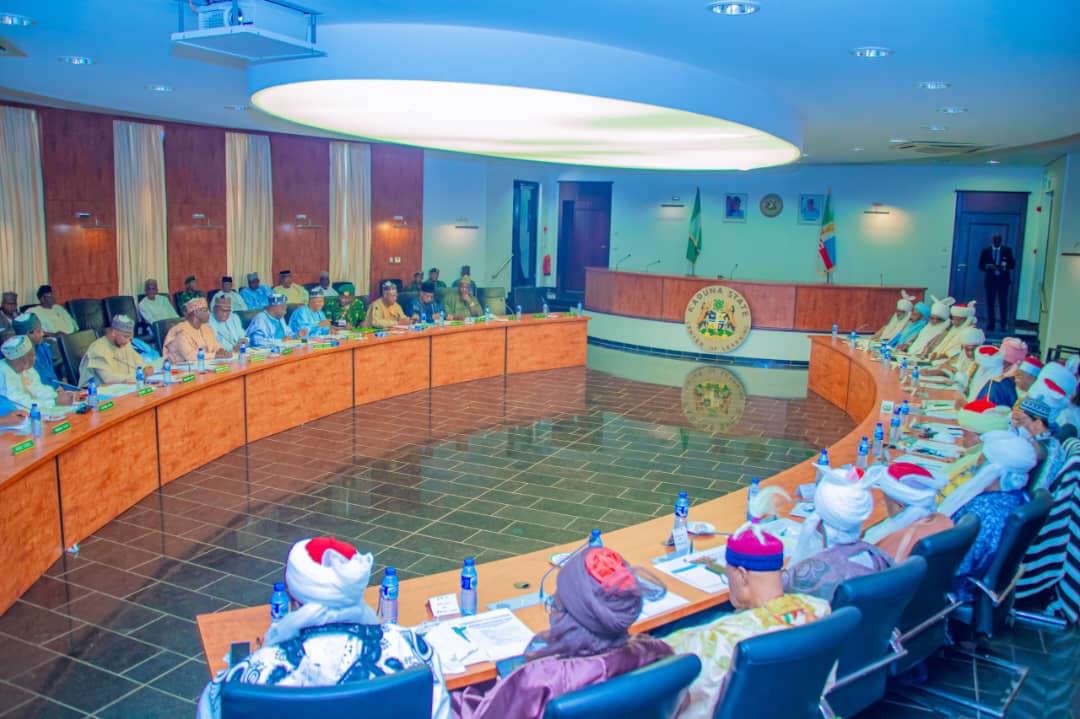
The Arewa Civil Rights Movement (ACRM) has voiced strong criticism against the Northern Governors Forum for opposing President Bola Tinubu’s tax reform bills currently before the National Assembly.
The Northern Governors’ stance has ignited debate, with ACRM claiming their opposition will hinder progress in tax reform and investment in Nigeria.
The four tax bills under scrutiny include the Nigeria Tax Bill 2024, the Tax Administration Bill, the Nigeria Revenue Service Establishment Bill, and the Joint Revenue Board Establishment Bill.
Each of these bills is designed to streamline tax collection, promote federal revenue sharing, and encourage economic growth across all states.
However, a key source of controversy is the proposed Value Added Tax (VAT) sharing structure, which reduces the Federal Government’s share from 15% to 10% while introducing an allocation formula based on the “derivation principle.”
This change aims to encourage states to attract businesses by allowing them to retain a higher percentage of taxes from companies within their territories.
The Northern Governors argue this would place their states at a disadvantage since many major companies are headquartered in the south, which would benefit more from the proposed formula.
Dr. Agabi Emmanuel, National President of ACRM, called the Governors’ objections “disingenuous” and said they undermine efforts to create an investment-friendly atmosphere in the north.
“This is a wake-up call for northern states to build a business-friendly climate,” Dr. Emmanuel stated at a press briefing in Abuja on Wednesday.
“The governors cannot rely on sectarian extremism that discourages investment and then expect corporations to locate their headquarters in their states.”
The ACRM took issue with the Governors’ directive to lawmakers to reject the bills, arguing that this oversteps their authority and paints the northern region in a negative light.
“Our movement is concerned with the far-reaching consequences of this ill-conceived directive,” Dr. Emmanuel said.
According to the ACRM, the Governors’ directive not only risks portraying the north as unwilling to support tax compliance but also creates an impression that the region is too economically weak to handle the proposed tax reforms.
“This rejection paints the north in a beggarly light, implying that we are unwilling to contribute to the tax system,” he added.
The movement went on to argue that northern governors should focus on managing their states’ finances, particularly given the substantial allocations they receive from the Federation Account.
ACRM also criticized the governors’ approach, suggesting they focus on pressing issues like revenue generation rather than hindering national tax reform efforts.
“We urge the Northern Governors to concentrate on the excess earnings from the Federation Account since they assumed office,” Emmanuel stated, pressing for accountability on how funds are spent.
Emmanuel further stated that northern governors should reassess the sectarian policies in their states, which discourage businesses from setting up in the region.
“If northern lawmakers follow the governors’ lead and reject these bills, they may face calls for recall by their constituents,” he warned.
The ACRM emphasized that federal lawmakers are ultimately accountable to their constituents, not to state governors.
“Our lawmakers serve the people, not individual governors,” Emmanuel said, calling for lawmakers to disregard the governors’ directive and focus on national development.
The ACRM contended that the governors’ rejection of the bills reflects a long-standing pattern of regional reliance on federal resources rather than fostering independent revenue sources.
“The governors’ stance validates allegations of rubber-stamp parliaments in the states, controlled by governors,” Dr. Emmanuel argued, adding that this control infringes on democratic principles.
At the press conference, ACRM voiced their conviction that this is an opportunity for the north to demonstrate leadership by welcoming the reforms.
“These reforms could incentivize states to increase local business development and enhance self-reliance,” Emmanuel emphasized.
The organization called on northern lawmakers to consider the wider benefits of the proposed tax reforms, not just the short-term regional impact.
The ACRM’s message to the northern leaders was unequivocal: they should either support the tax bills and foster economic progress or risk backlash from the people.
In closing, the ACRM called for an end to sectarian extremism and a renewed commitment to attracting investment, saying this is essential for the region’s prosperity.
The group highlighted that northern Nigeria has historically upheld a strong tradition of tax compliance and that the current stance contradicts this heritage.
“Our leaders must show that the north is ready to contribute to Nigeria’s progress and that we are not reliant solely on federal allocations,” Emmanuel said.
The Northern Governors Forum has yet to respond to the ACRM’s criticisms, but their position remains a topic of heated debate.
With the bills still pending in the National Assembly, this rift between ACRM and the Northern Governors represents a pivotal moment in Nigeria’s fiscal policy development.
As lawmakers consider the bills, the spotlight remains on whether northern representatives will follow their governors or heed ACRM’s call for independent decision-making.