
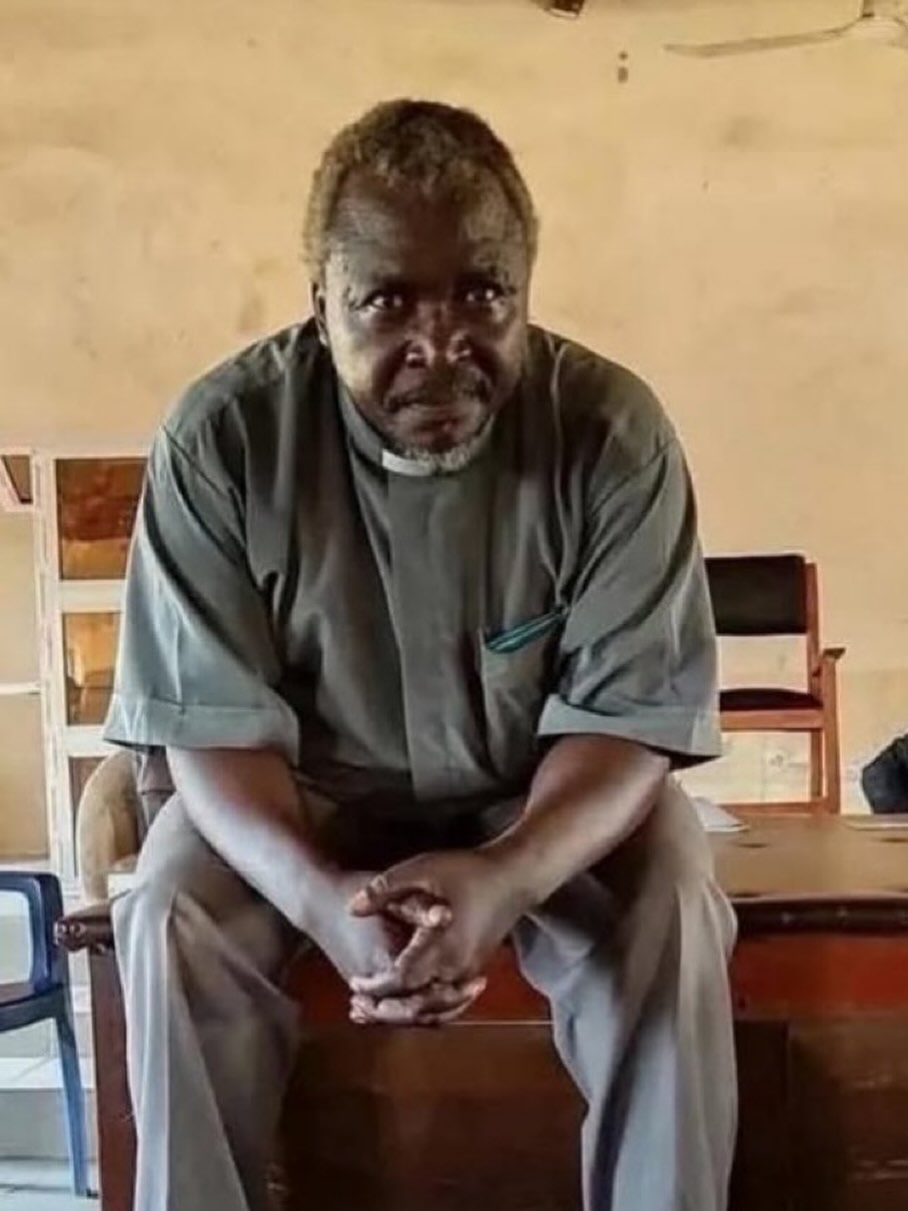
A prominent Plateau State cleric, Reverend Ezekiel Dachomo, has vowed to take the Federal Government of Nigeria before the International Criminal Court (ICC) over what he described as the targeted killing of Christians in Plateau State and other parts of northern Nigeria.
Rev. Dachomo, who is the Regional Chairman of the Church of Christ in Nations (COCIN) in Barkin Ladi Local Government Area, made the announcement in a statement shared on his social media page on Monday.
He accused both the Nigerian government and the Christian Association of Nigeria (CAN) of ignoring the widespread killings and destruction of churches across the Middle Belt region.
“The world needs to know that what we are saying is not false. I will go to any length to prove that this government is lying,” he declared.
“We are planning to take Nigeria before the International Criminal Court and also sue the Miyetti Allah association for their role in these atrocities.”
According to Rev. Dachomo, he has already compiled detailed records of killings, burnt churches, and displaced families from attacks dating as far back as 2010.
The cleric said his team has been documenting incidents across Plateau and other parts of the Middle Belt, collecting testimonies from survivors, photographs of mass graves, and burial sites to be presented before international authorities.
He said the report will be submitted to both the ICC and the United States government, calling for global action against those responsible.
“Hundreds of lives have been lost in attacks on Plateau villages that were never documented, and many victims remain unaccounted for,” he said.
The cleric also revealed that concerned Nigerians and international donors have started contributing funds to support the legal process and humanitarian relief for victims.
“Some individuals and organisations have started donating money for this cause and to help families affected by these attacks,” he said.
Rev. Dachomo drew attention to the recent mass burial of 17 people in Heipang District of Plateau State following another attack by suspected armed herders.
He said the attack bore the same pattern as previous incidents, describing it as evidence of a “Christian genocide,” despite official denials by the federal government and the presidency.
“The recent mass burial in Heipang shows again that Christians are being targeted,” he said.
“Yet, the government keeps denying this reality while communities continue to mourn their dead.”
He also cited previous attacks, including the 2010 Dogo Nahawa massacre in Jos South Local Government Area, where over 500 people were reportedly killed overnight by suspected armed herders.
“Because of my outcry over these killings, my own village has been attacked several times,” he recounted.
“Over 50 people, including my family members and friends, have been killed. My best friend’s wife and five children were burned alive.”
The Plateau cleric condemned what he described as the “shameful silence” of both the government and Christian leaders, saying their refusal to acknowledge the scale of the killings has emboldened the attackers.
“Since the Federal Government claimed there was no genocide, that statement has pushed me to intensify this work,” he said.
“CAN is also denying the genocide, so I’m determined to prove them wrong.”
According to him, his mission is not only about justice but also about ensuring that victims are not forgotten.
“I am travelling from one community to another to document Christian killings because many of the affected villages were never recorded,” he said.
“In Jaruwa, worshippers were burnt alive during a church service. None survived because the terrorists surrounded the building, set it on fire, and trapped everyone inside.”
Plateau State has been one of the flashpoints of religious and ethnic violence in Nigeria for more than two decades.
The state, located in the Middle Belt region, has witnessed repeated clashes between farming communities (mostly Christian) and herders (mostly Fulani Muslims) over land, grazing routes, and political representation.
In March 2010, the Dogo Nahawa massacre shocked the nation when armed men attacked the community at night, killing hundreds, including women and children.
Since then, attacks on villages in Barkin Ladi, Riyom, Mangu, and Bokkos have continued, leading to thousands of deaths and displacements.
Although the Nigerian government has consistently maintained that the violence is not religious but communal and criminal, many Christian leaders argue that the attacks have taken on a targeted pattern against Christian communities.
The Federal Government has repeatedly denied allegations of Christian persecution or genocide.
Officials insist that insecurity in Nigeria affects people of all religions and ethnic groups. The government blames the violence on bandits, terrorists, and criminal gangs operating across the North-Central and North-West regions.
In 2024, the Nigerian government also rejected a report from some foreign organisations that described the killings as “religious cleansing,” calling such claims “false and politically motivated.”
However, global watchdogs such as Open Doors International and the U.S. Commission on International Religious Freedom (USCIRF) have repeatedly listed Nigeria among countries where Christians face severe persecution.
These groups cite frequent attacks on churches, kidnappings of clergy, and destruction of Christian villages as signs of worsening religious intolerance.
The International Criminal Court (ICC), based in The Hague, Netherlands, is responsible for prosecuting cases of genocide, war crimes, and crimes against humanity.
In the past, the ICC has investigated similar cases in Sudan, the Central African Republic, and the Democratic Republic of Congo.
If Rev. Dachomo’s petition is formally submitted, the court will be expected to review the evidence before deciding whether to open an investigation.
While reactions to Rev. Dachomo’s statement continue to spread, some Christian leaders in Plateau have expressed support for his plan, saying it may draw global attention to the plight of victims.
Others, however, have called for dialogue and reconciliation, warning that international legal action could deepen divisions and worsen tensions.
Community leaders have urged the government to step up efforts to secure rural communities, provide justice for victims, and prevent further killings.
Human rights activists have also called for transparent investigations into all attacks, regardless of the victims’ religion.