
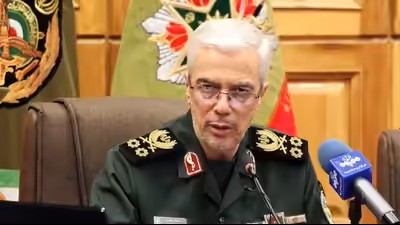
Fresh tension has gripped the Middle East following reports that General Amir Hatami, described by Israeli media as Iran’s army chief, has been killed in a series of Israeli air strikes on Tehran.
The strikes, which reportedly began on February 28, targeted several locations in the Iranian capital. Loud explosions were heard across Tehran, with blasts also reported in other parts of the country. However, Iranian authorities had not officially confirmed the death of Hatami as of the time of filing this report.
Israeli media outlets claimed that Hatami was “eliminated” during the attacks. He had previously served as Iran’s Minister of Defense and was a senior figure in the country’s military establishment.
There has been no immediate official statement from the Iranian government confirming his death. The lack of confirmation has added to uncertainty, even as tensions continue to rise.
The reported killing comes amid ongoing hostility between Iran and Israel, two long-time regional rivals. The two countries have been engaged in what analysts often describe as a shadow war for years, involving cyberattacks, air strikes, and proxy conflicts across the Middle East.
Israel has repeatedly accused Iran of supporting armed groups hostile to it, including Hezbollah in Lebanon and other factions in Syria and Gaza. Iran, in turn, has condemned Israel’s actions in the region and has often warned of retaliation against Israeli targets.
Hatami was known for making strong statements against Israel. In past speeches, he reportedly threatened to destroy major Israeli cities such as Tel Aviv and Haifa if Iran were attacked. Such remarks had drawn attention in Israeli media and among Western governments.
If confirmed, his death would mark a major escalation in the long-running conflict between the two countries.
Witnesses in Tehran reported hearing multiple explosions across the city. Social media videos showed plumes of smoke rising from different districts, although the exact targets were not immediately clear.
Iranian state media acknowledged that explosions had occurred but did not provide detailed information about casualties or specific locations that were hit.
Military analysts say that if Israel carried out direct strikes in Tehran, it would represent one of the boldest actions taken against Iran in recent years.
In the past, Israel has conducted air strikes against Iranian-linked targets in Syria, but direct attacks inside Iran have been rare and often covert.
The reported strikes have drawn concern from the international community. Middle East experts warn that open military confrontation between Iran and Israel could lead to a wider regional conflict.
Countries in the Gulf region, already dealing with security concerns and economic challenges, are closely watching developments. Oil markets also reacted nervously, as any disruption in the region could affect global energy supplies.
The United Nations has in the past urged both sides to exercise restraint. Western governments, including the United States and European Union members, have repeatedly called for calm to prevent further escalation.
At the time of writing, there was no official confirmation from Israel’s government regarding the specific targets of the strikes or the reported killing of Hatami.
Iran has one of the largest military forces in the Middle East. Its armed forces include the regular army and the Islamic Revolutionary Guard Corps (IRGC), both of which play significant roles in national defence and regional operations.
Senior military figures in Iran are often seen as powerful political actors as well. The reported death of such a high-ranking officer could have serious political and military consequences within the country.
In 2020, the killing of Iranian General Qassem Soleimani in a US drone strike led to heightened tensions and retaliatory missile attacks. Observers say a similar situation could unfold if Iran confirms the death of Hatami and chooses to respond.
Residents of Tehran have expressed fear as explosions echoed through the city. Schools and offices in some areas were reportedly closed as a precaution. Families rushed to secure safe locations, while emergency services were seen moving through affected districts.
There are concerns that further strikes or retaliatory attacks could put civilian lives at risk. Tehran is home to more than eight million people, making it one of the largest cities in the region.
The hostility between Iran and Israel dates back decades. Since the 1979 Islamic Revolution in Iran, relations between the two countries have been openly hostile. Iran does not recognize Israel as a state and has supported groups opposed to Israeli policies.
Israel, on its part, views Iran’s nuclear program and regional influence as major security threats. Israeli leaders have repeatedly said they will not allow Iran to develop nuclear weapons.
The latest reported strikes come at a time when diplomatic efforts to revive talks over Iran’s nuclear programme have faced difficulties. Increased military tension could further complicate those efforts.
Much now depends on whether Iran confirms the reported killing of Hatami and how it chooses to respond. If retaliation follows, the situation could escalate quickly.
For Nigeria and other countries far from the Middle East, the crisis still matters. Instability in the region can affect global oil prices and economic stability. Nigeria, as an oil-producing country, often feels the impact of shifts in global energy markets.
As of now, the world waits for official confirmation from Tehran and further details from Israeli authorities. Until then, the reports remain claims from Israeli media, with the full picture still unfolding.

