
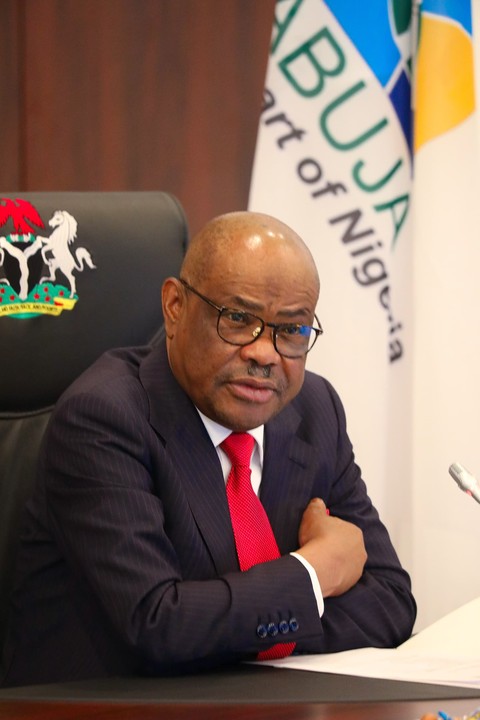
The Minister of the Federal Capital Territory (FCT), Nyesom Wike, has cautioned residents of the Abuja Municipal Area Council (AMAC) to be careful of what he described as “emergency human rights activists and democrats.”
Wike gave the warning on Wednesday evening during a thank-you visit to AMAC following the February 21 FCT Area Council elections. He addressed party leaders, council officials, youths and women at the gathering.
According to him, some politicians only identify with the people when it suits their political ambitions. He said such individuals often disappear once they achieve their aims.
“Be careful of emergency human rights activists. Be careful of emergency democrats,” Wike told the crowd. He stressed that leadership should be about steady commitment, not seasonal promises made during election periods.
The minister’s visit came after the recently concluded area council elections in the FCT, where chairmen and councillors were elected across the six area councils. The elections are important because the area councils serve as the closest level of government to residents in the capital territory.
Wike said the visit was to appreciate the people of AMAC for their support and to reassure them of his administration’s commitment to development.
During his speech, Wike recalled an earlier town hall meeting held in the FCT at the directive of President Bola Tinubu. At that meeting, residents were invited to nominate projects that would directly impact their communities.
He explained that one of the projects nominated by residents of the area was the Saburi road. According to him, the road has now been completed and commissioned.
“One of the projects that this area nominated was the Saburi road. To the glory of God, that road has been commissioned. Is it not?” he asked, as the crowd responded in agreement.
The minister said the completion of the Saburi road showed that the current administration listens to the people and fulfils promises. He urged residents not to allow what he described as deceptive politics to return.
Road infrastructure has remained a major challenge in parts of the FCT, especially in satellite towns and rural communities. While Abuja city centre has modern roads and facilities, many communities in the area councils still struggle with poor road networks, especially during the rainy season.
Wike also spoke about the Apo-Karshi road project. He said the contract for the road was first awarded in 2010 but was abandoned for many years.
“That road has been awarded since 2010. But I said before the end of this year, we will finish that road,” he promised.
The Apo-Karshi road connects communities on the outskirts of Abuja and serves as an important link for farmers, traders and workers who travel daily into the city. Residents have often complained about its poor state and the hardship it causes.
Since his appointment as FCT Minister in 2023, Wike has focused strongly on infrastructure projects. Several road projects in Abuja have either been completed or revived under his leadership. The minister has repeatedly said that development must not be limited to the city centre but must also reach communities in the area councils.
He told the AMAC residents that democracy requires mutual commitment between leaders and the electorate. According to him, when agreements are reached with communities, they must be honoured.
“When you are happy, we are happy. When you are not happy, we cannot be happy. Because we are here for you,” he said.
Beyond roads and infrastructure, Wike addressed a long-standing issue affecting many indigenous communities in the FCT — land ownership and documentation.
He assured youths and community leaders that issues surrounding land documentation would receive serious attention. In particular, he promised to work towards ensuring that indigenous communities receive Certificates of Occupancy (CofO) for their ancestral lands.
“I know how land is, and I will do everything possible to see that your communities have Certificates of Occupancy,” he said.
Land matters have remained sensitive in the FCT since Abuja became Nigeria’s capital in 1991. When the territory was created in 1976, land was acquired from indigenous communities to allow for the development of the new capital. Over the years, disputes have arisen over compensation, relocation and land rights.
Many indigenous residents have complained that they lack proper land documents, making them vulnerable to eviction or land disputes. The promise of issuing Certificates of Occupancy is therefore significant, as it would provide legal recognition of ownership.
Under Nigerian law, a Certificate of Occupancy is an official document that proves a person or community has legal rights to a piece of land. Without it, landowners may face difficulties defending their property in court or accessing loans from financial institutions.
Wike’s assurance is likely to be welcomed by many communities who have long demanded better protection of their ancestral lands.
The minister also said President Tinubu expects FCT officials to remain accessible and responsive to grassroots communities. He noted that leadership should not be distant from the people.
In recent years, residents of the area councils have demanded more attention to basic needs such as roads, schools, healthcare and water supply. They have also called for greater inclusion in decision-making processes.
Wike used the occasion to urge residents to elect representatives who understand their challenges and remain accountable beyond election periods. He encouraged the people to reject leaders who only appear during campaigns.
As the FCT continues to expand due to population growth, pressure on infrastructure and land is expected to increase. This makes issues such as road construction and land documentation even more urgent.
For many residents at the AMAC gathering, the minister’s promises offered hope. However, some observers note that the real test will be in implementation.

