
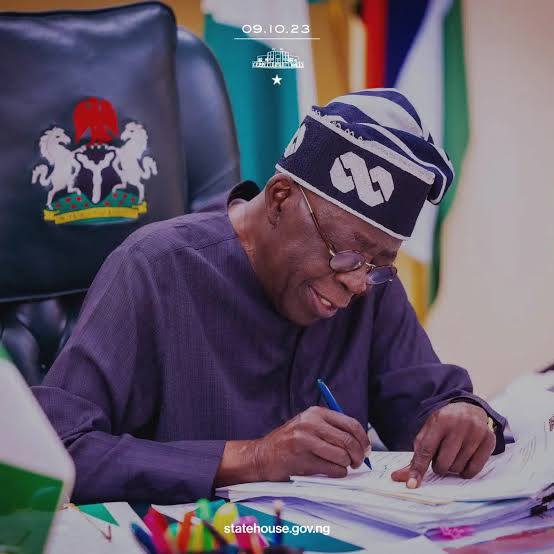
President Bola Ahmed Tinubu has signed into law the 2026 Appropriation Bill, approving a total expenditure of ₦68.32 trillion for the fiscal year. The move marks a major step in the Federal Government’s plan to stabilise the economy, improve infrastructure, and drive growth.
At the same time, the President also approved an extension of the 2025 budget implementation period, shifting its deadline from March 31 to June 30, 2026. The decision is aimed at allowing Ministries, Departments, and Agencies (MDAs) to complete ongoing projects and fully utilise allocated funds.
The announcement was made in a statement issued on Friday by the President’s Special Adviser on Information and Strategy, Bayo Onanuga.
According to the statement, the ₦68.32 trillion budget provides ₦4.799 trillion for statutory transfers, ₦15.8 trillion for debt servicing, ₦15.4 trillion for recurrent expenditure, and a significant ₦32.2 trillion for capital expenditure through the Development Fund.
The presidency noted that capital spending accounts for about 50 per cent of the total budget, showing a strong focus on infrastructure and development projects across the country.
“This budget reflects the administration’s continued commitment to economic stability, national security, infrastructure development, and inclusive growth,” the statement said.
The 2026 budget, which officially took effect on April 1, is being implemented under the government’s “Renewed Hope Agenda,” a policy direction introduced by President Tinubu to reform the economy and improve living conditions.
Alongside the new budget, President Tinubu also signed the Appropriation (Repeal and Enactment) (Amendment) Bill, 2026. This amendment extends the capital component of the 2025 budget by three months.
According to the presidency, the extension is necessary to ensure that important projects already close to completion are not abandoned.
“The extension will ensure the full and effective utilisation of appropriated funds, particularly for critical infrastructure and development projects that are at advanced stages,” the statement explained.
It added that the move would help MDAs complete ongoing works, improve project delivery rates, and ensure value for public spending.
In recent years, Nigeria has struggled with delayed budget implementation and project execution, often due to late approvals and funding challenges. The extension is seen as an attempt to address these long-standing issues.
President Tinubu has directed all government agencies to ensure strict discipline in the use of public funds. He stressed the need for transparency, accountability, and efficient spending.
He also highlighted the importance of delivering projects on time and ensuring that Nigerians get value for money.
Analysts say this directive is important, as concerns about wasteful spending and abandoned projects have been a major issue in the past.
The President also commended the National Assembly for its role in passing the budget.
He praised lawmakers for their “diligence, cooperation, and patriotism” in reviewing and approving the proposal.
“The President reaffirmed the importance of sustained collaboration between the Executive and Legislative arms of government,” the statement noted.
The 2026 budget was first presented by President Tinubu to a joint session of the National Assembly on December 19, 2025. At the time, the proposed figure was ₦58.47 trillion.
During the legislative process, the budget was reviewed and increased to ₦68.32 trillion before it was finally passed and signed into law.
The House of Representatives began debate on the bill in January 2026. During the second reading, the House Leader, Julius Ihonvbere, urged lawmakers to support the proposal.
He pointed to several economic projections, including a 3.98 per cent growth rate, a drop in inflation to 14.45 per cent, and improved revenue generation.
He also noted expectations that the naira would stabilise at around ₦1,400 to the dollar, while Nigeria’s external reserves could rise to about $47 billion.
These projections, according to him, show that the budget is designed to strengthen the economy and restore confidence.
The budget includes major allocations to critical sectors of the economy.
Defence and security received ₦5.41 trillion, reflecting ongoing efforts to tackle insecurity across different parts of the country.
Infrastructure was allocated ₦3.56 trillion, aimed at improving roads, rail, power supply, and other essential services.
Education received ₦3.52 trillion, while the health sector was allocated ₦2.48 trillion.
The 2026 budget is officially titled “The Budget of Consolidation, Renewed Resilience and Shared Prosperity.”
According to the government, it is built around four main objectives: maintaining economic stability, improving the business environment, creating jobs, and investing in people while protecting vulnerable groups.
When presenting the budget last year, President Tinubu described it as a critical stage in Nigeria’s reform journey.
He admitted that economic reforms had brought hardship to many Nigerians but insisted they were necessary for long-term progress.
“The path of reform is seldom smooth, but it is the surest route to lasting stability and shared prosperity,” he said at the time.
Since assuming office in 2023, Tinubu’s administration has introduced several reforms, including fuel subsidy removal and exchange rate changes. While these policies have been praised by some economists, they have also led to rising costs of living.
The government says the 2026 budget is designed to ease these pressures by boosting investment, creating jobs, and strengthening social support systems.
President Tinubu has assured Nigerians that his administration will continue to deepen fiscal reforms and improve revenue generation.
He said the government will prioritise investments that promote economic growth and provide support for vulnerable citizens.
For many Nigerians, the key concern remains whether the large budget will translate into real improvements in daily life, including better infrastructure, job opportunities, and lower cost of living.
As implementation begins, attention will be on how well government agencies carry out their responsibilities and whether the ambitious plans outlined in the budget can be achieved.