
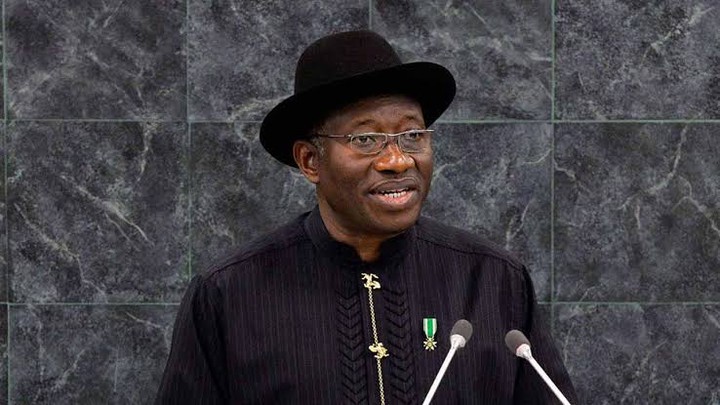
Former President Goodluck Jonathan has responded to criticism from former Vice President Atiku Abubakar, insisting that he did his best while serving as Nigeria’s leader between 2010 and 2015.
Jonathan’s reaction comes days after Atiku described him as “inexperienced” during a television interview, sparking renewed debate about leadership and governance in Nigeria.
Atiku, who is currently seeking political relevance ahead of future elections, made the remarks during an appearance on Arise Television, where he reviewed past administrations and assessed the strengths of key political figures across the country. In the interview, he suggested that Jonathan’s lack of experience contributed to challenges faced during his time in office.
“I know Goodluck Jonathan very well. He is a decent young man, but also inexperienced, and I believe that contributed to his inability to manage the affairs of the country, particularly when he was faced with challenges,” Atiku said.
His comments have drawn attention partly because both men once worked closely together. Jonathan served as Vice President under the late President Umaru Musa Yar’Adua before assuming office in 2010 following Yar’Adua’s death. Atiku, on the other hand, was Vice President from 1999 to 2007 under former President Olusegun Obasanjo.
Jonathan, however, has now pushed back against Atiku’s claims, saying that no leader can govern without making mistakes. He spoke on Monday in Abuja at an event organised by the Association of Retired Career Ambassadors of Nigeria (ARCAN), where he addressed diplomats and senior officials.
According to him, criticism about age and experience is misplaced, stressing that leadership is not about perfection.
“So not too long ago, a very senior politician said, ‘Oh, Jonathan was too young and probably that’s why he made mistakes,’” he said.
“If I made mistakes, yes, nobody who becomes a governor or a president will say you did not make mistakes. All human beings must make mistakes.”
Jonathan noted that he became president at the age of 53 and left office at 58, questioning the idea that he was too young to lead the country.
“Must it have been 100 years before I ran the affairs of the state?” he asked.
The former president maintained that despite any shortcomings, he worked in the interest of the country and took decisions he believed were right at the time. He also pointed to achievements in Nigeria’s foreign policy, especially the country’s election to the United Nations Security Council during his administration.
“I knew what I did for us to appear in the UN Security Council two times. If I were so naive, I don’t think I would have been able to navigate through that process,” Jonathan said.
The exchange between Jonathan and Atiku reflects a wider political conversation in Nigeria as prominent leaders continue to position themselves and shape public opinion ahead of future elections. Atiku has remained active in politics and has contested for the presidency multiple times, including in the 2023 election.
During his interview, Atiku also assessed other political figures, including Peter Obi, Rotimi Amaechi, and Rabiu Kwankwaso. He downplayed their national influence, suggesting that their support bases are limited to specific regions.
He further criticised the current administration of President Bola Tinubu, expressing dissatisfaction with the direction of governance in the country.
Beyond the political exchange, Jonathan used the Abuja event to speak on broader issues affecting West Africa, especially political instability. He warned that without stable governments, countries in the region would struggle to achieve economic growth.
“We cannot progress economically if we are very unstable societies politically,” he said.
Jonathan referred to the challenges facing the Economic Community of West African States (ECOWAS), noting that while the organisation was founded with a strong vision, it continues to face setbacks due to political crises in member states.
The regional bloc, established in 1975, was designed to promote economic cooperation and integration among West African countries. However, in recent years, coups and political unrest in some member states have tested its ability to maintain democratic standards.
Jonathan explained that enforcing democracy across the region often leads to tension because it involves вмешательство in the internal affairs of sovereign nations.
“That means that ECOWAS must interfere with the internal affairs of the states, and the issue of sovereignty becomes a problem,” he said.
He called on leaders in the region to work together more closely to ensure stability, stressing that economic integration cannot succeed without strong democratic institutions.
Also speaking at the event was former Head of State Yakubu Gowon, who reflected on the creation of ECOWAS. Gowon, who played a key role in the formation of the organisation, described it as a collective effort driven by the need for regional cooperation after Nigeria’s civil war.
According to him, the idea of ECOWAS emerged from discussions with other West African leaders during diplomatic visits.
“Why don’t we also think about having something that we can at least have in agreement for all of us when we are working together?” he recalled.
Gowon emphasised that the success of ECOWAS was not the work of one person but the result of teamwork involving government officials and civil servants.
The event also marked the 50th anniversary of ECOWAS, with speakers highlighting its achievements and ongoing challenges. The President of ARCAN, Joe Keshi, noted that diplomacy often goes unnoticed but plays a key role in maintaining peace and stability.
“Diplomacy is one profession where success is often invisible,” he said.
Keshi urged diplomats to adapt to new global challenges, including security threats, climate change, and economic transformation.
The Chief of Army Staff, Lt. Gen. Waheed Shaibu, also paid tribute to Gowon, describing him as a symbol of unity and visionary leadership. He said the recognition given to the former leader reflects his contributions to Nigeria’s peace and development.
As political debates continue, Jonathan’s response to Atiku highlights the ongoing scrutiny of past leaders in Nigeria. While opinions may differ, the exchange shows that questions of experience, performance, and accountability remain central to the country’s political discourse.