
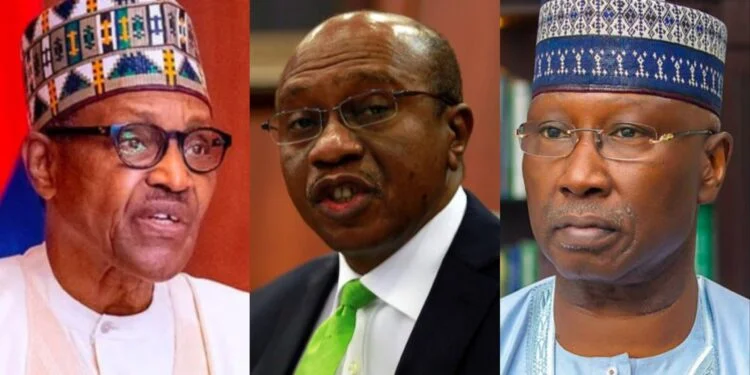
The Economic and Financial Crimes Commission (EFCC) on Monday told the High Court of the Federal Capital Territory in Abuja that the signatures of former President Muhammadu Buhari and former Secretary to the Government of the Federation, Boss Mustapha, were allegedly forged in a scheme to defraud Nigeria of $6.23 million.
The anti-graft agency made the claim during the ongoing trial of former Governor of the Central Bank of Nigeria (CBN), Godwin Emefiele, who is facing multiple charges related to financial misconduct.
Testifying before the court, an EFCC official, Chinedu Eneanya, said investigations revealed that the money was removed from the CBN under the pretext that it would be used to pay foreign election observers during the 2023 general elections.
Emefiele is being prosecuted on a 20-count charge that includes criminal breach of trust, forgery, abuse of office, and obtaining money under false pretence. The case is marked FCT/HC/CR/577/2023.
According to the EFCC, the former CBN governor allegedly approved the release of the $6.23 million for a purpose that was not genuine. The agency further accused him of conferring unfair advantages on two companies, April 1616 Nigeria Ltd and Architekon Nigeria Ltd.
Emefiele, however, has denied all the allegations and pleaded not guilty.
Eneanya, who appeared as the 13th prosecution witness, told the court that five officials of the CBN facilitated the movement of the funds.
He explained that the officials signed internal documents that authorised the release of the money from the apex bank.
“The investigation revealed that the money was removed from the coffers of the CBN for a purported funding of foreign observers for the 2023 elections,” he said.
He added that his team interviewed several individuals connected to the transaction and also recovered documents from the CBN during the investigation.
A key part of the EFCC’s case is the claim that the signatures of Buhari and Mustapha were forged to make the transaction appear legitimate.
Eneanya told the court that forensic analysis was conducted on the documents used to approve the release of the funds.
According to him, the results of the examination showed that the signatures of both officials were not genuine.
He said this discovery suggested that some individuals created false documents to support the withdrawal of the money.
The allegation has raised serious concerns, as it involves the use of forged approvals from the highest levels of government.
However, the proceedings took a dramatic turn during cross-examination by Emefiele’s lawyer, Mathew Burkaa.
The defence pointed out that although forensic tests were carried out on the signatures of Buhari and Mustapha, the EFCC did not conduct a similar examination on Emefiele’s own signature.
Emefiele has claimed that his signature may also have been forged in the documents used for the transaction.
When questioned, the EFCC witness admitted that no forensic analysis was carried out on Emefiele’s signature.
This revelation could become a key point in the defence’s case as the trial continues.
Eneanya also told the court that five CBN officials were directly involved in signing the internal memo that authorised the release of the funds.
However, he confirmed that none of these officials is currently on trial alongside Emefiele. Instead, they were reportedly suspended by the CBN.
This development has raised questions about why only the former governor is being prosecuted in the case.
During the hearing, the witness also said he did not personally take statements from Emefiele.
He further disclosed that while a lawyer representing Emefiele, Ifeanyi Omeke, allegedly claimed that he received money on behalf of the former CBN governor, the EFCC did not question Emefiele directly on that claim.
The defence is expected to rely on these gaps as it challenges the prosecution’s case.
Earlier in the proceedings, the defence criticised the EFCC for calling multiple investigating officers to testify, arguing that their testimonies were repetitive.
Burkaa told the court that the prosecution had earlier indicated it would present its final witness, only to return with another.
“We understand their strategy. It seems they are ridiculing the court,” he said.
In response, the prosecution counsel, Rotimi Oyedepo, said the EFCC still had two more witnesses to present.
He explained that the witnesses were currently outside Abuja and that efforts were being made to secure their appearance in court.
At this point, the defence asked the court to close the prosecution’s case if the remaining witnesses fail to appear.
Burkaa argued that repeated delays were putting unnecessary pressure on the defendant.
“This is an antic by the prosecution to put maximum hardship on the defendant,” he said.
However, Oyedepo urged the court to allow the EFCC to present all its witnesses, stating that the agency was committed to ensuring a fair and thorough trial.
Presiding judge, Hamza Muazu, advised both parties to save their arguments for the final stage of the case.
He also directed the prosecution to ensure that all remaining witnesses appear in court on the next adjourned dates.
The judge subsequently adjourned the case until April 28 for continuation of trial.
The trial of Emefiele is one of several high-profile corruption cases in Nigeria involving senior government officials.
As former CBN governor, Emefiele played a key role in managing Nigeria’s monetary policy and financial system.
His tenure, however, was marked by controversies, including allegations of financial mismanagement and abuse of office.
The EFCC’s case against him centres on the alleged misuse of public funds and irregular financial transactions.
The allegation that top government signatures were forged in a major financial transaction has raised concerns about internal controls within public institutions.
For many Nigerians, the outcome of the trial will be an important test of the country’s commitment to fighting corruption.