
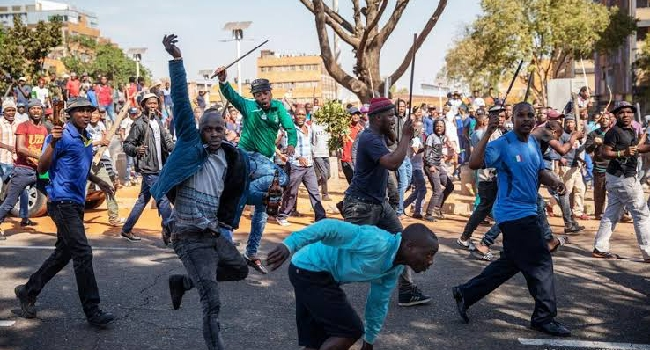
The Federal Government of Nigeria has demanded urgent protection for its citizens in South Africa following the killing of two Nigerians in separate incidents linked to rising xenophobic violence.
The development has heightened fear among Nigerians living in the country, with many calling for immediate government intervention to safeguard lives and property.
The Nigerian Consulate General in Johannesburg confirmed the deaths of Amaramiro Emmanuel and Ekpenyong Andrew, describing the incidents as shocking and deeply troubling.
In a statement issued on Monday, the Consul-General, Ninikanwa Okey-Uche, said Emmanuel died from injuries allegedly sustained after he was beaten by personnel of the South African National Defence Force on April 20.
Andrew, on the other hand, was reportedly arrested on April 19 in the Booysens area of Pretoria after an altercation with members of the Tshwane Metro Police. His body was later discovered at the Pretoria Central Mortuary.
According to Okey-Uche, both cases involve security personnel, a development that has left families of the victims, members of the Nigerian community, and diplomatic officials in shock.
Following the incidents, the Nigerian mission in South Africa has opened a formal case with the South African Police Service and called for a thorough investigation.
The consulate also urged the Independent Police Investigative Directorate to ensure that the probe is transparent and impartial.
“We call on South African authorities to thoroughly investigate the matter and bring the perpetrators to justice,” Okey-Uche said.
She stressed that no individual should take the law into their hands, noting that every accused person deserves a fair hearing in court.
The consulate further assured that it is engaging relevant authorities and providing support to the families of the deceased.
At the same time, it warned against the growing trend of profiling Nigerians as criminals, which it said fuels hostility and violence.
The killings have triggered panic within the Nigerian community in South Africa, where many say they now feel unsafe.
Members of the diaspora have called on the Nigerian government to act swiftly, insisting that protecting citizens abroad is both a constitutional duty and a moral responsibility.
Tensions have been rising in recent weeks, with several viral videos showing threats, harassment, and intimidation of foreign nationals.
In one widely shared video, a Nigerian trader was confronted by a group during an anti-immigrant protest and told to leave the country with his family.
Despite explaining that he had lived in South Africa for many years and was only trying to earn a living, the group insisted that foreigners were no longer welcome.
“Take your wife and go back to your country,” one voice was heard saying, reflecting the growing hostility on the streets.
Reacting to the situation, the South African Police Service condemned acts of intimidation and violence against foreigners.
The police described such actions as unlawful and contrary to the values of human dignity, equality, and human rights.
However, concerns remain among foreign nationals, especially Nigerians, who say incidents of harassment and discrimination are becoming more frequent.
The Nigerian Citizens Association in South Africa (NICASA) has also raised alarm over what it described as increasing hostility towards Nigerians and other African migrants.
Its president, Frank Onyekwelu, said the situation is worrying and requires urgent attention from both Nigerian and African leaders.
“We are alarmed by the increasing normalisation of hostility,” he said, citing inflammatory statements by some political figures, harassment, and alleged police brutality.
Onyekwelu called on President Bola Tinubu, the Ministry of Foreign Affairs, and the Nigerians in Diaspora Commission to act quickly and decisively.
He also urged authorities to ensure accountability for security personnel involved in misconduct and to establish systems for documenting and addressing xenophobic attacks.
According to him, Nigerians in South Africa are largely law-abiding and contribute positively to the economy and society.
“The reckless stereotyping and collective criminalization of our people must stop,” he said.
In response to the rising tension, the Nigerians in Diaspora Commission issued safety advisories to citizens living in South Africa.
The commission warned of increasing protests in cities such as Durban, Cape Town, and KwaZulu-Natal, where cases of looting, violence, and property damage have been reported.
It advised Nigerians to remain law-abiding, avoid confrontations, and closely monitor developments.
In some cases, Nigerians were advised to temporarily shut down their businesses to prevent losses.
Nigeria’s Acting Ambassador to South Africa, Alexander Ajayi, said the situation is under control and should not be seen as a coordinated attack against Nigerians.
“Nigerians are not under siege in South Africa,” he said, adding that both the Nigerian and South African governments are working together to address the situation.
He described the incidents as isolated cases of tension and urged Nigerians to remain calm while authorities handle the matter.
South African President, Cyril Ramaphosa, also addressed the issue, urging foreign nationals to respect the country’s laws and traditions.
Speaking during the Freedom Day celebration, he reaffirmed his commitment to human rights and international law.
“To those who are here legally, respect our laws and traditions, as you would expect in your own country,” he said.
Meanwhile, the Nigerian government has formally called on South Africa to ensure the safety of Nigerians and other foreign nationals.
In a statement issued by the spokesperson of the Ministry of Foreign Affairs, Kimiebi Ebienfa, Nigeria urged South African authorities to protect lives and property.
“As brotherly countries, Nigeria calls on the Government of South Africa to protect foreigners from attacks,” the statement said.
The government also reaffirmed its commitment to maintaining strong bilateral relations with South Africa.
Nigeria and South Africa share a long history of cooperation, dating back to the anti-apartheid struggle. Since the end of apartheid in 1994, both countries have built strong ties in trade, education, defence, and culture.
They also work together through international platforms such as the African Union and the United Nations.
However, repeated cases of xenophobic violence in South Africa have strained this relationship over the years.
As investigations continue into the deaths of Emmanuel and Andrew, many Nigerians are hoping for justice and improved safety.
For families of the victims, the pain remains fresh, while for others living in South Africa, uncertainty lingers.
The situation has once again brought attention to the challenges faced by migrants in foreign countries and the responsibility of governments to ensure their safety.
With diplomatic efforts now underway, both Nigeria and South Africa face renewed pressure to address the root causes of xenophobic violence and strengthen protections for all residents.