
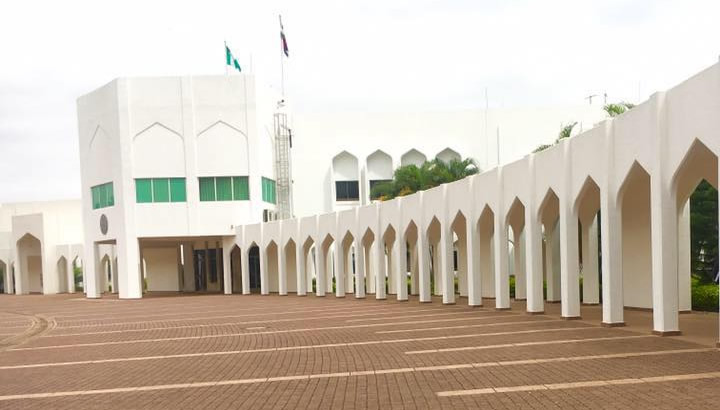
Fresh details have emerged in the ongoing trial over an alleged plot to overthrow President Bola Tinubu, as one of the accused persons, Zekeri Umoru, admitted in court that he became involved in activities linked to the plan while working inside the Presidential Villa in 2025.
Umoru, who is the fourth defendant in the case, is a staff member in the maintenance department of the Presidential Villa. He works with Julius Berger Nigeria, a firm responsible for key infrastructure and maintenance services in government facilities.
In a video recording of his extra-judicial statement presented before the court, Umoru explained how his involvement began through his contact with Inspector Ahmed Ibrahim, a police officer attached to the Presidential Clinic within the Villa.
According to Umoru, his relationship with Ibrahim started around May 2025. He said Ibrahim later introduced him to a man identified as Hassan Mohammed, who he would eventually learn was Colonel Mohammed, also known as “Ma’aji.”
Umoru told investigators that he initially believed Ma’aji was a businessman who wanted to hire him for electrical work at a building under construction. This belief, he said, was strengthened after he began receiving money transfers bearing Ma’aji’s name.
He recounted that he had several meetings with Ma’aji, sometimes in the presence of Inspector Ibrahim. During these meetings, he said, money was often given to him and others present.
One such meeting reportedly took place at a location known as Tiger Bar, where Ma’aji bought drinks and gave out cash ranging from ₦100,000 to ₦120,000 to those present, while asking questions about their professions.
However, Umoru told the court that a more serious transaction took place on September 24, 2025. On that day, he said Ma’aji handed him a large bag, commonly referred to in Nigeria as a “Ghana Must Go” bag, filled with cash.
He said he later took the money to a branch of Zenith Bank, where it was counted and confirmed to be ₦8.8 million.
According to his statement, he met with Ma’aji again the following day alongside Inspector Ibrahim. During that meeting, he said an additional ₦2 million was given, with Ibrahim expected to provide further instructions later.
Umoru said he began to feel uneasy about the steady flow of money and decided to question Ibrahim about the true nature of the dealings. It was at that point, he claimed, that Ibrahim hinted at a broader plan.
He told investigators that Ibrahim said Ma’aji was unhappy with the state of the country and wanted to “sanitize the government.” The plan, according to Ibrahim, allegedly involved support from unnamed associates described as “boys.”
Umoru also claimed that Ibrahim mentioned a possible plan involving an ambulance driver as a way to gain access into the Presidential Villa. The goal, he said, was tied to expectations of financial gain.
Despite these claims, Umoru insisted throughout his statement that he was never aware of any concrete plan to overthrow the government. He maintained that he did not knowingly take part in any coup plot.
“I was misled,” he said in the recorded interview, adding that he believed he was dealing with ordinary business matters and not a political or military operation.
He further told the court that if he had known Ma’aji was a military officer or had intentions beyond business, he would have cut off all contact.
The defendant also described an incident in which he escorted a man identified as Usman into the Presidential Villa. According to him, security officials at the gate did not stop them after he indicated that the visitor was there to see him.
Umoru said he later found Usman taking photographs inside his office and warned him to stop, suggesting that he did not approve of such actions.
During the interview, he expressed regret over his actions and apologised to his employers. He also affirmed his support for the current administration, distancing himself from any attempt to undermine the government.
The court also reviewed another video statement involving an Islamic cleric, Sheikh Imam Kassim Goni, who was also linked to the case.
Goni told investigators that he had relocated to Karu, Abuja, after fleeing insurgency in Maiduguri. He denied any involvement in the alleged coup plot.
According to him, any money he received from Ma’aji was strictly for religious purposes. He said the funds were meant for prayers, charity, and spiritual support, including requests related to career advancement.
However, investigators raised concerns about inconsistencies in his claims. They pointed out that financial records showed he had been receiving money as far back as March 2023, which was earlier than the period he mentioned.
Further records presented in court indicated that the transactions involved large sums of money, including a transfer of ₦10 million in October 2024.
Investigators also suggested that certain conversations referenced in the videos, including discussions about gaining access and acquiring “work tools,” could point to a wider plan. Despite this, both Umoru and Goni denied having any knowledge of a coup attempt.
The trial is one of the most sensitive cases in recent times, given Nigeria’s history with military takeovers. Although the country has enjoyed uninterrupted democratic rule since 1999, memories of past coups still shape public concern about any threat to civilian government.
Security around the Presidential Villa, which serves as the seat of power, is usually tight, making the allegations in this case particularly serious.
Legal proceedings are still ongoing, and the court has yet to determine the guilt or innocence of the accused persons.
During the latest hearing, counsel to the sixth defendant, Senior Advocate of Nigeria, Michael Numa, told the court that he had just received the video evidence related to his client and needed time to study it.
The presiding judge, Justice Joyce Abdulmalik, agreed to adjourn the case to allow for proper review of the materials.
The matter has now been fixed for continuation of trial on May 11, 12, and 13.
As the case continues, Nigerians are watching closely, with many hoping that the trial will bring out the full truth behind the alleged plot and strengthen confidence in the country’s democratic system.