
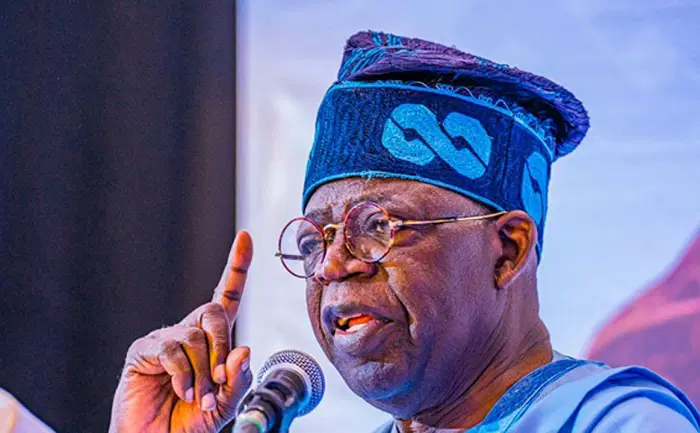
President Bola Ahmed Tinubu has reaffirmed his administration’s commitment to restoring the importance of traditional institutions in Nigeria’s governance system, saying traditional rulers remain critical to peace, security and grassroots development across the country.
Tinubu made the statement on Saturday during the final farewell and reception organised in honour of the late Awujale and Paramount Ruler of Ijebuland, Oba Sikiru Kayode Adetona, at the Dipo Dina Stadium.
The late monarch, one of Nigeria’s longest-reigning traditional rulers, died in July last year at the age of 91 after spending 65 years on the throne. His death marked the end of an era in Ijebuland and across Nigeria’s traditional institution landscape, where he was widely respected for his outspoken views, leadership style and advocacy for reforms.
Represented at the event by Ogun State Governor Dapo Abiodun, the President said his administration’s Renewed Hope Agenda recognises traditional rulers as active partners in governance and nation-building, rather than mere ceremonial leaders.
According to Tinubu, the Federal Government envisions a Nigeria where monarchs and traditional institutions are fully recognised as important stakeholders in maintaining peace, preserving cultural values and promoting development at the grassroots.
“Our vision is clear — a Nigeria where traditional institutions are recognized as critical stakeholders in promoting peace, preserving values, strengthening harmony, and advancing grassroots development,” the President stated.
Tinubu noted that traditional rulers possess local knowledge, moral influence and social legitimacy that government institutions alone cannot easily provide. He said their closeness to the people gives them an advantage in resolving conflicts, gathering intelligence and promoting unity within communities.
He explained that Nigeria’s traditional institutions historically played major roles in governance before their influence gradually reduced under later constitutional arrangements.
According to him, the 1963 Constitution gave traditional rulers significant recognition, but subsequent constitutions weakened their authority and reduced collaboration between governments and grassroots leadership structures.
The President said his administration would continue to support ongoing discussions aimed at assigning clearer constitutional responsibilities to traditional rulers through consultations at the National Assembly.
“This is not about politics; it is about strengthening governance, deepening inclusion, and recognizing an institution that has sustained social order for centuries,” Tinubu added.
Over the years, there have been increasing calls from monarchs, community leaders and political stakeholders for constitutional roles for traditional rulers, especially in areas relating to security, mediation and local governance.
Supporters of the proposal argue that traditional rulers are closer to ordinary citizens and often understand local problems better than government officials. They also believe monarchs can help reduce insecurity by supporting intelligence gathering and peacebuilding efforts in troubled communities.
Nigeria has in recent years faced growing security challenges, including banditry, kidnapping, communal clashes and violent extremism in different parts of the country. Analysts say traditional rulers could play stronger roles in preventing conflicts if properly integrated into governance and security systems.
Tinubu disclosed that the Federal Government had maintained consultations with traditional and religious leaders through the National Council of Traditional Rulers of Nigeria on issues concerning national security, economic development and social stability.
He charged traditional rulers across the country to continue serving as custodians of peace and unity in their communities.
The President urged monarchs to make their palaces centres for wisdom, reconciliation and conflict resolution. He also encouraged them to strengthen community-based security systems through intelligence gathering and early warning mechanisms.
Tinubu further called on traditional rulers to guide young people away from violence, cultism, extremism, drug abuse and other social vices threatening the country’s social fabric.
He said Nigeria’s cultural heritage should not only be preserved but also used as a strategic tool for development, tourism and national unity.
The President also praised the Oba Sikiru Adetona School of Governance for organizing the lecture and activities held in honour of the late monarch.
He described Oba Adetona as a disciplined, courageous and principled traditional ruler who stood firmly for justice and good governance throughout his reign.
Speaking on the lecture theme, “Bridging the Gap Between Traditional Institutions and Modern Government,” Tinubu said the topic addresses one of the most important governance issues facing Nigeria today.
“The theme speaks to one of the most important governance questions of our time — how to harmonise the authority of our ancestral institutions with the structures of constitutional democracy in advancing national progress,” the President stated.
The late Awujale was widely known for his bold interventions on national issues and his willingness to challenge political leaders when necessary. During his reign, he became one of the most influential traditional rulers in Nigeria and played major roles in political and social discussions affecting Ogun State and the country at large.
Many political leaders, business figures and traditional rulers attended the farewell ceremony in Ijebu-Ode to pay tribute to the monarch’s legacy.
In a keynote address delivered at the event, former President Olusegun Obasanjo described the late monarch as a highly respected traditional ruler whose influence went beyond Ijebuland.
Represented by Architect Abiodun Fari-Arole, Obasanjo said Oba Adetona was a close ally who consistently promoted peace, justice and fairness during his lifetime.
He recalled the monarch’s role in advocating reforms within Ogun State’s traditional institution framework, particularly changes to the Traditional and Obas Law.
One of the most notable reforms supported by the late Awujale was the provision granting monarchs the right to determine how they should be buried after death, in line with their personal wishes and beliefs.
The issue had generated debate in some parts of the country, especially concerning whether traditional rulers should be buried according to customary rites or religious practices chosen by their families.
His death has continued to attract tributes from across the country, with many describing him as a fearless monarch who defended the dignity and independence of traditional institutions.
Saturday’s event therefore served not only as a farewell to a respected monarch but also as a platform for renewed discussions about the future of traditional leadership in Nigeria.