
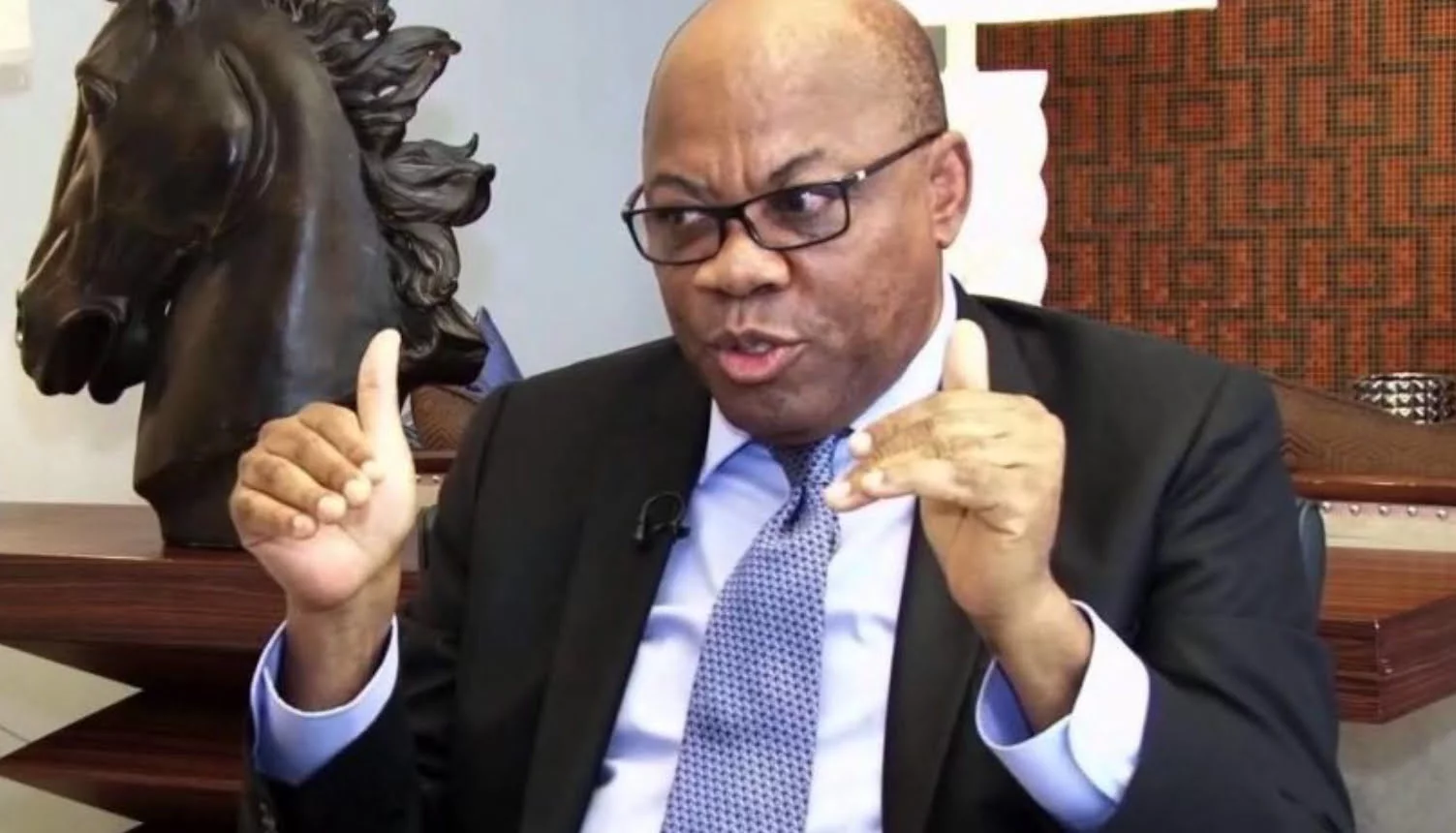
Former President of the Nigerian Bar Association (NBA), Olisa Agbakoba, has raised fresh concerns over the state of Nigeria’s public finances, warning that the country may be sliding deeper into economic trouble because huge revenues meant for the Federation Account are either deducted before remittance or not remitted at all.
Agbakoba said the situation has created a dangerous cycle where the country now borrows money that it has already earned but failed to properly account for.
The senior lawyer made the remarks in a statement shared on his X account on Wednesday, where he described the Federation Account as the “financial heartbeat” of Nigeria.
According to him, many Nigerians do not fully understand the importance of the account, which was established under Section 162 of the 1999 Constitution to receive and distribute revenues collected by the Federal Government among the federal, state and local governments.
He explained that all revenues generated by the country, especially from oil, taxes, customs duties and other government sources, are expected to flow into the Federation Account before they are shared through the Federation Account Allocation Committee (FAAC).
Agbakoba, however, alleged that the system is now under severe pressure because of massive deductions, under-remittances and rising debt obligations.
“Most Nigerians are unaware that the country has a vital financial institution known as the Federation Account,” he wrote.
“Created under Section 162 of the 1999 Constitution, this account is designed to collect and store every kobo of revenue generated by the federal government. From there, these funds are shared among federal, state and local governments.
“In essence, the Federation Account serves as the financial heartbeat of our nation. However, it is facing severe challenges.”
The former NBA president backed his concerns with figures which he described as alarming.
According to him, about N14.94 trillion, representing nearly 40 per cent of Nigeria’s total revenue in 2025, was deducted before reaching the Federation Account.
He also alleged that the Nigerian National Petroleum Company Limited withheld N500 billion from the N1.1 trillion it was expected to remit in 2024.
Agbakoba further referred to an ongoing investigation by the Federation Account Allocation Committee into allegations of $42.37 billion in under-remittances between 2011 and 2017.
He said the situation has weakened the financial strength of the country and increased pressure on government borrowing.
“Our total public debt has now ballooned to N159.27 trillion,” he stated.
He added that debt servicing alone consumed about 69 per cent of federal revenue last year, far above the 30 to 40 per cent benchmark recommended by the International Monetary Fund (IMF).
According to him, this means that a large part of government earnings is now being used to repay loans instead of funding development projects such as roads, healthcare, education and security.
“In essence, we are borrowing against funds that we have already earned because that revenue never reaches the Federation Account,” he said.
The Federation Account has remained one of the most important pillars of Nigeria’s fiscal structure because it determines how revenues are shared among the three tiers of government.
Every month, FAAC meets to distribute funds to the federal, state and local governments. The allocations are mainly drawn from crude oil sales, petroleum profits tax, company income tax, customs and excise duties, and Value Added Tax.
However, concerns over revenue leakages and deductions have repeatedly sparked disagreements among government agencies, especially between state governments and revenue-generating institutions.
In recent years, governors and financial experts have accused some agencies of making deductions at source before remitting funds into the Federation Account.
The issue became more controversial after the removal of fuel subsidy in 2023, when Nigerians expected higher revenues from crude oil sales to improve government finances.
Despite increased revenue expectations, Nigeria’s debt profile has continued to rise sharply.
According to data from the Debt Management Office (DMO), Nigeria’s public debt has climbed steadily over the years due to domestic and foreign borrowing by both the Federal Government and state governments.
Several analysts also believe that weak remittance systems, oil theft, pipeline vandalism and low crude oil production have affected government earnings.
Nigeria has struggled in recent years to meet its oil production targets due to illegal refining, crude oil theft and insecurity in parts of the Niger Delta.
This has reduced the amount of revenue available to government at a time when the country is battling inflation, rising unemployment and a weakening naira.
Agbakoba said urgent reforms were needed to restore transparency and accountability in the management of the Federation Account.
He disclosed that he had prepared a policy reform proposal for President Bola Ahmed Tinubu aimed at strengthening Executive Order 9 and improving the financial integrity of the federation.
Executive Order 9, signed in 2018 by former President Muhammadu Buhari, was introduced to improve transparency and support local content in public procurement.
Agbakoba believes stronger reforms are now needed to ensure that all revenues due to the Federation Account are fully remitted and properly managed.
He called for a national conversation on the issue, stressing that the country cannot continue to lose huge revenues while relying heavily on borrowing to fund its budget.
Many states still depend heavily on monthly FAAC allocations to pay salaries and run basic government activities. Any reduction in remittances to the Federation Account directly affects the financial stability of states and local governments.
Analysts also warn that if debt servicing continues to consume most of government revenue, the country may face increasing difficulties funding infrastructure, social services and economic development programs.
The Federal Government has repeatedly defended its borrowing strategy, arguing that loans are necessary to finance critical infrastructure and support economic growth.
Government officials have also maintained that efforts are ongoing to increase revenue generation, block leakages and improve tax collection.
However, critics insist that without stronger transparency measures and accountability in revenue management, Nigeria may continue to face mounting debt and economic pressure.
Agbakoba’s latest comments are expected to reignite public debate over the management of the Federation Account and the broader issue of government revenue accountability.
For many Nigerians already struggling with rising living costs and economic hardship, the concerns raised by the senior lawyer may further increase demands for greater openness in the handling of public funds.