
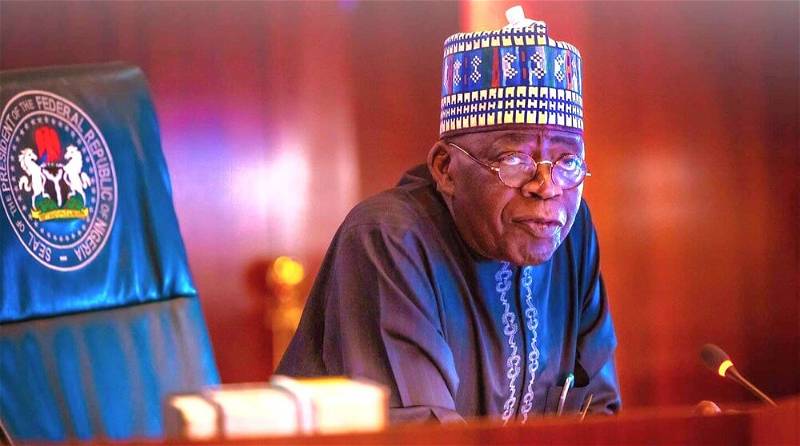
President Bola Ahmed Tinubu has said the economic partnership between Nigeria and France is moving into what he described as an “execution phase,” with both countries now placing greater attention on implementing business agreements and investment plans.
Tinubu made the remark following the 10th France-Nigeria Business Council Meeting held during the Africa Forward Summit in Nairobi, Kenya.
The development was disclosed in a statement released by the State House and shared on May 12, 2026, through the official page of Presidential Adviser on Information and Strategy, Bayo Onanuga.
According to the statement, trade between Nigeria and France reached 4.7 billion dollars in 2025, further strengthening economic ties between both countries.
The Presidency also noted that Nigeria remains the biggest destination for French investments in sub-Saharan Africa, reflecting the growing interest of French companies in Africa’s largest economy.
The meeting brought together top government officials and business leaders from Nigeria and France to discuss trade, investment opportunities and economic cooperation.
Nigeria’s Minister of Industry, Trade and Investment, Jumoke Oduwole, attended the meeting alongside France’s Minister Delegate for Foreign Trade and French Nationals Abroad, Nicolas Forissier.
President Tinubu praised the Chairman of the France-Nigeria Business Council, Aigboje Aig-Imoukhuede, for organising the meeting and bringing together leading private sector players from both nations.
The gathering also featured some of Nigeria’s biggest business figures, including Aliko Dangote, Abdul Samad Rabiu, Tony Elumelu and Wale Tinubu.
Representatives of major French and international companies also participated in the meeting. They included TotalEnergies, CMA CGM, Danone and Accor.
One of the major highlights of the meeting was the signing of an agreement between Accor and Shoreline Group for what was described as Nigeria’s first national hotel platform.
Tinubu welcomed the agreement, saying it reflected the type of investment Nigeria is seeking under his administration.
“This is the partnership Nigeria is ready for. We are ready for investment that builds, capital that produces and enterprise that creates jobs,” the President said.
He added that his government would continue efforts aimed at improving the ease of doing business, supporting investors and strengthening ongoing economic reforms.
Since assuming office in May 2023, Tinubu has introduced a number of economic reforms aimed at attracting foreign investment and improving government finances.
These include the removal of fuel subsidy, reforms in the foreign exchange market and efforts to increase non-oil revenue.
The government has repeatedly argued that the reforms, though difficult in the short term, are necessary to stabilise the economy and create long-term growth.
Nigeria has been working to attract more foreign direct investment as it battles inflation, unemployment, currency instability and rising debt pressures.
The country’s economy has faced serious challenges in recent years, including declining oil production, foreign exchange shortages and rising living costs.
French companies have maintained a strong presence in Nigeria for decades, especially in sectors such as oil and gas, construction, logistics, telecommunications, food production and hospitality.
TotalEnergies remains one of the largest international oil companies operating in Nigeria, with investments in offshore oil production and gas projects.
French shipping giant CMA CGM has also expanded its operations in Nigeria’s maritime and logistics sector as trade activities continue to grow.
France has in recent years stepped up trade and investment engagement across Africa, particularly in infrastructure, energy, technology and manufacturing.
Nigeria, on the other hand, remains one of Africa’s most attractive markets because of its large population, natural resources and expanding consumer market.
The France-Nigeria Business Council was created to strengthen economic cooperation between both countries by encouraging private sector partnerships and identifying investment opportunities.
The council has played a key role in promoting dialogue between business leaders and government officials from Nigeria and France.
In recent years, investors have complained about problems such as multiple taxation, infrastructure deficits, insecurity, unstable power supply and foreign exchange difficulties.
The Federal Government has repeatedly promised to address these challenges through policy reforms and infrastructure development.
Tinubu’s administration has also been engaging foreign governments and investors through international meetings and business summits in an effort to secure investments that can support economic growth and job creation.
The hospitality agreement involving Accor and Shoreline Group is also expected to boost tourism and create jobs within Nigeria’s growing hospitality industry.
Industry stakeholders believe stronger foreign investment could support the government’s efforts to diversify the economy away from dependence on crude oil.
For Nigeria, the growing relationship with France comes at a time when the government is seeking stronger international partnerships to revive economic growth and improve investor confidence.
As both countries push ahead with new investment plans and business agreements, attention will now shift to how quickly the projects move from discussions to actual implementation.