
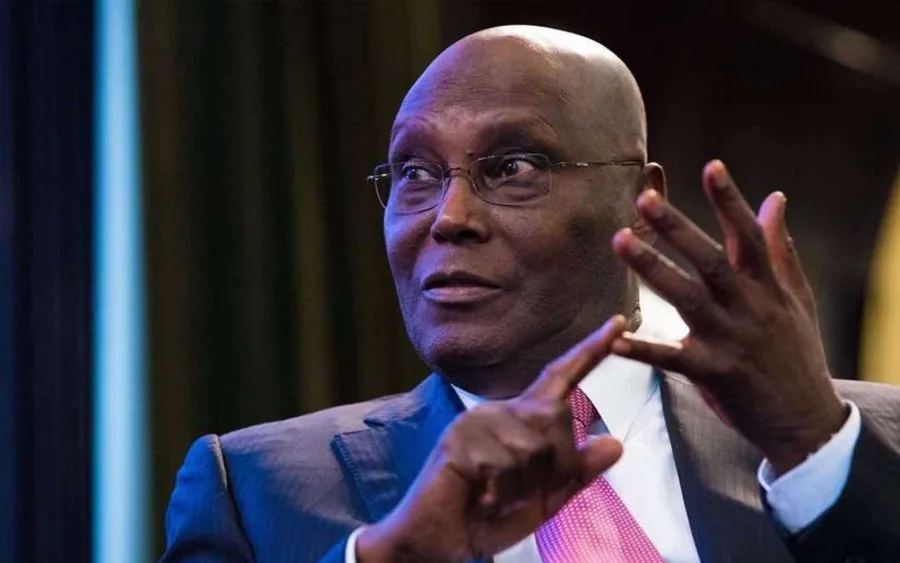
Former Vice President and presidential candidate of the African Democratic Congress (ADC), Atiku Abubakar, has strongly responded to recent comments made by former Secretary to the Government of the Federation, Babachir Lawal, accusing him of promoting ethnic division and making allegations without evidence.
The exchange marks a fresh twist in the growing political disagreement between the two prominent northern politicians as political activities ahead of the 2027 general elections continue to gather momentum.
Atiku’s reaction came on Sunday through a statement issued by his spokesperson, Phrank Shaibu, following comments by Lawal questioning his emergence as the ADC presidential candidate.
Lawal had recently alleged that the party’s presidential primary was manipulated in favour of Atiku and his associates. The former SGF later doubled down on his criticism, urging the ADC to replace Atiku with what he described as a more qualified candidate if the party hoped to win the 2027 presidential election.
His comments generated reactions within political circles, especially among members and supporters of the ADC, which has increasingly become a major platform for opposition politics ahead of the next election cycle.
Responding to the allegations, Atiku dismissed Lawal’s remarks as divisive and based on ethnic considerations rather than facts.
The former vice president said it was disappointing that a political figure of Lawal’s stature had chosen to engage in what he described as ethnic profiling and prejudice instead of presenting evidence to support his claims.
According to Atiku, Lawal failed to provide any proof for the serious allegations he made against him and instead attempted to encourage Nigerians to rely on suspicion rather than verifiable facts.
“It is unfortunate that a man of Babachir’s standing has chosen to abandon facts and reason in favour of ethnic profiling, prejudice and conspiracy theories in his desperate attempt to discredit a political opponent,” the statement said.
The latest dispute appears to stem from comments made by Lawal regarding Atiku’s political ambitions and his Fulani background.
Atiku argued that such remarks were unfair and contradicted Lawal’s own political history.
The former vice president pointed out that Lawal had served under the administration of former President Muhammadu Buhari, who is also of Fulani extraction.
According to Atiku, Lawal did not object to receiving a senior government appointment under Buhari and therefore should not seek to portray the ethnic background of another presidential aspirant as a political issue.
“At no point did Mr Lawal object to receiving such trust and elevation from a Fulani president. He accepted the office, the privileges and the prestige that came with it,” Atiku said.
“It is therefore difficult to understand why he now seeks to stigmatise an entire ethnic group merely because another Fulani man seeks the presidency through democratic means.”
The former vice president also questioned what he described as contradictions in Lawal’s public statements.
According to him, the former SGF has at different times portrayed himself as both a victim of political conspiracies and an influential political figure being courted by governors and political leaders.
“Nigerians are entitled to ask a simple question: which Babachir should they believe?” Atiku asked.
“One moment, he presents himself as a lonely patriot standing against an imagined threat to Nigeria. The next moment, he portrays himself as a prized political asset being courted by powerful governors.”
The statement further suggested that Lawal’s criticisms were motivated more by personal disappointment than by genuine concerns about national leadership.
Atiku said if Lawal wished to align himself with another political party, he was free to do so, but should not disguise personal political decisions as patriotic concerns.
“If Mr Lawal truly believes that his political future lies in the APC, he is perfectly free to return,” Atiku said.
“What he cannot do is cloak personal political calculations in the language of patriotism while expecting Nigerians not to notice the inconsistency.”
The exchange comes amid ongoing political realignments as parties and influential politicians position themselves for the 2027 elections.
Lawal, a former ally of President Buhari and a key figure in northern politics, has become increasingly vocal about developments within opposition parties in recent months.
His resignation from the ADC and subsequent criticism of the party’s presidential primary have attracted significant attention, particularly because of his previous role in national politics and his influence in parts of the North.
The contest for leadership within opposition parties is expected to intensify in the coming months as politicians build alliances and seek support across different regions of the country.
Despite the sharp criticism, Atiku sought to present himself as a leader focused on national unity rather than ethnic divisions.
In one of the strongest parts of his statement, he accused Lawal of allowing bitterness and resentment to influence his public comments.
“His heart appears full of bitterness, and his public utterances increasingly reflect anger rather than reason, grievance rather than evidence,” Atiku stated.
“Babachir may see the tribe. I see Nigerians. Babachir may see division. I see a nation that must come together if it is to overcome its present challenges.”
The former vice president used the opportunity to restate his vision for Nigeria, emphasizing unity, equal opportunity and inclusion.
He reaffirmed his commitment to building a country where citizens are treated equally regardless of their ethnic, religious or regional backgrounds.
According to him, Nigeria’s future depends on leaders who can unite the country and address its economic, security and social challenges without resorting to divisive politics.
As the political exchange continues to generate debate, it highlights the increasingly intense discussions already shaping the race toward 2027, even though the next general election remains some time away.
For now, the disagreement between Atiku and Babachir has become one of the latest signs of the growing competition and internal tensions within Nigeria’s opposition political landscape as preparations for the next presidential contest gradually take shape.