
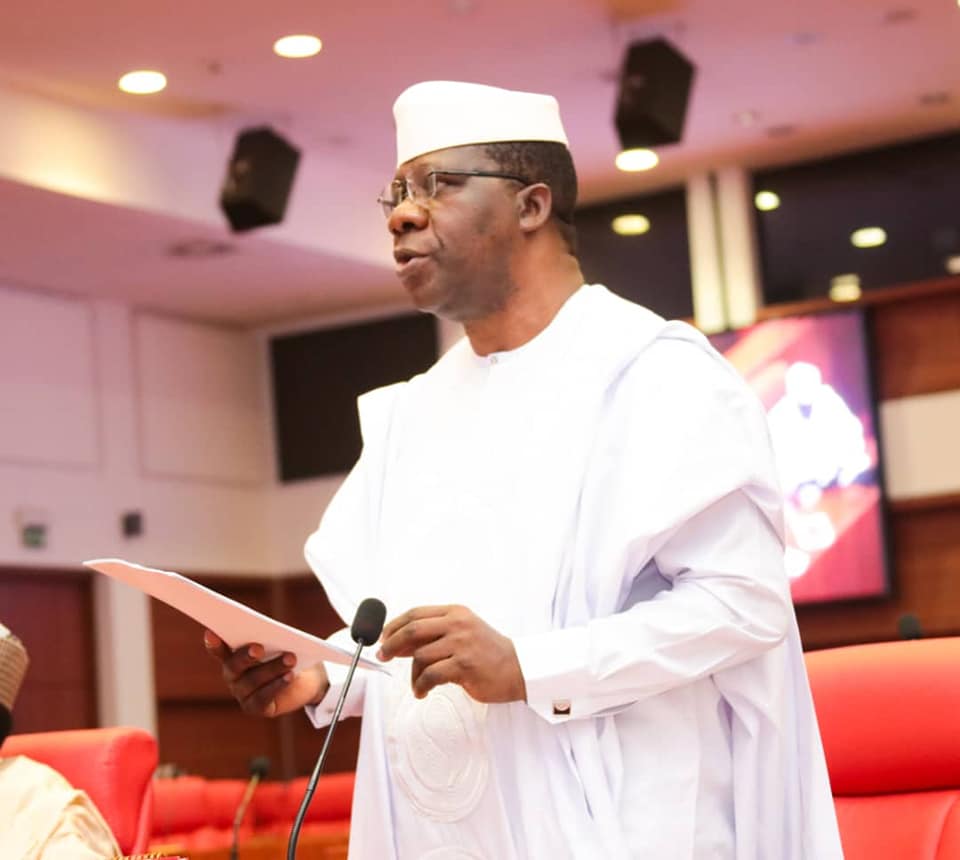
Senate Leader, Opeyemi Bamidele, has unveiled plans to sponsor a bill seeking a single six-year tenure for Nigeria’s president and state governors, arguing that the reform would allow elected leaders to focus on governance rather than spending valuable time pursuing re-election.
Bamidele disclosed the proposal during an interview with journalists in his office on Tuesday, saying the bill would be among the first pieces of legislation he intends to introduce in the next Senate after the 2027 general elections.
Nigeria currently operates a constitutional system that allows presidents and governors to serve a maximum of two four-year terms. Under the arrangement, an elected leader can remain in office for up to eight years if re-elected after the first term.
However, the Senate leader believes the system has created a situation where many office holders begin planning for their second term too early, often at the expense of governance and service delivery.
According to him, a single six-year tenure would remove the distractions associated with campaigning for re-election and encourage leaders to concentrate fully on fulfilling their mandates.
“One of the first set of bills that I look forward to moving, by God’s grace, when we come back for the 11th Senate, God willing, is for a bill that will only make it possible for anyone who wants to be president of this country, or governor in any part of this country, to spend only one term of six years,” Bamidele said.
He argued that under the current system, leaders often spend a significant portion of their first term preparing for another election rather than focusing entirely on governance.
“So that you don’t even have to worry about wasting almost one and a half years of your first term thinking and struggling and looking forward to how you’ll be re-elected.
“If you know you are there for six years, only one tenure, you put in your best from day one. You know this is the only chance that you have,” he added.
The lawmaker acknowledged that his proposal may not enjoy universal support and could trigger intense national debate. Nevertheless, he insisted that lawmakers have a responsibility to continually review existing laws and propose reforms aimed at improving governance.
“That’s my opinion. It doesn’t mean everybody will agree with me. But it also does not mean that I am prevented from doing that because that has not been the law,” he said.
Bamidele further stressed that laws should evolve in response to changing national realities.
“The essence of law, the essence of parliament, is that laws are like human beings; they grow,” he stated.
His comments have revived a long-standing constitutional debate that has surfaced repeatedly since Nigeria returned to democratic rule in 1999.
Over the years, several politicians, constitutional experts and civil society groups have suggested replacing the current two-term system with a single tenure. Supporters of the idea argue that it would reduce political tension, lower the cost of elections and help leaders focus on implementing long-term development programs.
Advocates also argue that incumbents often use the machinery of government to strengthen their chances of winning a second term, creating an uneven political playing field. According to them, removing the possibility of re-election would reduce such pressures and promote more objective governance.
However, critics of the proposal maintain that the existing two-term arrangement gives citizens the opportunity to assess a leader’s performance after four years and either reward or reject that leader at the ballot box.
They argue that a single tenure could make some elected officials less accountable to the electorate because they would not need to seek another mandate.
The debate is not entirely new in Nigeria’s political history.
During the administration of former President Olusegun Obasanjo, a controversial constitutional amendment proposal sought to allow a third presidential term. The plan generated widespread opposition and was eventually defeated in the National Assembly.
Since then, discussions about executive tenure have continued to emerge from time to time, although most proposals have focused on a single tenure rather than extending the maximum period a leader can remain in office.
More recently, former Vice President and presidential candidate of the African Democratic Congress (ADC), Atiku Abubakar, also advocated a six-year single term for presidents and governors.
In constitutional review proposals submitted to the National Assembly, Atiku argued that the presidency should rotate among Nigeria’s six geopolitical zones and that the president should serve only one six-year term.
According to him, such an arrangement would promote national inclusion, reduce political rivalry and give every region a fair chance of producing the country’s leader.
He had indicated that constitutional reform would be one of his top priorities if elected president.
Bamidele’s latest proposal is therefore likely to attract attention from politicians, legal experts and civil society organisations, many of whom have previously expressed views on the issue.
For the proposal to become law, however, it would have to pass through a rigorous constitutional amendment process.
Any bill seeking to alter the tenure of presidents and governors would require amendments to the 1999 Constitution. Such changes must secure the approval of at least two-thirds of members of both chambers of the National Assembly.
Beyond the National Assembly, the proposal would also need the endorsement of at least two-thirds of the 36 state Houses of Assembly before it can be transmitted for presidential assent.
This means the bill would require broad national consensus to succeed.
The proposal comes at a time when conversations about constitutional reform have gained momentum across the country. Several stakeholders have called for changes in areas such as devolution of powers, state policing, electoral reforms, fiscal federalism and local government autonomy.
As discussions continue, Bamidele’s six-year single tenure proposal is expected to generate fresh arguments on the best way to strengthen governance and deepen democracy in Nigeria.
Whether the idea eventually gains enough support to become law remains uncertain. However, it has once again placed the issue of executive tenure and constitutional reform at the centre of national political discourse.