
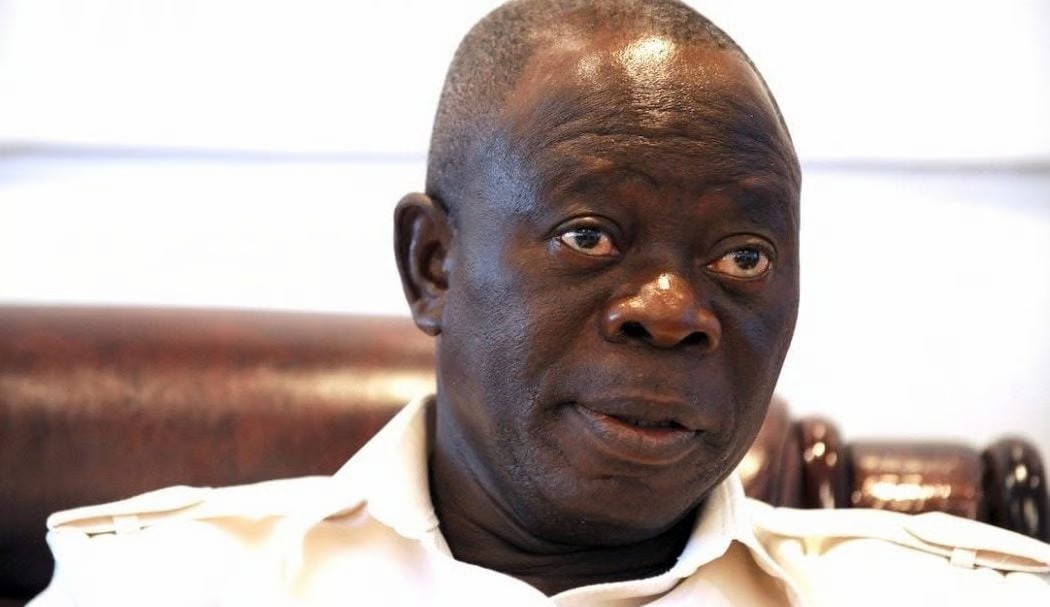
Senator Adams Oshiomhole has alleged that the committee report which recommended the six-month suspension of Senator Natasha Akpoti-Uduaghan contained forged signatures, claiming that some lawmakers whose names appeared on the document neither signed nor approved it.
The Edo North senator made the allegation during an interview on Africa Independent Television (AIT), while reacting to comments by Senate Leader Opeyemi Bamidele regarding the controversial suspension of the Kogi Central lawmaker.
According to Oshiomhole, at least three senators privately informed him that their names were included in the report despite the fact that they did not endorse it by signing the document.
He specifically mentioned Senator Ireti Kingibe, who represents the Federal Capital Territory (FCT), as one of those who allegedly objected to the inclusion of her name.
“The committee holds a hearing; members are expected to sign the report to endorse it. If you don’t agree, you can abstain. But some said they didn’t sign, yet their names were published,” Oshiomhole said.
“People like Senator Ireti Kingibe. She told me, ‘But I didn’t sign that report. Yet my name was published.'”
The former Edo State governor questioned how the names of lawmakers who allegedly refused to endorse the report eventually appeared on the final document presented to the Senate.
According to him, appending a signature to a committee report amounts to supporting its recommendations, while refusing to sign indicates disagreement or neutrality.
“So, where many don’t accept the content, they could abstain from signing because to sign is to endorse. One, two or three senators said, ‘We didn’t sign, but our names were there,'” he stated.
“But how? Some say maybe they attached an attendance register, which is not the appropriate thing. But that’s not my problem. If Opeyemi said so, I think you should take it seriously,” he added.
Oshiomhole’s comments followed recent remarks by Senate Leader Opeyemi Bamidele, who reportedly described Natasha Akpoti-Uduaghan’s suspension as one of the lowest moments of the 10th Senate.
Bamidele’s comments revived public interest in the circumstances that led to the suspension and reopened debate about the procedures adopted by the Senate in handling the matter.
The controversy surrounding Akpoti-Uduaghan’s suspension has remained one of the most discussed issues in the current National Assembly.
The senator representing Kogi Central was suspended by the Senate in March 2025 following allegations of gross misconduct and unruly behaviour.
The disciplinary action was linked to a prolonged dispute involving accusations she made against Senate President Godswill Akpabio.
The disagreement between both lawmakers generated nationwide attention and deepened divisions within political circles and among civil society groups.
The Senate eventually approved recommendations for her suspension, barring her from participating in legislative activities for six months.
As part of the sanctions, Akpoti-Uduaghan’s salaries and allowances were withdrawn for the duration of the suspension.
Her office within the National Assembly complex was also shut, and she was restricted from accessing the premises during the suspension period.
The development sparked mixed reactions across the country.
While some lawmakers and political observers defended the Senate’s decision as necessary to maintain discipline and order within the chamber, others criticised the punishment as excessive.
Women’s groups, rights advocates and some opposition figures argued that the suspension denied the people of Kogi Central effective representation in the Senate.
They maintained that constituents should not suffer because of disagreements involving their elected representative.
The latest allegations by Oshiomhole have added another layer of controversy to the issue.
If proven, claims that signatures were forged or that names of senators were included without their consent could raise serious questions about the integrity of the committee process and the credibility of the report that formed the basis for the suspension.
However, Oshiomhole did not provide documentary evidence to support his allegations during the interview.
Neither the Senate leadership nor members of the committee responsible for the report had publicly responded to the claims at the time of his remarks.
The controversy also comes at a time when public trust in political institutions remains fragile, with many Nigerians demanding greater accountability and openness from elected officials.
For supporters of Akpoti-Uduaghan, Oshiomhole’s allegations could strengthen calls for a reassessment of the suspension process.
For others, the claims represent another chapter in the political tensions that have characterised the relationship between the suspended senator and the Senate leadership.
As the debate continues, attention is likely to remain focused on whether the allegations will prompt an official investigation or further explanation from the National Assembly.