
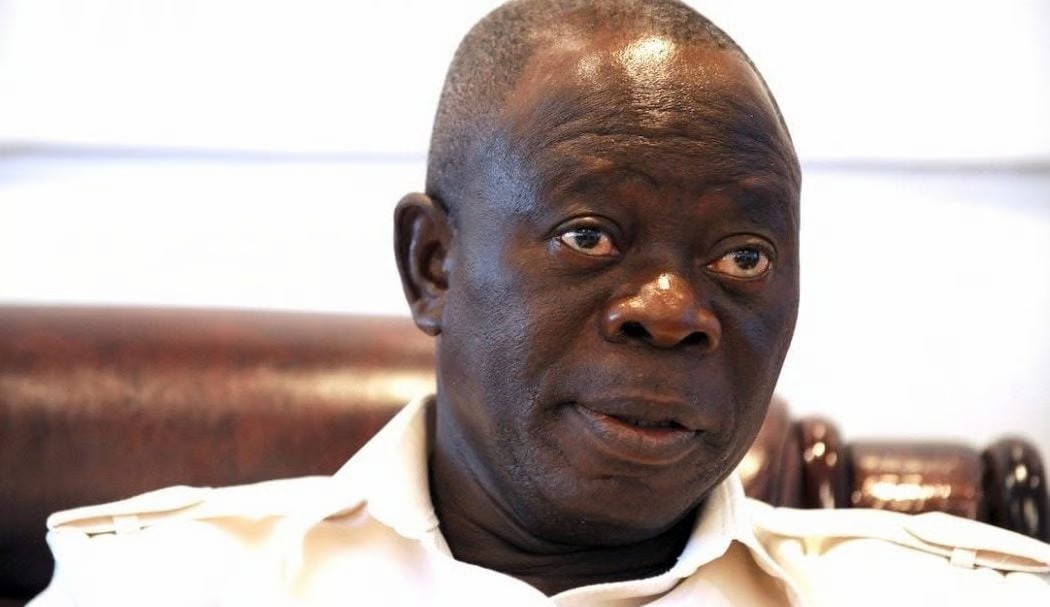
Senator Adams Oshiomhole has defended President Bola Tinubu’s handling of the country’s security challenges, insisting that the President possesses the political will required to tackle insecurity and has demonstrated this through concrete actions since assuming office.
The senator representing Edo North made the remarks on Friday in Abuja during the launch of a book written by the Federal Capital Territory Commandant of the Nigeria Security and Civil Defence Corps (NSCDC), Olusola Odumosu.
Oshiomhole, a former governor of Edo State and former national chairman of the All Progressives Congress (APC), dismissed claims that the Federal Government was not giving adequate attention to the country’s worsening security situation.
According to him, President Tinubu has consistently shown commitment to addressing insecurity through policy decisions, increased funding and administrative measures aimed at strengthening the nation’s security architecture.
He argued that critics who claim the President lacks political will have ignored the practical steps already taken by the administration.
“What is the difficult thing in political will? The commander-in-chief gives the order: go and ensure that the country is safe, as President Bola Tinubu has done repeatedly,” Oshiomhole said.
“I am putting my mouth where I am putting resources, and he has provided more money, even supplementary budget at the National Assembly, approved. What more political will do you need?”
Nigeria has continued to grapple with multiple security threats, including terrorism in the North-East, banditry in the North-West, kidnapping for ransom in several states, communal clashes and attacks by criminal gangs.
The growing insecurity has remained one of the major concerns of Nigerians, with many calling on the government to adopt stronger measures to protect lives and property.
Since taking office, the Tinubu administration has repeatedly pledged to restore security and improve the effectiveness of the country’s security institutions.
Oshiomhole said one of the strongest indications of the President’s determination was his willingness to make difficult decisions, including changes in the leadership of security agencies.
“The Commander-in-Chief decided to declare a state of emergency and even told the armed forces no more excuses. He even replaced the former security chiefs with these ones,” he said.
“To sack chiefs in a village, you know the challenges, not to talk of sacking security chiefs. There is no question that there is no political will.”
The senator called on political leaders across party lines to stop politicising security matters and instead unite in support of efforts to defeat criminal elements threatening the country.
According to him, insecurity should not be viewed through partisan lenses because all Nigerians suffer the consequences when security deteriorates.
“So, I think all of us as a people, particularly those who are in politics, whether in the opposition, need to understand that when it comes to security, there is one Nigeria,” he said.
“There is no APC, no PDP, or whatever.”
He added, “I’m not aware that anybody has been queried for apprehending a dangerous criminal. So what is political will? The President has it in abundance.”
However, while defending the President, Oshiomhole acknowledged that challenges may exist in translating directives from the highest levels of government into effective action on the ground.
He suggested that gaps in implementation within the chain of command could undermine the impact of decisions taken by political leaders and security commanders.
“But between the commander and the other guy in the battlefield, I think it is where we probably can benefit from relations, how the system goes, because the system works on a command basis,” he said.
Addressing the author of the book, Oshiomhole questioned whether officers carrying out assignments always possess the motivation, equipment and welfare support needed to execute their duties effectively.
“As a commander of the FCT, when you give out these instructions—go and do X, Y, Z on the field—and this is to be carried out by other ranks, do you always find out if those in the other ranks share your concerns and are willing, and have the equipment, morale and allowances required to do what you have commanded?” he asked.
The former labour leader also called for a review of the name and perception of the Nigeria Security and Civil Defence Corps.
He argued that the term “civil” appears inconsistent with the dangerous responsibilities assigned to the agency, especially as its personnel increasingly confront heavily armed criminals.
“And lastly, I think from what I can see now, we might need to review the name of the Nigerian Civil Defence,” he said.
“Because the concept of ‘civil’ means do not bear firearms.”
He questioned whether officers confronting oil thieves, vandals and other armed criminals could effectively carry out their duties without access to adequate firepower.
“If the criminals you have to fight have sophisticated weapons, you who is fighting them, your weapon should not be less sophisticated,” he said.
“When we talk of a civil society, it means you can talk, you can persuade. When I see service chiefs holding meetings and I don’t see the CG of NSCDC, I am like something is missing.”
Oshiomhole’s comments appeared to support calls for greater recognition of the NSCDC’s role in the country’s security framework.
In his remarks, the author of the book and FCT Commandant of the NSCDC, Olusola Odumosu, stressed the need for stronger collaboration among security agencies.
He said the publication was intended to promote a united approach to tackling insecurity and to address the persistent problem of rivalry among security institutions.
According to him, no single agency possesses all the knowledge, expertise or resources needed to confront the complex security threats facing Nigeria.
“I am looking at security from a very holistic perspective,” Odumosu said.
“There is need for a united front between security agencies because the challenges are beyond what one agency or individual can handle.”
He identified unhealthy competition among agencies as one of the major obstacles to effective security responses.
“Of course, we have been having issues around unhealthy inter-security agency rivalry which has been a bane to national responses to our security challenges,” he said.
Odumosu urged security organisations to recognise their shared responsibility to protect the country regardless of differences in mandates.
“We have the same focus, the same goal, and whether your mandate is intertwined or interwoven, we have a collective responsibility to ensure peace and order in Nigeria,” he said.
As Nigeria continues its battle against insecurity, the comments by both Oshiomhole and Odumosu have once again brought attention to the importance of leadership, adequate resources, effective implementation and cooperation among security agencies.