
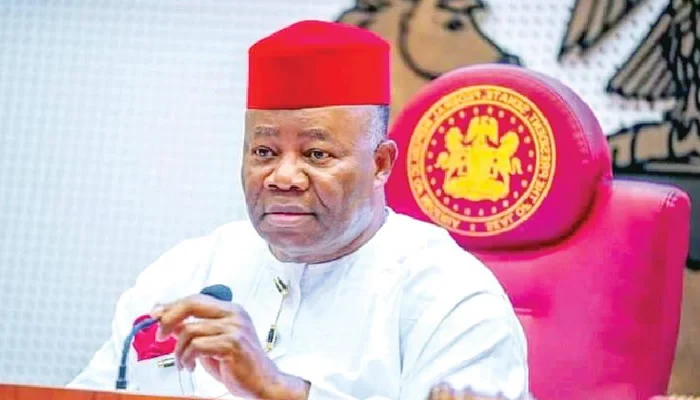
A fresh war of words has erupted over the proposed State Police Bill after an aide to Senate President Godswill Akpabio accused Labour Party presidential candidate in the 2023 election, Peter Obi, of criticising the legislation without reading its contents.
Tijani Mustapha, Special Assistant on Media to the Senate President, said Obi’s comments on the bill showed that he had failed to study the provisions approved by the Senate before making public remarks.
Mustapha made the remarks in a post on X (formerly Twitter) on Friday while responding to Obi’s criticism of the bill recently passed by the Senate.
The exchange comes amid growing national debate over the proposed creation of state police, a long-discussed constitutional reform aimed at allowing state governments to establish and control their own police services alongside the Nigeria Police Force.
Obi had criticised the Senate’s handling of the State Police Bill, describing the process that led to its passage as hasty and lacking in due legislative procedure.
According to the former Anambra State governor, the speed with which the bill was considered raised questions about the motives behind the legislation.
He argued that the manner of its passage had created public suspicion and suggested that important democratic processes were not fully followed before lawmakers approved the proposal.
Obi also expressed concern that there was no public hearing before the Senate passed the bill.
He maintained that such an important constitutional amendment required broad consultations with Nigerians, security experts, civil society organisations and other stakeholders.
According to him, public participation is essential when introducing reforms that could significantly reshape Nigeria’s security architecture.
The former presidential candidate further warned that the creation of state police could be abused by state governors to intimidate or suppress political opponents if adequate safeguards were not put in place.
He said many Nigerians remained concerned about the possibility of governors using state-controlled police for political purposes, especially during elections and periods of political disagreement.
However, Mustapha rejected Obi’s criticism, insisting that the concerns raised had already been addressed in the version of the bill passed by the Senate.
According to him, Obi would not have made those observations if he had carefully read the legislation.
The Senate President’s aide stated that the bill provides for the establishment of an independent State Police Service Commission to oversee the operations of state police and reduce the possibility of political interference.
“I know this because his major concern of the creation of an independent State Police Service Commission was duly addressed in the bill,” Mustapha wrote.
He argued that the provision was specifically included to ensure professionalism, accountability and independence in the administration of state police across the country.
Mustapha also took a swipe at Obi in the course of his response, questioning the former governor’s understanding of the legislation.
“For a man who doesn’t know the meaning of KPI, one again wonders what this individual’s mental capacities are,” he wrote.
His remarks have since generated reactions on social media, with supporters of both political figures defending their respective positions on the proposed legislation.
The debate over state police has remained one of the most controversial constitutional issues in Nigeria for more than two decades.
Supporters of the proposal argue that the country’s current policing structure is overstretched and unable to effectively tackle growing security challenges, including terrorism, banditry, kidnapping, communal clashes and other violent crimes.
They believe that allowing states to establish their own police forces would improve intelligence gathering, strengthen community policing and enable quicker responses to security threats.
Several state governors, traditional rulers and security experts have repeatedly called for decentralised policing, arguing that local authorities better understand the peculiar security challenges within their states.
On the other hand, critics have consistently warned that state police could become political tools in the hands of governors.
They argue that without strong legal safeguards, state governments could deploy police officers to harass political opponents, influence elections or silence critics.
These concerns have remained at the centre of public discussions whenever proposals for state policing are introduced.
The current bill seeks to amend relevant provisions of the Constitution to create a legal framework for state police while also establishing oversight mechanisms, including State Police Service Commissions, to regulate recruitment, discipline and administration.
Although the Senate has passed the bill, it must still complete the constitutional amendment process before becoming law.
Constitutional amendment bills require approval by both chambers of the National Assembly and must also be endorsed by at least two-thirds of the 36 state Houses of Assembly before they can receive presidential assent.
As discussions continue, political leaders, legal experts and civil society organisations are expected to closely examine the details of the legislation to determine whether it contains sufficient safeguards against abuse while addressing Nigeria’s growing security challenges.