
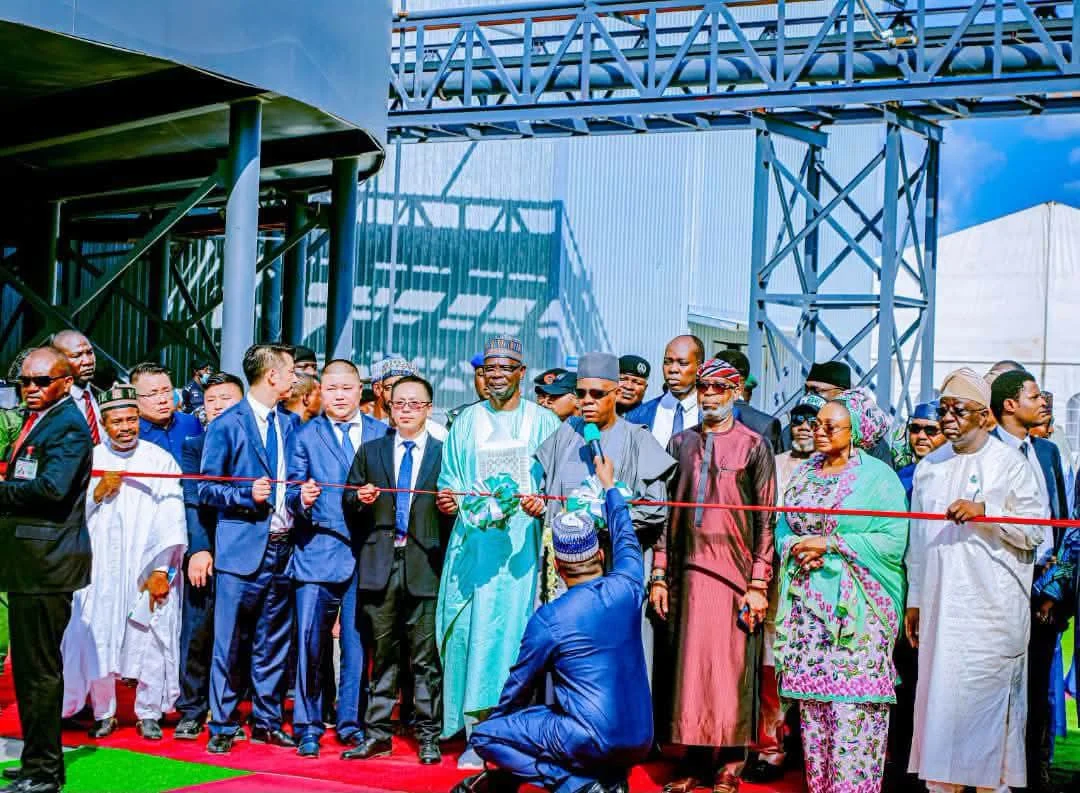
President Bola Tinubu on Thursday inaugurated what the Federal Government described as West Africa’s largest lithium processing plant in Nasarawa State, declaring that Nigeria must move beyond exporting raw minerals and focus on local processing to create jobs, build industries and strengthen the economy.
The new plant, located in Endo community in Nasarawa Local Government Area, has a daily processing capacity of 6,000 metric tonnes and an annual capacity of three million metric tonnes, making it one of the biggest investments in Nigeria’s solid minerals sector in recent years.
The project is expected to boost Nigeria’s ambition to become a major player in the global lithium market, driven by growing demand for batteries used in electric vehicles, renewable energy storage and other modern technologies.
The company behind the investment has already created more than 1,000 direct jobs and over 2,000 indirect jobs since it began operations in the area, providing employment opportunities for residents and stimulating economic activities in the host community.
President Tinubu, who was represented at the inauguration by Vice President Kashim Shettima, said the development reflects his administration’s commitment to transforming Nigeria’s vast mineral resources into real economic benefits for citizens.
He noted that while Nigeria is richly blessed with valuable mineral deposits, natural resources alone do not guarantee economic prosperity.
According to him, countries become successful when they process their natural resources, develop industries around them and create jobs through technology, innovation and skilled manpower.
“Across the world, countries blessed with minerals, oil, gas, fertile lands and strategic locations remain trapped in poverty because they failed to convert these resources into productive capacity, while nations with far fewer advantages have risen to global prominence through discipline, enterprise, technology, skills and industrial organisation,” the President said.
He stressed that natural resources become meaningful only when governments create policies that encourage industrial development and attract investments capable of transforming local economies.
“Natural resources may be a blessing, but only vision can turn them into wealth. Only institutions can protect that wealth. Only industry can multiply it, and only people can give it meaning,” he added.
Tinubu said discussions about Nigeria’s economy have for years focused on the country’s huge deposits of gold, lithium, iron ore, tin, coal, bitumen and rare earth elements.
However, he argued that possessing mineral deposits alone does not improve people’s lives unless those resources are processed locally to create industries and employment.
“But pride does not build factories. Statistics do not create jobs, and mineral maps do not transform the lives of young Nigerians. What changes a nation is a deliberate movement from extraction to processing, from potential to production, from raw materials to value-added goods, and from isolated investments to integrated industrial ecosystems,” he said.
According to the President, the commissioning of the Diamond New Energy lithium processing facility represents investor confidence in Nigeria’s economy and in the reforms introduced by his administration.
He said the project demonstrates that Nigeria is becoming an attractive destination for investors seeking opportunities in the global minerals industry.
Tinubu explained that lithium has become one of the world’s most valuable minerals because of its importance in battery production, electric vehicles and renewable energy technologies.
He therefore described the new plant as more than just another factory, saying it forms part of Nigeria’s broader industrial development strategy.
“A factory is never just a building; it is where policy becomes employment, where investment becomes production, and where hope begins to acquire structure. Every factory that opens on Nigerian soil is an act of faith in our people, our institutions and the possibilities of this Republic,” he said.
The President also commended Nasarawa State Governor Abdullahi Sule for creating an enabling environment that has attracted major investments into the state’s mining sector.
He said the governor’s leadership had helped position Nasarawa as one of Nigeria’s leading destinations for solid minerals development.
According to Tinubu, investments flourish where there is good leadership, peace and stable policies.
“There can never be peace without development, and there can never be development without peace,” he said.
Speaking at the event, Governor Sule thanked the management of the company for choosing Nasarawa State as the location for the investment.
He described the project as a major milestone for the state and urged more local and foreign investors to take advantage of Nasarawa’s rich mineral deposits and business-friendly environment.
The governor said the state has commercial deposits of lithium, lead, zinc, copper, gold, gemstones, marble and iron ore, making it one of Nigeria’s richest mining destinations.
He also highlighted the state’s fertile agricultural land and its proximity to the Federal Capital Territory as additional advantages for businesses.
“I want to thank the Chairman and the CEO of this company for believing in us, coming to Nasarawa State and believing that Nasarawa State is the destination for your investment,” Sule said.
He also praised residents of Endo community for their patience and cooperation throughout the period leading to the completion of the project.
“The biggest beneficiaries of this effort are you people,” the governor told community members.
Also speaking, the Minister of Solid Minerals Development, Dele Alake, described the project as proof that the Federal Government’s policy on local value addition in the mining sector is already producing results.
He said the Tinubu administration is determined to end the practice of exporting raw minerals without processing them within Nigeria.
According to him, encouraging local processing will create more jobs, develop technical skills and increase revenue from the mining industry.
“What we are doing here today is an eloquent testimony to the prophetic statement of Mr President and to our commitment in the Ministry of Solid Minerals to developing and transforming Nigeria’s solid minerals sector,” Alake said.
The minister explained that local value addition has become one of the central pillars of the ministry’s reforms.
He expressed satisfaction that mining companies are embracing the policy by investing in processing facilities instead of simply exporting raw minerals.
Alake also revealed that several African countries have started adopting similar policies after seeing Nigeria’s approach.
“Virtually every other African country where mining is taking place is now issuing directives against the export of raw minerals,” he said.
Nigeria is believed to possess significant deposits of lithium, especially in Nasarawa, Kogi, Ekiti, Kwara and parts of the North Central region. In recent years, global demand for the mineral has risen sharply because it is a key component in rechargeable batteries used in electric vehicles, mobile phones, laptops and renewable energy systems.
The Federal Government has identified the solid minerals sector as one of the key industries expected to diversify the economy, reduce dependence on crude oil and generate foreign exchange earnings.