
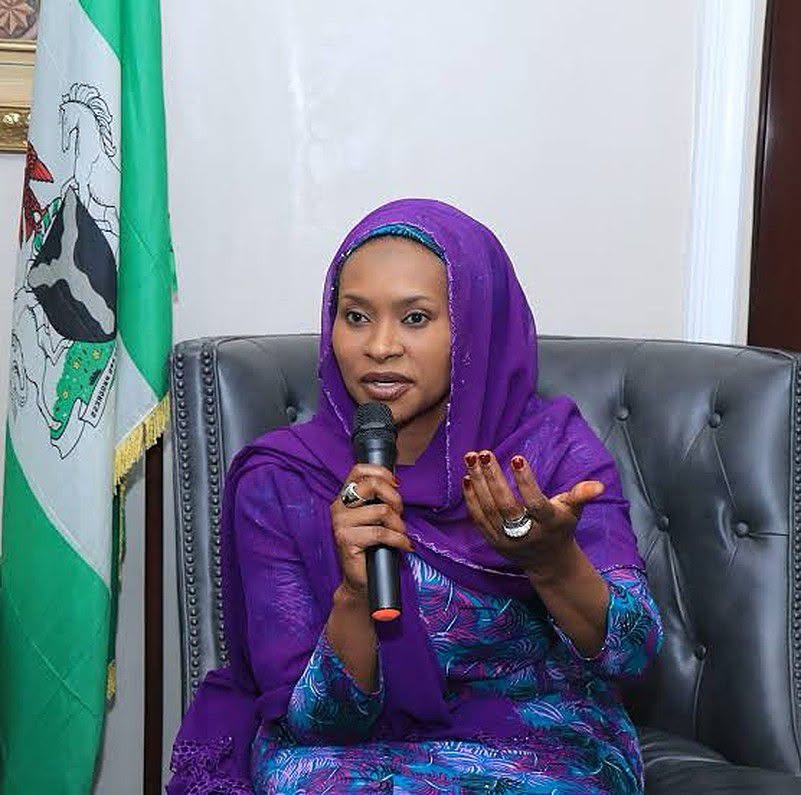
The wife of former Kaduna State Governor Nasir El-Rufai, Hajiya Asia El-Rufai, has condemned the arrest of her husband’s longtime personal physician, Professor Bello Abubakar, warning that the development could have far-reaching consequences for Nigeria’s healthcare system and discourage doctors from carrying out their professional duties without fear.
Speaking during an interview on ARISE NEWS on Wednesday, the lawyer described the arrest as a dangerous trend that goes beyond the legal challenges facing her husband. She argued that healthcare should never become a tool in political or legal disputes and warned that intimidating medical professionals could deepen the country’s shortage of doctors.
According to her, if doctors become afraid to give independent medical opinions because of the risk of arrest or harassment, many more healthcare professionals may decide to leave Nigeria in search of safer working environments.
“The fact that we are weaponising healthcare. If doctors become afraid to offer opinions, what does it say? It’s not about Nasir El-Rufai anymore. It’s about the fact that professionals are being muzzled so that they are afraid to give professional opinions,” she said.
She questioned what such actions say about Nigeria as a country, especially at a time when many trained doctors and other healthcare workers are leaving for better opportunities abroad.
“What does this say about our nation? We have been saying that our people are running away to go abroad to be doctors and all that. This is one example of what will make somebody leave,” she added.
Her comments came amid the continued controversy surrounding the detention and prosecution of the former Kaduna governor, whose legal battle has attracted widespread political attention and divided public opinion.
Asia El-Rufai disclosed that Professor Bello Abubakar had been her husband’s personal physician for many years, dating back to his time as Director-General of the Bureau of Public Enterprises (BPE).
According to her, despite the long-standing relationship between the doctor and her husband, authorities have prevented the former governor from consulting him.
“They’ve now arrested him. Professor Bello has been mallam’s doctor since mallam was DG, BPE,” she said.
She also revealed that while authorities had taken El-Rufai to specialist eye clinics for treatment, they allegedly refused to allow him access to his preferred physician.
According to her, the former governor suffers from glaucoma and has received treatment from different eye specialists while in custody. However, she claimed that access to Professor Bello had remained restricted.
“That’s quite dicey to say because previously, they’ve taken him to see his eye doctors, the different eye clinics, because he has issues with glaucoma. However, they do not want him to access, I think, this particular doctor. Whatever the reason is,” she stated.
Glaucoma is a long-term eye disease that damages the optic nerve and can lead to permanent blindness if not properly managed. Medical experts say patients often require regular monitoring by doctors familiar with their medical history.
Asia also rejected allegations that her husband’s visits to hospital were being used as an opportunity to hold political meetings with associates.
She insisted that every hospital visit was solely for medical treatment and complied with a court order granting him unrestricted access to healthcare.
According to her, claims that El-Rufai deliberately used hospital appointments to meet politicians were false and ignored the circumstances surrounding his medical visits.
“There is no court directive, sir. The court directive was very clear: he should have unfettered access to health care. The ICPC is interpreting the order too narrowly,” she said.
She explained that the family deliberately requested evening appointments to reduce public attention and avoid unnecessary contact with visitors.
According to her, appointments were usually fixed for around 5 p.m. because hospitals are generally less crowded at that time.
She said after each consultation, officials insisted on collecting a medical report from the attending doctor, requiring El-Rufai to wait in the hospital reception while the report was prepared.
During that waiting period, she said, members of the public who recognised the former governor naturally approached him to exchange greetings.
“What I will say about this is that we requested for 5pm because of the same issue. It will be less busy, there will be less people. They opened the door. Now, after the consultation, they always insist on a report. And that letter, they asked mallam to wait to collect the letter. Mallam was sitting in the reception. There were people already there. Mallam is a prominent person, people come to greet him,” she explained.
She argued that it would be unreasonable to accuse him of arranging political meetings simply because people greeted him in a public place.
“And so, if in the process, something went wrong, people that they didn’t want to see happened to be there, how do you blame him? A conversation… yeah, he had conversations; in a public place. It’s not as if it was a closed-door meeting. It’s not as if he called somebody to come,” she said.
She further questioned how authorities could accuse her husband of organising political meetings while he remained without access to communication devices.
“You informed him at 7pm. He does not have access to a phone. How is it that he arranged to have a meeting with politicians?” she asked.
The former Kaduna governor has remained at the centre of public attention following his arrest and ongoing legal proceedings. His detention has generated reactions from political allies, civil society groups and legal experts, with many calling for strict adherence to constitutional rights and due process.
Earlier this week, former presidential adviser Dr. Hakeem Baba-Ahmed described El-Rufai as a political prisoner, arguing that his continued detention without a speedy conclusion of legal proceedings was damaging public confidence in the rule of law.
Members of El-Rufai’s family have also appealed to the Federal Government to ensure that he receives fair treatment and that his constitutional rights, including access to adequate medical care, are protected throughout the legal process.
The controversy has also renewed discussions about the independence of medical professionals in Nigeria. Health experts have long argued that doctors should be free to provide medical opinions based solely on professional judgment, without fear of intimidation or interference.
Nigeria has continued to struggle with the migration of healthcare workers to Europe, North America and the Middle East, where working conditions and salaries are generally better. Medical associations have repeatedly warned that the country is losing thousands of experienced doctors every year, placing additional pressure on an already overstretched healthcare system.
Against this backdrop, Asia El-Rufai said the arrest of her husband’s physician sends the wrong message to healthcare professionals and could further weaken confidence in the medical profession.