
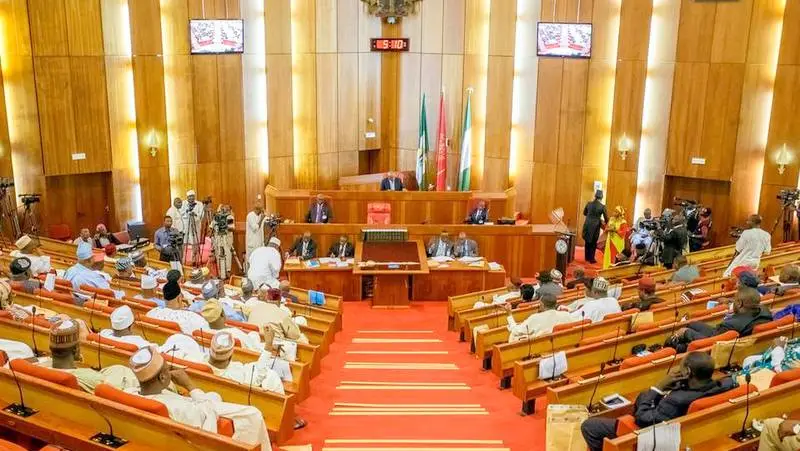
The Senate on Thursday passed a bill seeking to establish an independent agency that will oversee the recovery, protection, management and disposal of assets linked to criminal activities, in what lawmakers described as a major step towards strengthening Nigeria’s anti-corruption system.
The upper chamber also approved a separate bill to repeal and re-enact the Legal Practitioners Act, introducing a new legal framework aimed at improving the regulation of the legal profession in Nigeria.
Both the Proceeds of Crime Act (Amendment) Bill, 2026 (SB. 343) and the Legal Practitioners Act (Repeal and Re-enactment) Bill, 2026 (SB. 965), scaled third reading during Thursday’s plenary after senators considered and adopted the reports of the Senate Committee on Judiciary, Human Rights and Legal Matters.
The proposed agency under the Proceeds of Crime Act (Amendment) Bill will be responsible for the recovery, preservation, administration and disposal of assets believed to have been acquired through illegal activities. Lawmakers said the move would bring greater transparency and accountability to the management of recovered assets and prevent waste or misuse.
Presenting the committee’s report, Chairman of the Senate Committee on Judiciary, Human Rights and Legal Matters, Senator Adeniyi Adegbonmire, said the amendment was necessary to address long-standing concerns over how assets recovered from criminal activities are handled.
According to him, Nigeria’s anti-corruption efforts have for years suffered from the absence of a central body dedicated to managing seized and forfeited assets.
He explained that the proposed agency would coordinate the recovery, preservation and disposal of such assets in line with the law, ensuring they are properly managed until final forfeiture or disposal.
Adegbonmire said the legislation would close a major gap in Nigeria’s anti-corruption framework.
“The bill addresses a genuine and long-standing gap in Nigeria’s anti-corruption architecture,” he said.
“Its objectives are laudable, its need is urgent, and the committee is satisfied that, with the amendments recommended in this report, it will serve the public interest well.”
The lawmaker noted that creating a specialised agency would improve transparency and ensure that recovered properties are protected from deterioration, abuse or illegal disposal.
Over the years, concerns have been raised over the condition and management of assets seized by anti-corruption agencies. Some recovered properties have reportedly deteriorated because of poor maintenance, while allegations have also emerged in the past over the disappearance or questionable disposal of recovered assets.
Speaking after the bill was passed, Senate President Godswill Akpabio said the establishment of the agency would ensure recovered properties are managed in the interest of Nigerians.
He said the Senate had taken an important step by approving the legislation.
“Now we have an agency that will manage those properties for the benefit of Nigerians. I also thank my colleagues for rising to the occasion and seeing the need to conclude this,” Akpabio said.
The Senate considered the committee’s recommendations clause by clause while sitting as the Committee of the Whole before adopting the amendments through a voice vote. The bill was thereafter read for the third time and passed.
The lawmakers also passed the Legal Practitioners Act (Repeal and Re-enactment) Bill, which seeks to replace the existing Legal Practitioners Act, Cap. L11, Laws of the Federation of Nigeria, 2004.
According to Adegbonmire, the current law has become outdated and no longer reflects the realities and demands of modern legal practice.
He said the proposed legislation would establish a stronger regulatory framework for the legal profession while promoting higher professional standards.
“The Senate Committee on Judiciary, Human Rights and Legal Matters recommends that the Senate do consider and pass the bill for an Act to repeal the Legal Practitioners Act Cap. L11, Laws of the Federation of Nigeria, 2004, and enact the Legal Practitioners Act, 2025, to provide for the regulation of the legal profession in Nigeria and for related matters, subject to the observations, findings and amendments set out in this report,” he said.
Adegbonmire added that the committee conducted a detailed review of the bill because of its significance to the country’s justice system.
He described lawyers as key defenders of the rule of law and said an effective legal profession depends on a modern and credible regulatory framework.
“The legal profession is the guardian of the rule of law, and the primary instrument through which Nigerians access justice.
“The framework that governs it must be constitutionally sound, proportionate and worthy of the confidence of both the profession and the public itself,” he said.
The passage of the Legal Practitioners Bill is expected to pave the way for reforms in the regulation of lawyers, legal education and professional conduct, although the full details of the new provisions will become clearer after the law is enacted.
The Senate’s approval of both bills forms part of ongoing legislative efforts to strengthen public institutions and improve governance.
Nigeria has, over the years, introduced several laws aimed at tackling corruption, including the Proceeds of Crime Act, which provides legal procedures for tracing, freezing, confiscating and managing assets believed to be proceeds of criminal activities.
However, stakeholders have argued that the absence of a dedicated agency to manage recovered assets has weakened implementation and created opportunities for abuse.
Similarly, legal practitioners have for years sought reforms to the Legal Practitioners Act to address emerging challenges in the legal profession, improve regulation and align existing laws with current realities.
Although both bills have cleared the Senate, they are yet to become law.
In line with the legislative process, they will now be transmitted to the House of Representatives for concurrence. If approved by the lower chamber, the bills will then be forwarded to the President for assent before they become law.