
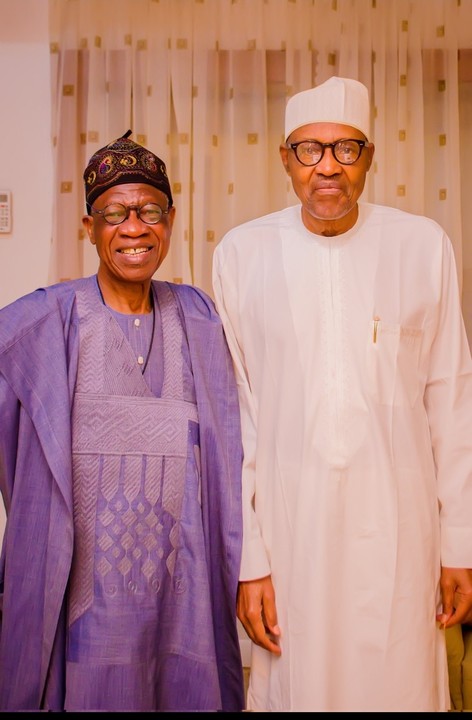
Former Minister of Information and Culture, Lai Mohammed, has shared a light-hearted story about the late former President Muhammadu Buhari, revealing how the ex-president once jokingly asked him how many people he had killed because of his frequent fasting.
Mohammed recounted the incident in Abuja during an event held to mark one year since Buhari’s death. The gathering brought together political associates, former government officials and admirers who paid tribute to the former Nigerian leader, recalling his personal qualities, leadership style and years of public service.
Speaking at the memorial, Mohammed said the encounter happened after the formation of the All Progressives Congress (APC) in 2013, when he regularly visited Buhari in Kaduna alongside the party’s national leader at the time, Bola Tinubu, who is now Nigeria’s president, and former APC National Chairman, Chief Bisi Akande.
According to him, the visits often took place on Mondays or Thursdays, the two days of the week on which he observed voluntary fasting.
Mohammed explained that whenever food was served during the visits, he politely declined to join the others at the dining table because he was fasting.
He said Buhari initially noticed his refusal to eat and became curious.
“After the merger in 2013, I used to accompany Chief Bisi Akande and the president today, Bola Tinubu, to see the president in Kaduna, and incidentally it used to be either a Monday or a Thursday,” Mohammed said.
“And every time I was invited to come to the table, I would excuse myself, until one day, the president asked Asiwaju, ‘Doesn’t Lai trust me enough to eat in my house?’ And Asiwaju said, ‘No, Lai fasts on Mondays and Thursdays.'”
Mohammed said the explanation did not completely satisfy Buhari, who later called him aside for a private conversation.
He recalled that Buhari looked at him and jokingly asked, “Lai, tell me the truth; how many people have you killed?”
Surprised by the question, Mohammed said he quickly replied that he had never killed anyone.
According to him, Buhari then responded with another humorous remark: “Why are you fasting every day?”
The audience at the memorial responded with laughter as Mohammed narrated the story, using it to highlight Buhari’s simple nature and sense of humour, which he said many people rarely saw in public.
The former minister said the incident reflected the warm personal relationship he enjoyed with Buhari over the years.
He noted that their relationship went beyond official duties in government and continued even after Buhari left office in May 2023.
Mohammed said he deliberately maintained regular contact with the former president after his retirement, visiting him both in his hometown of Daura in Katsina State and at his Kaduna residence.
He described those visits as moments of quiet reflection during which they discussed national issues and shared personal conversations away from the pressures of public life.
“The unique and special relationship I enjoyed with Buhari transcended our years in office,” Mohammed said.
“I made a conscious effort to maintain regular contact with him after he retired from public office, visiting him both in Daura and Kaduna to spend quiet time with him.”
He added that serving under Buhari remained one of the greatest privileges of his public career.
“It was an extraordinary privilege to have known, served, and worked alongside Buhari,” he said.
Muhammadu Buhari, a retired Major General, served as Nigeria’s military Head of State between January 1984 and August 1985 before returning as a democratically elected president in 2015. He won a second term in 2019 and completed eight years in office before handing over to President Bola Tinubu in May 2023.
During his presidency, Buhari was widely known for his disciplined lifestyle, personal austerity and commitment to fighting corruption, although his administration also faced criticism over insecurity, economic challenges and rising inflation.
His death last year marked the end of a political career that spanned several decades. Since then, political leaders, former aides and associates have continued to reflect on his legacy and share personal memories that reveal a different side of the former president.
The Abuja memorial formed part of activities organised to remember Buhari’s contributions to Nigeria and celebrate his life. Speakers at the event described him as a man of integrity, discipline and strong convictions, while also recalling moments that showed his human side.
Mohammed’s account stood out because it offered a rare glimpse into Buhari’s private personality. Although the former president was often viewed by the public as reserved and serious, the story suggested he also had a playful sense of humour, especially with people he knew well.
The former minister said the memory remains one of his favourite experiences with Buhari, adding that it reflected the trust and friendship they built over many years in politics and government.