
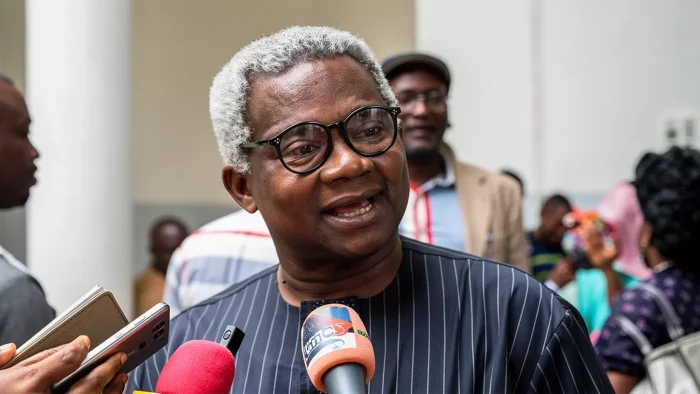
A founding member of the All Progressives Congress (APC), Osita Okechukwu, has urged the presidential candidate of the African Democratic Congress (ADC), Atiku Abubakar, to allow the South to complete its turn in the presidency in the interest of national unity and political stability.
Okechukwu made the appeal on Sunday while reacting to calls by the Southern Political Progressive Amalgamation Forum, which had advised Atiku to carefully consider his choice of running mate ahead of the 2027 presidential election in order to strengthen his support in the South.
However, the APC chieftain said the issue before Atiku was bigger than selecting a vice-presidential candidate. According to him, the former Vice President should instead respect the principle of power rotation by allowing the South to complete its tenure before seeking the presidency again.
In a statement he personally signed, Okechukwu dismissed the forum’s appeal, arguing that similar pressures from political groups contributed to Atiku’s decision to abandon the zoning arrangement in the Peoples Democratic Party (PDP), a development he said triggered prolonged internal crises within the opposition party.
He maintained that Nigeria’s democracy would be stronger if political leaders respected the unwritten agreement on the rotation of presidential power between the North and the South.
According to him, the zoning principle has remained an important tool for promoting fairness, national inclusion and peaceful coexistence in a country as diverse as Nigeria.
Okechukwu recalled that Atiku had in the past supported zoning and acknowledged its importance during the administration of former President Goodluck Jonathan.
He argued that having benefited from the rotational arrangement in previous political contests, the former Vice President should continue to uphold the principle rather than seek to alter it.
The former Director-General of the Voice of Nigeria (VON) said adherence to zoning would strengthen democracy and help reduce political tension across the country.
He urged Atiku to return to what he described as the convention of power rotation, insisting that it remained one of the best ways to preserve national unity and political balance.
According to Okechukwu, allowing the South to complete its turn would also reinforce public confidence in the country’s democratic process and demonstrate respect for political agreements.
“It is never too late to make things right,” he said.
“He should act like a leader and stop blaming President Tinubu with harsh words. Instead, he should use the few months left to build a strong opposition.”
The debate over zoning has continued to dominate political discussions ahead of the 2027 general election.
Although Nigeria’s Constitution does not require the presidency to rotate between regions, major political parties have, over the years, adopted zoning or power-sharing arrangements to ensure that both the North and the South have opportunities to produce the country’s leader.
Supporters of zoning argue that the arrangement promotes equity and gives every region a sense of belonging in the nation’s leadership. They believe it has helped to reduce political tension in a country with diverse ethnic, religious and regional interests.
On the other hand, opponents argue that political parties should be free to nominate candidates based on competence and electoral strength rather than geographical considerations.
The issue became more contentious before the 2023 general election when the PDP fielded Atiku Abubakar, a northerner, as its presidential candidate following the completion of President Muhammadu Buhari’s eight-year tenure.
The decision generated sharp divisions within the party, with many southern leaders insisting that the presidency should shift to the South in line with the party’s zoning tradition.
The disagreement led to the emergence of the G5 governors, led by former Rivers State Governor Nyesom Wike, who opposed Atiku’s candidacy and demanded that the party’s presidential ticket be zoned to the South.
President Bola Tinubu of the APC, a southerner, eventually won the election and is currently serving his first term in office.
As preparations gradually begin for the 2027 elections, conversations about zoning, power rotation and regional balance have again resurfaced across the political landscape.
Atiku, who has contested for the presidency multiple times under different political platforms, remains one of the leading opposition figures and is expected to play a major role in the next election.
The African Democratic Congress has also been attracting attention following the movement of several opposition politicians into the party as efforts continue to build a broad coalition ahead of the polls.