
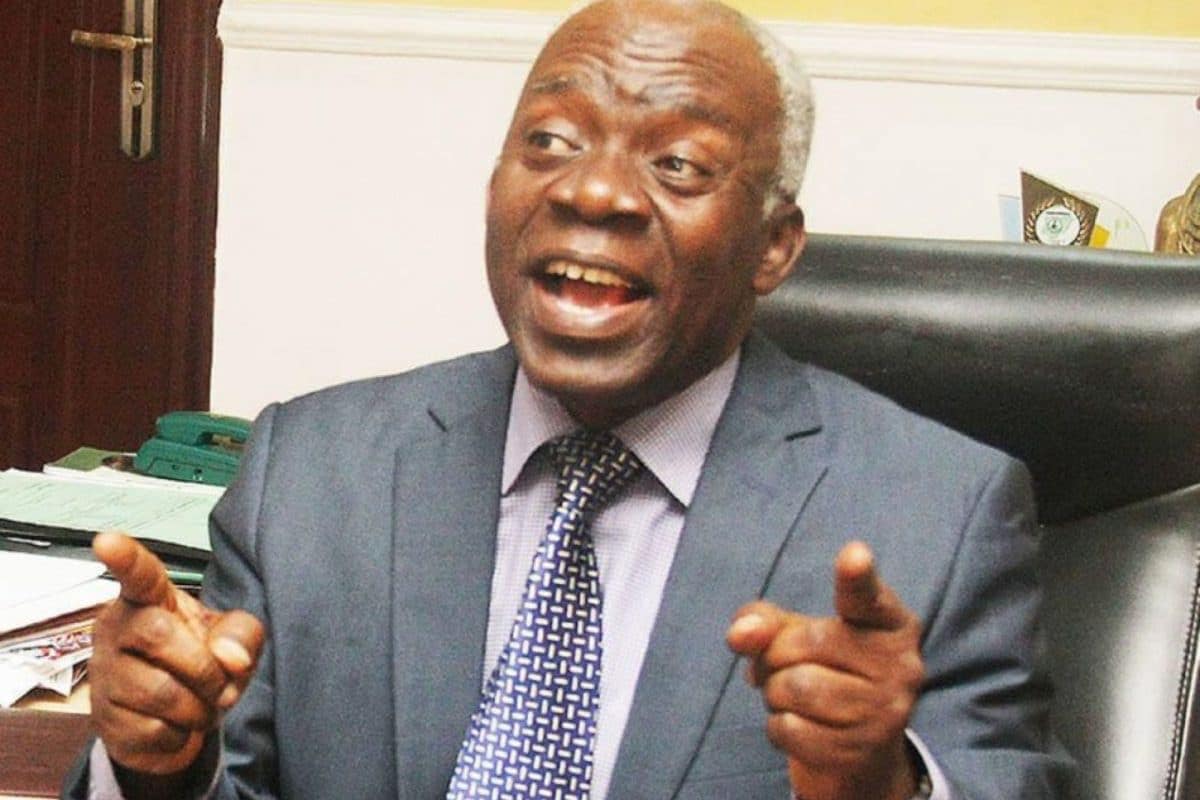
Human rights lawyer and Senior Advocate of Nigeria (SAN), Femi Falana, has urged the governments of Nigeria and Ghana to take legal action against South Africa before the African Court on Human and Peoples’ Rights over renewed xenophobic attacks on African migrants.
Falana said the two countries should seek compensation for their citizens who were forced to flee South Africa after losing businesses, investments and other properties during the latest wave of attacks.
In a statement issued on Sunday, the senior lawyer argued that referring the matter to the African Union (AU) would not produce any meaningful result because the continental body does not have the legal authority to award compensation to victims.
Instead, he said the African Court on Human and Peoples’ Rights, based in Arusha, Tanzania, is the appropriate institution to hear the case and order damages against the South African government if it finds that the rights of the victims were violated.
“The decision of the governments of Nigeria and Ghana to report South Africa to the African Union is completely diversionary and time-wasting,” Falana said.
He added that the African Union lacks the legal powers to compel the South African government to compensate victims of xenophobic violence.
Falana’s comments followed reports that the South African government had rejected Nigeria’s request for compensation for citizens who abandoned their businesses and properties while escaping renewed attacks.
The Federal Government had earlier announced plans to seek compensation for affected Nigerians.
Nigeria’s Acting High Commissioner to South Africa, Alexander Ajayi, also disclosed that the Nigerian mission had begun documenting businesses, investments and properties left behind by victims to support discussions with the South African authorities.
However, Falana criticised Pretoria’s reported refusal to pay compensation, describing the decision as insensitive to the suffering of the victims.
According to him, many Nigerians and other African migrants lost years of hard work and investment after they were forced to flee for their safety.
He accused the administration of South African President Cyril Ramaphosa of failing to show empathy to affected migrants.
“Out of sheer insensitivity, the Cyril Ramaphosa administration has turned round to reject Nigeria’s request for compensation for its citizens who were forced to abandon their businesses and properties after fleeing renewed xenophobic attacks,” he said.
Falana noted that South African authorities reportedly justified their refusal by claiming that many of the affected migrants were living in the country illegally.
He, however, said many of the victims had disputed the allegation, insisting they were law-abiding residents before the attacks forced them to leave.
The senior advocate urged not only Nigeria and Ghana but also other African countries whose citizens were attacked or killed during the violence to jointly institute legal proceedings against South Africa.
According to him, the case should seek immediate measures to stop further attacks while also asking the court to award aggravated damages to victims.
“I am compelled to call on Nigeria, Ghana and other African countries whose nationals have either been killed or brutalised in the xenophobic attacks to sue the South African Government at the African Court on Human and Peoples’ Rights in Arusha, Tanzania,” he said.
He explained that apart from compensation, the affected countries should ask the court to issue provisional orders directing South Africa to take urgent steps to prevent further attacks on foreign nationals.
Falana argued that the attacks and forced displacement of African migrants violated the African Charter on Human and Peoples’ Rights.
He specifically referred to Article 12 of the charter, which prohibits the mass expulsion of non-nationals except in accordance with the law.
According to him, the repeated attacks on African migrants and the failure of authorities to protect them amount to violations of regional human rights obligations.
The human rights lawyer also criticised comments reportedly made by President Ramaphosa urging migrants to obey South Africa’s laws and traditions.
Falana argued that such statements could be interpreted as encouraging anti-immigrant sentiments rather than addressing the violence directed at foreign nationals.
He further drew attention to South Africa’s role in international human rights advocacy.
Falana recalled that South Africa successfully approached the International Court of Justice (ICJ) over allegations of genocide against Israel in the Gaza conflict.
He argued that if South Africa expects other countries to comply with international human rights standards, it should also be held accountable under African human rights mechanisms for failing to protect migrants within its borders.
Beyond the case against South Africa, Falana also called on the administration of President Bola Tinubu to strengthen Nigeria’s commitment to the African Court on Human and Peoples’ Rights.
He pointed out that Nigeria has not made the declaration required under Article 34(6) of the court’s protocol, which allows individuals and non-governmental organisations to directly file cases before the court.
According to him, accepting the court’s jurisdiction would make it easier for Nigerians whose rights are violated in other African countries to seek justice without depending solely on government action.
“If Nigeria had recognised the competence of the court, victims of xenophobic attacks and other gross abuses of human rights in South Africa and other African countries would have been able to seek legal redress, including payment of compensatory damages,” he said.
He therefore urged the Tinubu administration to take the necessary legal steps to enable Nigerian citizens to access the regional court.
Nigeria and South Africa have enjoyed strong diplomatic and economic ties for decades and are regarded as two of Africa’s largest economies.
However, relations between both countries have repeatedly come under strain because of recurring xenophobic attacks on Nigerians and other African migrants living in South Africa.
Major outbreaks of violence in 2015 and 2019 resulted in the deaths of several foreign nationals, widespread destruction of businesses and the evacuation of hundreds of Nigerians back home.
Those incidents sparked diplomatic protests, with Nigeria demanding better protection for its citizens and compensation for victims.
In recent weeks, another wave of attacks reportedly forced thousands of African migrants, including Nigerians and Ghanaians, to flee parts of South Africa amid rising anti-immigrant sentiment.
Following the latest incidents, the Nigerian government announced plans to seek compensation for affected citizens and directed officials to document abandoned businesses and properties.
South African authorities, however, reportedly rejected the request, maintaining that many of those affected were living in the country illegally.
The victims have disputed that claim, insisting they were targeted because they were foreigners and that they deserve justice and compensation for the losses they suffered.
Falana maintained that only a legal challenge before the African Court on Human and Peoples’ Rights would provide an effective remedy for the victims and help prevent future attacks on African migrants across the continent.