
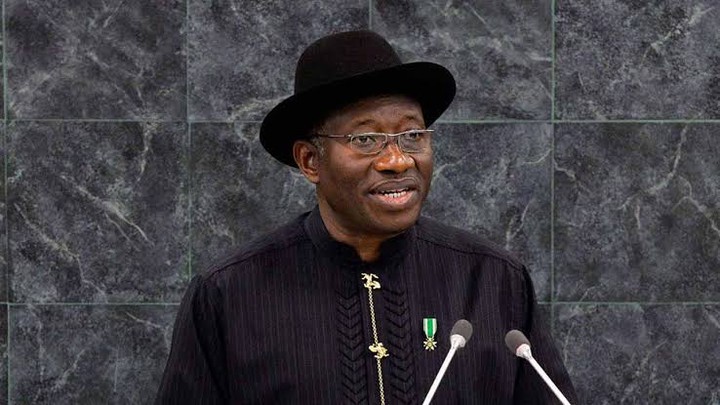
Former President Goodluck Jonathan has revealed how he risked his life by entering a militant camp in the Niger Delta without armed security in a bid to end years of violence that threatened Nigeria’s oil industry and national economy.
Jonathan said the daring visit took place while he was serving as Vice President, despite strong objections from security chiefs who warned that the mission was too dangerous.
According to him, the decision to go into the camp unarmed helped build trust with the militants and laid the foundation for negotiations that eventually led to the Niger Delta Amnesty Program, which has remained one of the Federal Government’s major peace initiatives in the region.
The former President made the disclosure on Monday while delivering the chairman’s address at the De Mangrove Conversation, held at the Nigerian Content Development and Monitoring Board (NCDMB) Conference Hall in Yenagoa, Bayelsa State.
The event was organised in collaboration with the Bayelsa State Government, the Niger Delta Development Commission (NDDC), the Nigerian Content Development and Monitoring Board (NCDMB), Renaissance Africa Energy and the Goodluck Jonathan Foundation.
Jonathan used the occasion to reflect on his long relationship with the Niger Delta and Nigeria’s oil industry, saying his understanding of the region’s problems began from childhood and deepened through his career as a scientist, governor, vice president and eventually president.
He said growing up in what is now Bayelsa State, he witnessed the arrival of oil companies and the gradual expansion of oil exploration in communities across the Niger Delta.
According to him, his professional career later gave him the opportunity to conduct environmental studies on the impact of oil exploration, allowing him to understand first-hand the environmental damage suffered by communities in the region.
Jonathan said these experiences gave him a unique perspective on the social, environmental and economic challenges facing the Niger Delta.
He explained that when he became Vice President, he was entrusted with leading negotiations aimed at ending the violence that had crippled oil production and threatened national stability.
At the time, militant groups frequently attacked oil pipelines, kidnapped expatriate workers and engaged security forces in violent confrontations.
The insecurity disrupted crude oil production, reduced government revenue and created serious concerns for investors in Nigeria’s petroleum sector.
Jonathan recalled that one of the most difficult parts of the peace mission was his decision to personally visit Camp One, one of the best-known militant camps in the region.
He said the militants sent word that they were ready to receive him but insisted that nobody accompanying him should carry any weapon.
According to him, they warned that if any member of his delegation arrived armed, there would be an exchange of gunfire.
He said the warning immediately alarmed security officials responsible for his safety.
Jonathan recalled that both the Delta State Commissioner of Police and the State Director of the State Security Service strongly advised him not to proceed with the visit because of the obvious danger.
However, he said he believed peace could only be achieved through dialogue and mutual trust.
“As the vice president, I was to go and negotiate to bring peace to the Niger Delta,” Jonathan said.
He explained that after arriving in Warri with his security team, he received the militants’ message and decided to comply with their conditions.
“I told them I will go. There must be peace and development in the Niger Delta,” he said.
Jonathan said he then instructed every member of his security team wearing a uniform to remain behind.
Only his Chief Security Officer (CSO) and Aide-de-Camp (ADC) accompanied him to the camp, but even they were ordered to surrender their firearms before the journey continued.
According to him, he instructed both officers to hand over their weapons to the Commissioner of Police and the State Director of the State Security Service.
“I told them if we come back alive, you get your guns back and we will go back to Abuja,” he recalled.
Jonathan said arriving at the camp was a tense moment.
He described seeing two long lines of armed young men standing on both sides of the path leading to the meeting venue.
The militants, he said, carried different kinds of rifles while he and his aides walked between them without weapons.
“When we arrived at the camp, there were two lines of young people… with assorted rifles,” he said.
“We passed in-between the two lines.”
He added that the discussions with the militant leaders lasted for about one and a half hours before his team safely returned to Abuja.
According to him, the meeting marked a turning point in the Federal Government’s engagement with militant groups.
He said the dialogue eventually resulted in the creation of the Niger Delta Amnesty Programme, through which thousands of militants surrendered their weapons in exchange for rehabilitation, education, vocational training and reintegration into society.
“That meeting led to the birth of Amnesty granted to the Niger Delta militants,” Jonathan said.
“Amnesty is still there till today. That was the beginning of peace in the Niger Delta region.”
The Presidential Amnesty Program was officially launched in 2009 during the administration of the late President Umaru Musa Yar’Adua, with Jonathan serving as Vice President before succeeding Yar’Adua as President in 2010.
The program significantly reduced attacks on oil installations and helped Nigeria recover lost crude oil production.
Thousands of former militants benefited from education and skills acquisition programs both within Nigeria and abroad.
Although the program has been praised for improving security and restoring oil production, it has also faced criticism over allegations of corruption, poor management and delays in implementing some of its promises.
Despite these challenges, it remains one of the Federal Government’s longest-running peace initiatives.
Jonathan stressed that peace alone would not solve the problems of the Niger Delta.
He said sustainable peace depends on addressing the environmental destruction caused by decades of oil exploration, including oil spills, pollution and the destruction of mangrove forests.
According to him, the people of the region deserve greater attention because they have endured years of environmental degradation while contributing significantly to Nigeria’s economy through oil production.
He urged governments at all levels, development agencies, oil companies and community leaders to work together to protect the environment and improve the living conditions of people in the region.
The former President also highlighted that development should remain a national priority for the Niger Delta, saying infrastructure, environmental restoration, education and economic opportunities are essential for preventing a return to violence.
His remarks come at a time when stakeholders continue to debate the future of the Niger Delta, with renewed calls for environmental cleanup, youth empowerment and increased investment in communities affected by oil exploration.