
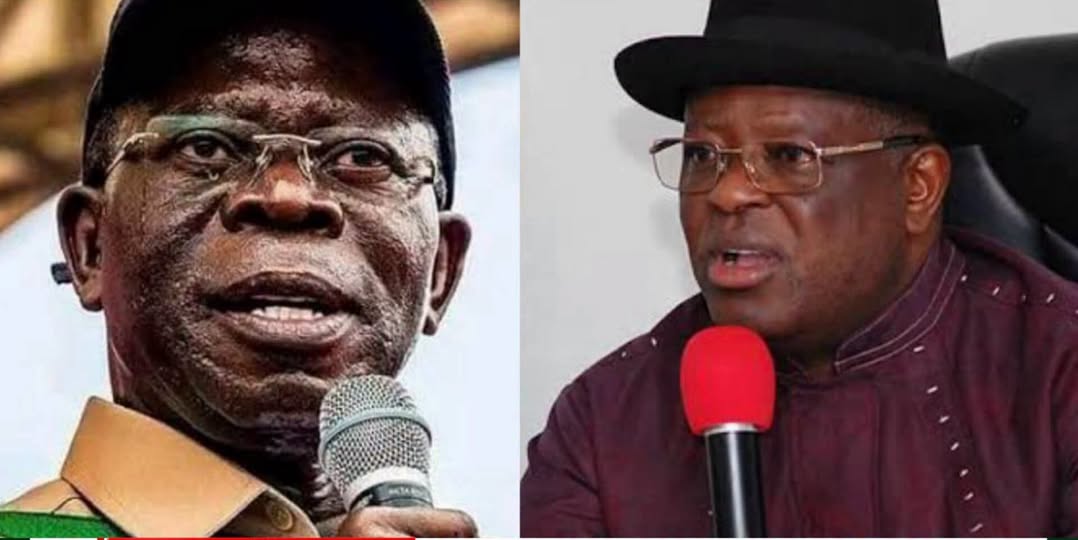
Minister of Works, David Umahi, has dismissed allegations by the senator representing Edo North Senatorial District, Adams Oshiomhole, that he is biased in the allocation of federal road projects, insisting that the claims are unfair and do not reflect the realities of road construction across the country.
Umahi also reminded the former Edo State governor that one of the major roads he complained about had already been awarded by the Federal Government while Oshiomhole was still serving as governor of the state.
Speaking on Friday during an inspection of an ongoing road project, the minister said he would not engage in a public argument with Oshiomhole, whom he described as his senior in both governance and the legislature.
His reaction came barely a day after Oshiomhole accused the Ministry of Works of favouring some parts of the country in the award and execution of federal road projects.
Speaking during a Senate session on Thursday, Oshiomhole complained about the poor state of major federal highways linking Edo State to other parts of the country.
According to the senator, several strategic roads serving Edo and neighbouring states have remained in bad condition despite repeated calls for government intervention.
He specifically mentioned the roads linking Benin to Warri, Asaba, Auchi and Okene, saying they had become difficult for motorists to use.
“You cannot go from Benin to Warri, Asaba, Auchi or Okene. What have we done wrong?” Oshiomhole asked.
He further alleged that the Minister of Works had “consistently shown that there is no federal allocation” to the affected areas and urged the Senate to appeal to the minister “to be more balanced and have a national outlook in his response.”
Responding to the criticism, Umahi said he had no intention of engaging in a public debate with the former governor.
He said: “People said that I should go and debate with Oshiomhole. I cannot debate with Oshiomhole; I can only reason with him.”
The minister praised Oshiomhole for his experience in public service, noting that they had both served as governors at the same time.
“He is my senior in governance, and he is also my senior in the legislature. We served together when I was a deputy governor and he was a governor,” Umahi said.
However, he questioned why Oshiomhole was criticising the Federal Government over a road that had been awarded during his own tenure as governor of Edo State.
“The road he is talking about, that straight road from Lokoja down to Benin and Warri, was awarded in 2018 when he was still a governor,” Umahi stated.
The minister argued that state governments also have a role to play in supporting the maintenance and rehabilitation of federal roads, especially those that are critical to the economic life of their states.
“I expected him to have done part of that federal road. When I was a governor, I did a lot of federal roads, and I did not complain,” he added.
Umahi served as governor of Ebonyi State between 2015 and 2023 before he was appointed Minister of Works by President Bola Tinubu.
During his time as governor, he became known for embarking on several major road and bridge projects, including the reconstruction of some federal roads passing through Ebonyi State.
The minister has repeatedly defended the Tinubu administration’s road infrastructure programme, saying projects are being awarded based on available funding, economic importance and engineering priorities rather than political or regional considerations.
Since assuming office, the Ministry of Works has continued work on several inherited road projects while also awarding new contracts aimed at improving connectivity across the country.
Among the priority projects of the current administration are the Lagos-Calabar Coastal Highway, the Sokoto-Badagry Super Highway and the rehabilitation of several major federal highways linking different geopolitical zones.
The Federal Government has also introduced alternative funding arrangements, including the use of tax credit schemes and special financing models, to accelerate road construction.
However, many lawmakers have continued to express concern over the slow pace of work on several federal roads, particularly in areas where poor road conditions have affected economic activities and increased travel time.
Road infrastructure remains one of the major issues raised regularly by members of the National Assembly, who often demand more projects for their constituencies and states.
The disagreement between Umahi and Oshiomhole reflects the growing debate over the distribution of infrastructure projects and the condition of federal roads across Nigeria.
Many highways built several decades ago have deteriorated due to heavy traffic, poor maintenance and funding challenges, leading to frequent complaints from motorists, transport operators and businesses.
The Benin-Warri, Benin-Asaba and Benin-Auchi corridors are among the country’s busiest road networks, serving as major links between the South-South, South-East and Northern parts of Nigeria.
Their poor condition has long been a source of concern because they play a critical role in the movement of people, agricultural produce and petroleum products.
Successive administrations have announced rehabilitation plans for many of these roads, but progress has often been slowed by funding constraints, contract disputes and rising construction costs.
Despite the exchange of words between the two political figures, stakeholders say the focus should remain on ensuring that strategic federal roads across the country are completed on schedule to improve transportation, reduce travel time and support economic growth.