
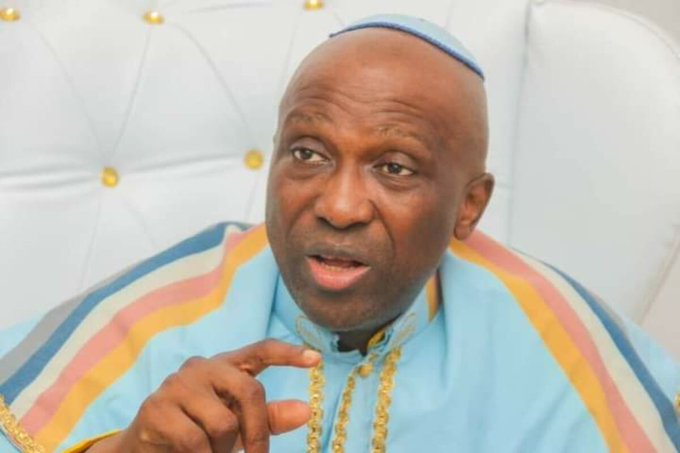
The founder of INRI Evangelical Spiritual Church, Primate Elijah Ayodele, has claimed that President Bola Tinubu is operating under a spiritual spell that is preventing him from accepting good advice and making the right decisions for the country.
The cleric made the remarks during a church service on Sunday, where he addressed his congregation on what he described as the spiritual state of the President and the people surrounding him.
According to Ayodele, President Tinubu’s inability to listen to sound advice is not ordinary but the result of spiritual influence that has affected his judgment.
He alleged that the President’s eyes had been “spiritually covered,” making it difficult for him to recognise sincere counsel while drawing him closer to people who do not have the country’s best interests at heart.
The prophet also expressed concern about those within the President’s inner circle, claiming that individuals capable of giving honest advice were being pushed aside while others with selfish motives continued to gain influence.
He warned that such a situation could have serious consequences for both the President and the country if it was not addressed.
“Tinubu, if you like, they advise you on the right thing, don’t do it. Those advising you, when you lose, your eyes will open,” Ayodele said during the service.
He continued: “I said your eyes have been covered with juju. They have cast spell on Tinubu’s eyes and he’s operating under a spell. So when you tell him this is not the right thing, he will hate you.”
The cleric maintained that the President’s alleged refusal to accept genuine advice would eventually prove costly.
Ayodele did not identify any specific government policy or official while making the remarks, but his comments come at a time when President Tinubu’s administration continues to face criticism over insecurity, economic hardship and the rising cost of living.
Since assuming office in May 2023, Tinubu has introduced several major economic reforms, including the removal of petrol subsidy and the unification of the foreign exchange market.
The Federal Government has defended the reforms, describing them as necessary measures to stabilise the economy, increase government revenue and attract both local and foreign investment.
Government officials have repeatedly argued that while the reforms initially caused hardship, they are beginning to produce positive results through improved public finances, stronger foreign reserves and renewed investor confidence.
Despite these assurances, many Nigerians continue to struggle with high food prices, rising transport costs and inflation, leading to increasing calls for more measures to cushion the impact of the reforms.
The administration has responded by introducing intervention programmes such as cash transfers, student loans, support for small businesses and agricultural initiatives aimed at increasing food production and easing the burden on citizens.
Beyond economic concerns, security remains one of the major issues confronting the government.
Several parts of the country have continued to witness attacks by terrorists, bandits and kidnappers, prompting renewed demands for stronger action to protect lives and property.
In recent weeks, religious leaders, civil society organisations and opposition politicians have also urged the Federal Government to take more decisive steps to address insecurity and improve the welfare of Nigerians.
Primate Ayodele has, over the years, become known for making prophecies on national politics, elections and governance. Some of his predictions have attracted widespread public attention, while others have generated debate and differing opinions among Nigerians.
His latest comments on President Tinubu are expected to spark fresh reactions, especially among supporters and critics of the administration.
Nigeria’s Constitution guarantees freedom of religion and freedom of expression, allowing religious leaders to comment on national issues and share their views.
However, claims of a spiritual nature, including prophecies and assertions about spiritual influence, are matters of personal religious belief and cannot be independently verified.
Ayodele nevertheless urged the President to pay closer attention to those advising him, insisting that ignoring sincere counsel could have serious political and national consequences.
His comments add to the ongoing public debate over the direction of the Tinubu administration as Nigerians continue to assess the government’s handling of the economy, security and other key national challenges.
While the Presidency has not responded to the cleric’s latest remarks, the administration has consistently maintained that it remains focused on implementing reforms and policies aimed at improving the country’s long-term economic stability and strengthening national security.