
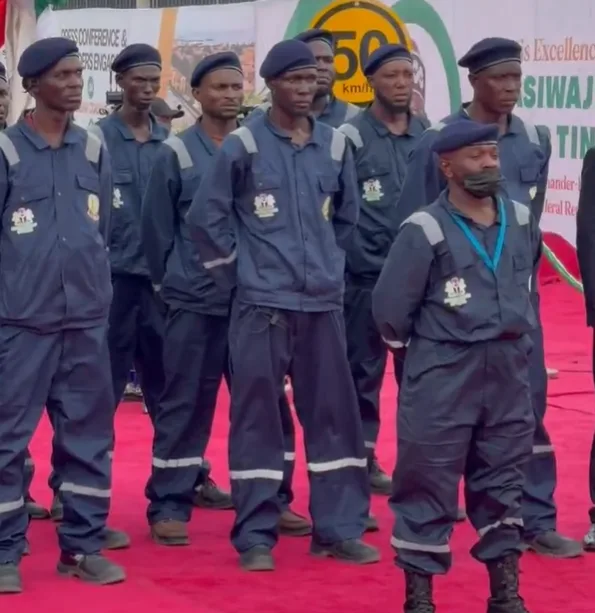
The Federal Government has launched the Coastal Highway Guards to protect the Lagos-Calabar Coastal Highway from vandalism, illegal occupation and other unauthorised activities.
The initiative, which began with 40 officers, is aimed at maintaining a constant presence along the highway and protecting the federal government’s investment in the major road project.
The Senior Special Assistant on New Media to the Lagos State Governor, Jubril Gawat, disclosed this in a statement posted on his X handle on Sunday.
Gawat said the Minister of Works, David Umahi, launched the guards as part of efforts to improve security and protect the highway from activities that could damage the project.
He said the officers would be responsible for monitoring the highway, reporting suspicious activities and preventing the removal or destruction of construction materials.
According to him, the guards would also restrict hawking, motorcycle and tricycle operations, as well as loitering along the highway.
He said the team would be led by retired General Adekunle Shodunke and would work with security agencies in Lagos State.
“The Honorable Minister of Works, Senator @realdaveumahi, today launched the COASTAL HIGHWAY GUARDS, starting with 40 officers,” Gawat said.
He listed the responsibilities of the officers to include maintaining a presence on the highway, reporting suspicious activities, restricting hawking, monitoring vandalism, and preventing the use of motorcycles and tricycles on the road.
The minister stressed that the guards were not part of an empowerment scheme but were being employed specifically to protect a major national asset.
“The Hon. Minister says this is not an ‘empowerment program’, It is a full time job to protect National Assets of the Government and in line with the Renewed Hope of Mr President, Asiwaju Bola Ahmed Tinubu GCFR,” Gawat quoted Umahi as saying.
The development followed concerns raised by the minister over activities taking place along parts of the coastal highway.
Umahi expressed concern about the alleged removal of construction materials, destruction of parts of the project and illegal occupation of sections of the highway.
He described those involved in such activities as unpatriotic and warned that the government would no longer tolerate the destruction of infrastructure being built with public funds.
“We have had very terrible, unpatriotic elements removing the blocks, breaking the fence, removing the rods and treading on the highway. This must stop,” Umahi said.
He directed the Works Controller in Lagos to ensure that motorcycles, tricycles, hawkers and other unauthorised activities were kept away from the coastal highway.
“Their job is that no keke on the coastal highway, no motorcycle on the coastal highway, and no loitering. There is no superhighway all over the country where you see people loitering,” he said.
The minister also raised concern over people using sections of the highway as places to sleep and carry out other activities.
According to him, he visited the road with members of the National Assembly at about 11pm and found people sleeping on the highway.
“Last night, we were there with the National Assembly members by 11 pm; people were sleeping on the coastal highway. It must stop. No hawking, no occupation illegally along the entire coast,” he said.
The minister’s concerns highlight some of the challenges associated with protecting large infrastructure projects in Nigeria, particularly those passing through densely populated areas.
The government has invested heavily in the Lagos-Calabar Coastal Highway, which is expected to improve transportation along Nigeria’s coastline and support economic activities in several states.
The project is a 750-kilometre, 10-lane highway designed to connect Lagos to Cross River State.
The route passes through Ogun, Ondo, Delta, Bayelsa, Rivers and Akwa Ibom states before reaching Cross River.
The road is being constructed by Hitech Construction Company Limited under the supervision of the Federal Ministry of Works.
The Federal Government has described the highway as a major infrastructure project expected to improve connectivity, reduce travel time and support trade and investment along the coastal corridor.
However, the size and length of the project also make it vulnerable to vandalism, illegal activities and encroachment.
The launch of the Coastal Highway Guards is therefore expected to provide an additional layer of protection for the project, especially in areas where construction activities are ongoing.
The guards are expected to work closely with existing security agencies to identify threats and report suspicious activities.
Umahi also called on the Nigeria Security and Civil Defence Corps to strengthen its protection of strategic national infrastructure.
The NSCDC has a mandate to protect critical government infrastructure and other important national assets, making its involvement in the protection of the coastal highway important to the Federal Government.
The minister’s directive is also coming as the government continues to place emphasis on protecting public infrastructure from vandalism.
The removal of construction materials, damage to fences and other project facilities can increase the cost of construction and delay completion.
The government has therefore indicated that those found engaging in such activities will face the appropriate consequences under the law.
Umahi also disclosed that the Federal Ministry of Works had opened its ongoing projects to scrutiny by anti-corruption agencies.
The move, according to the ministry, is part of efforts to promote transparency and accountability in the management of public infrastructure projects.
The Lagos-Calabar Coastal Highway is one of the major road projects being undertaken by the Federal Government under President Bola Tinubu’s administration.
Apart from improving road transport, the coastal route is expected to connect communities and economic centres across several states.
The government hopes that the highway will support movement of people and goods, promote tourism and create opportunities for businesses along the coastal corridor when completed.
For the project to achieve these objectives, authorities have stressed the need to keep the highway free from illegal occupation and activities that could undermine its construction and future use.
The newly deployed guards will therefore be expected to monitor sections of the road, report security concerns and prevent activities that could damage the project.
With the initial deployment of 40 officers, the government is expected to assess the effectiveness of the initiative and strengthen the security arrangement where necessary.
The Federal Government’s message is that the coastal highway is a national asset and must be protected from vandalism, encroachment and activities that could threaten its development.
The authorities have also urged residents, road users and other stakeholders along the route to cooperate with the guards and security agencies by reporting suspicious activities and avoiding unauthorised use of the highway.